The short version: the Soundcore Motion Boom (Anker's rugged portable Bluetooth speaker, released late 2020) remains one of the best value outdoor speakers you can buy — 30 watts through dual titanium drivers with BassUp DSP, a 24-hour rated battery, IPX7 waterproofing that actually floats, and a USB port that charges your phone. It's big, it's chunky, and it won't win any design awards, but for loud, durable, all-day sound at a budget price, very little touches it. The main decision isn't whether it's good — it's whether to buy this or its bigger sibling, the Motion Boom Plus (80W, 20-hour battery), covered in detail below.
A note on method: I have not tested this product hands-on — this review is research-based, drawn from manufacturer specifications, retailer listing data, independent reviews, and verified owner reviews. Prices mentioned are sourced list/MSRP or documented retailer figures — never invented by us; street prices change daily, so verify the exact variant on the live listing before buying.
Scope note: this is a review of the original Soundcore Motion Boom (2020) — not the Motion Boom Plus (2022), a different and more powerful speaker that many ranking pages conflate with this one. Both are covered here so you can tell them apart. If you want a WiFi-connected home speaker rather than a portable Bluetooth box, see instead.
The Direct Answer: Should You Buy the Soundcore Motion Boom?
Yes — if you want maximum loud, durable, all-day portable sound for minimum money. The Motion Boom's formula hasn't aged: 30W of output, bass that punches well above the price class, a battery rated for 24 hours, and waterproofing that lets it survive (and float in) the pool. Independent reviewers consistently place it among the best-value outdoor speakers in its bracket, and long-term owner reviews — some written years after purchase — keep praising the same things: battery longevity, durability, and sheer volume.
Buy it if: you need a speaker for camping, the beach, the workshop, or backyard parties; you want bass-forward sound; you like the idea of a backup phone charger in your speaker; your budget is tight.
Skip it if: you need something pocketable (it's bulky); you're an audiophile chasing neutral tuning (the mids recess at max volume); you want a voice assistant or Wi-Fi streaming (it has neither); or the step-up Motion Boom Plus fits your budget — it's louder, newer, and often discounted close to this one's territory.
The one-line verdict: the best cheap loud speaker that can survive outdoors — just make sure you're buying the right model, because the naming is a trap (see below).
Soundcore Motion Boom at a Glance
| What it is | Rugged portable Bluetooth speaker (Anker Soundcore brand), released late 2020 |
| Power | 30W — dual titanium drivers + passive radiators, BassUp DSP |
| Battery | 10,000mAh, rated up to 24 hours (expect ~15–18 at high volume with BassUp on) |
| Durability | IPX7 waterproof — and it floats |
| Connectivity | Bluetooth 5.0 (~30m range), Soundcore app (EQ, firmware updates), TWS stereo pairing |
| Bonus trick | USB-A port with PowerIQ — charges your phone like a power bank |
| What's missing | No Wi-Fi, no voice assistant, no lighting effects |
| Buy it | Check Price on Amazon |
Motion Boom vs the Alternatives
| Speaker | Power | Battery (rated) | Waterproofing | Key advantage | Price anchor (sourced) |
|---|---|---|---|---|---|
| Soundcore Motion Boom | 30W | Up to 24 hrs | IPX7, floats | Best value: loud + durable + cheap | Budget class (verify live) |
| Motion Boom Plus | 80W | Up to 20 hrs | IPX7, floats | The step up: much louder, app EQ, PartyCast | Often $99–$120 street (was £169.99 RRP) |
| JBL Charge 5 | 30W | Up to 20 hrs | IPX7 | Sleeker design, more refined tuning | Higher price class |
| Sony SRS-XB33 | 24W | Up to 24 hrs | IP67 | Lighting effects, Extra Bass | Shorter real-world battery per reviewers |
Price anchors are documented figures (sources in product-research.md) — verify the live price before buying. The Motion Boom's own street price moves frequently; no fixed anchor is claimed.
Full Review: Design, Sound, Battery, and Features
Quick Picks
Short on time? These are our top recommendations.
Design and build: outdoor kit, not lifestyle accessory
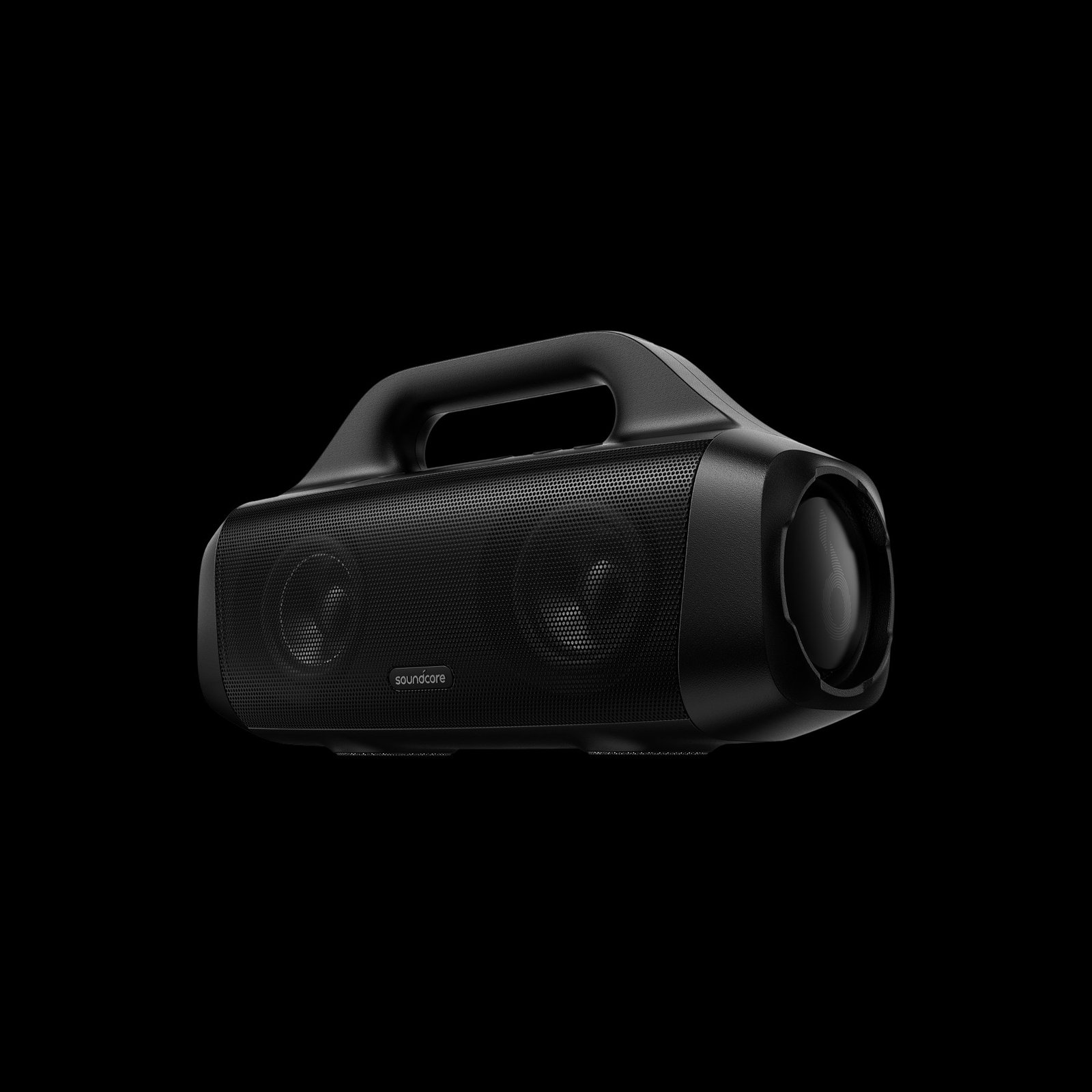
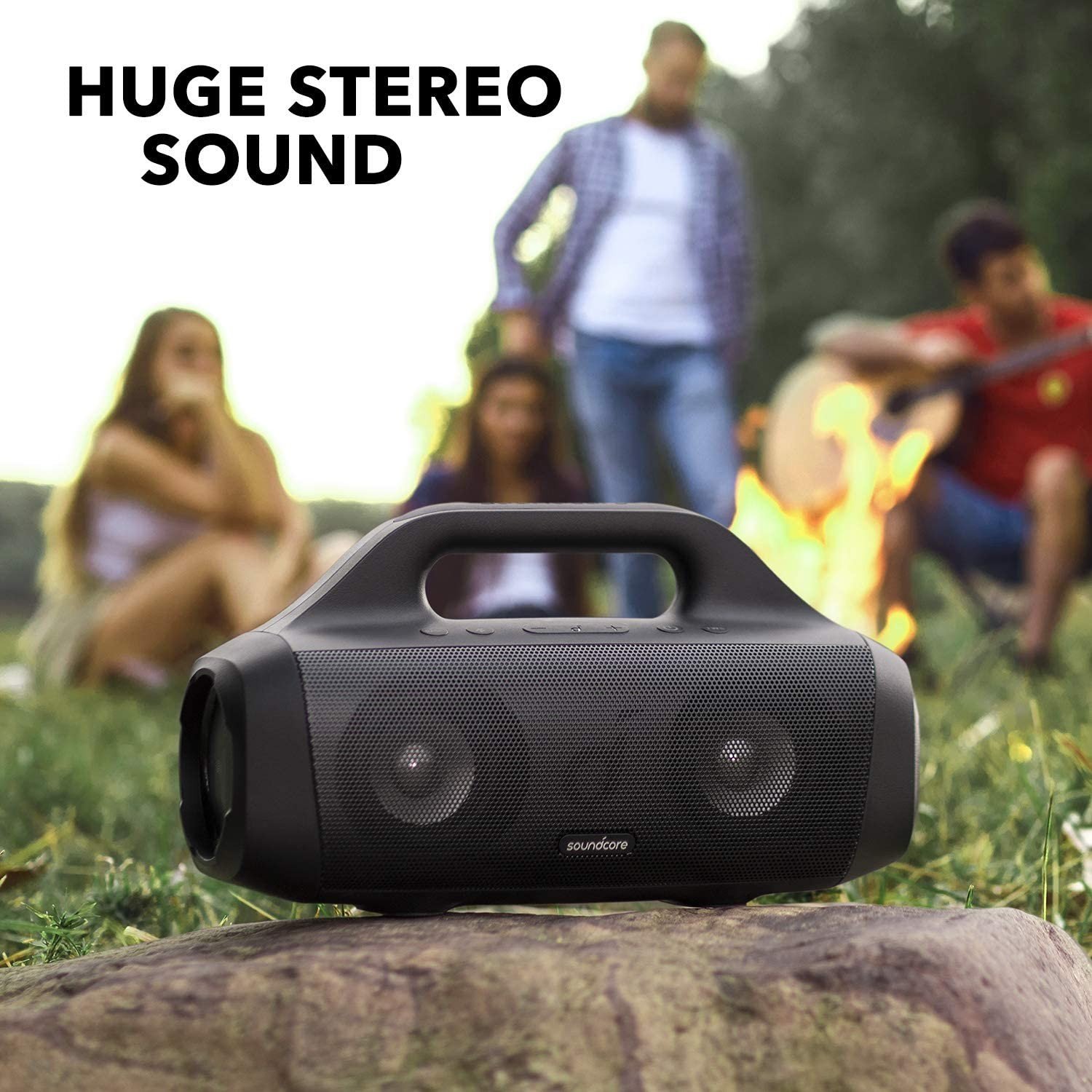
Soundcore Motion Boom
The original Motion Boom (2020) remains the budget benchmark for loud outdoor sound: 30 watts through dual titanium drivers with BassUp DSP, a 10,000mAh battery rated for up to 24 hours, and IPX7 waterproofing that genuinely floats. It is big and chunky rather than sleek, but for all-day sound by the water at this price level, very little touches it — which is why this review keeps it clearly separated from the louder Motion Boom Plus below.
- 30W stereo output through dual titanium drivers with BassUp DSP
- 10,000mAh battery rated up to 24 hours, with USB-A PowerIQ output that charges a phone
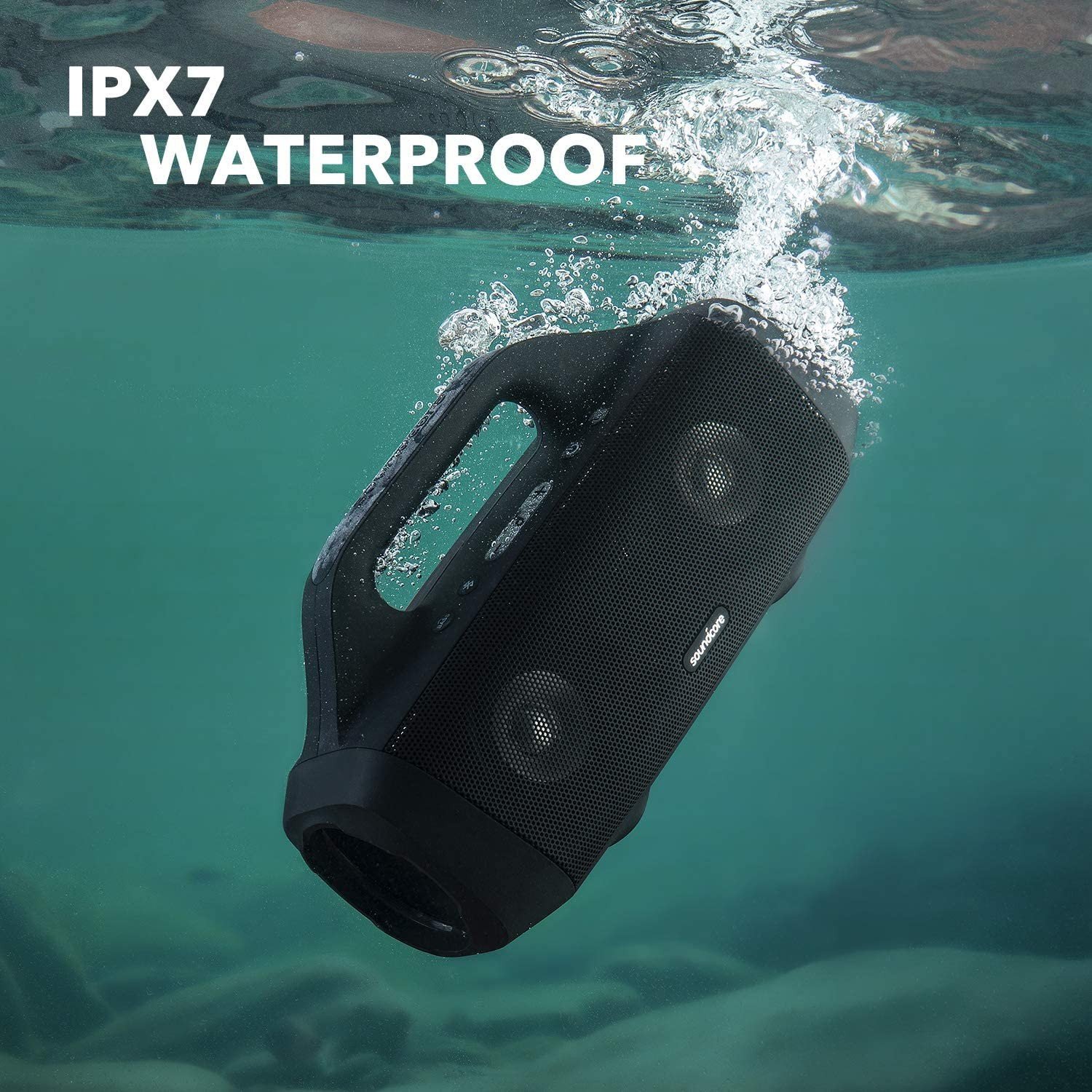
- IPX7 waterproof and it floats — built for pools, beaches and boats
Important limitation: Bulky, utilitarian design; the midrange recesses and vocals lose definition at maximum volume; no Wi-Fi or voice assistant.
- Power: 30W — dual titanium drivers + passive radiators, BassUp DSP
- Battery: 10,000mAh; up to 24h rated; USB-C in (~4h charge), USB-A PowerIQ out
- Durability: IPX7 waterproof; floats
- Connectivity: Bluetooth 5.0; TWS stereo pairing; Soundcore app EQ
Best for: Budget buyers who want loud, durable, all-day outdoor sound
Unboxing the Motion Boom sets expectations immediately: this is a big, heavy speaker that feels like outdoor equipment. The casing is chunky with large tactile buttons (power, Bluetooth, volume, play/pause, BassUp, TWS pairing), a rubberized top surface, sturdy rubber feet, and a built-in carry handle. In the box: the speaker, a USB-C charging cable, and a quick-start guide.
The headline durability spec is IPX7 waterproofing — submersion-proof — with the rare bonus that it floats. Drop it in the pool and it bobs rather than sinks, which is genuinely unusual at this size and price. It's not stylish the way a Sonos Roam or Bose SoundLink is, but it's built to survive the outdoors, and owners back that up: multi-year owner reviews describe units thrown in lakes, dropped repeatedly, and left at beaches still working flawlessly.
Limitation to know: "big and heavy" is relative — it's portable the way a small boombox is portable, not the way a pocket speaker is. If it needs to fit in a daypack side pocket, look elsewhere.
Sound: bold, bassy, and very loud for the money
Soundcore Motion Boom Plus
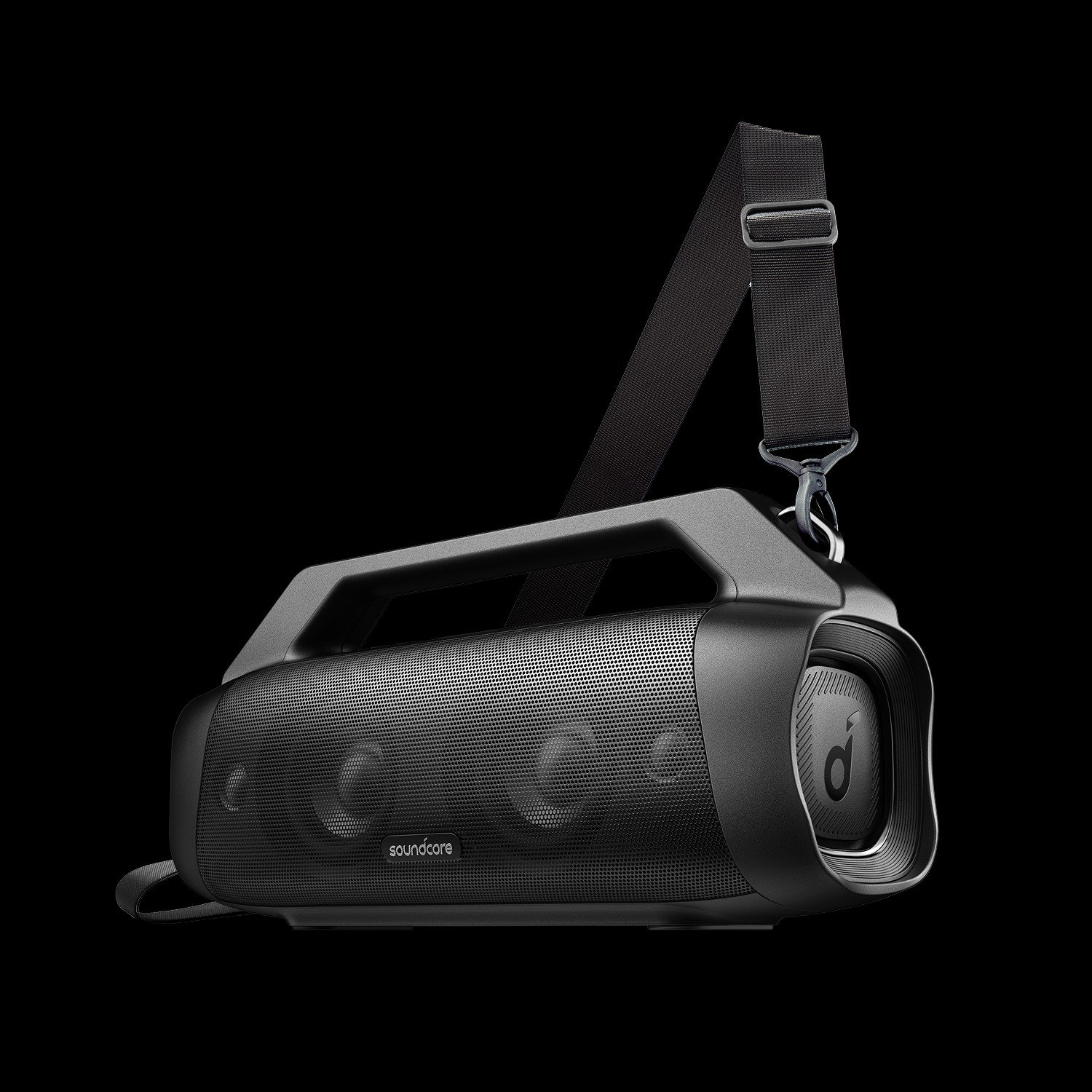
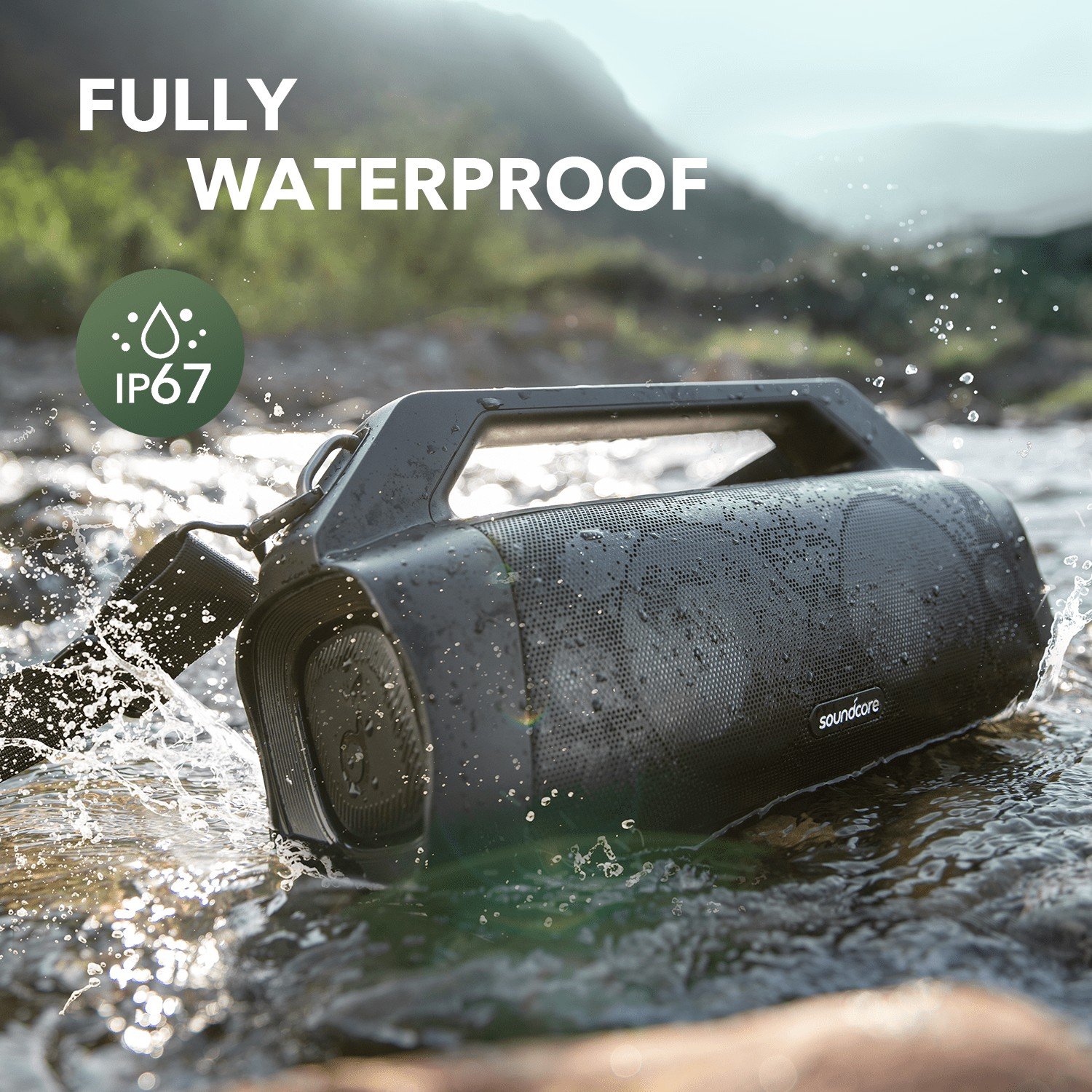
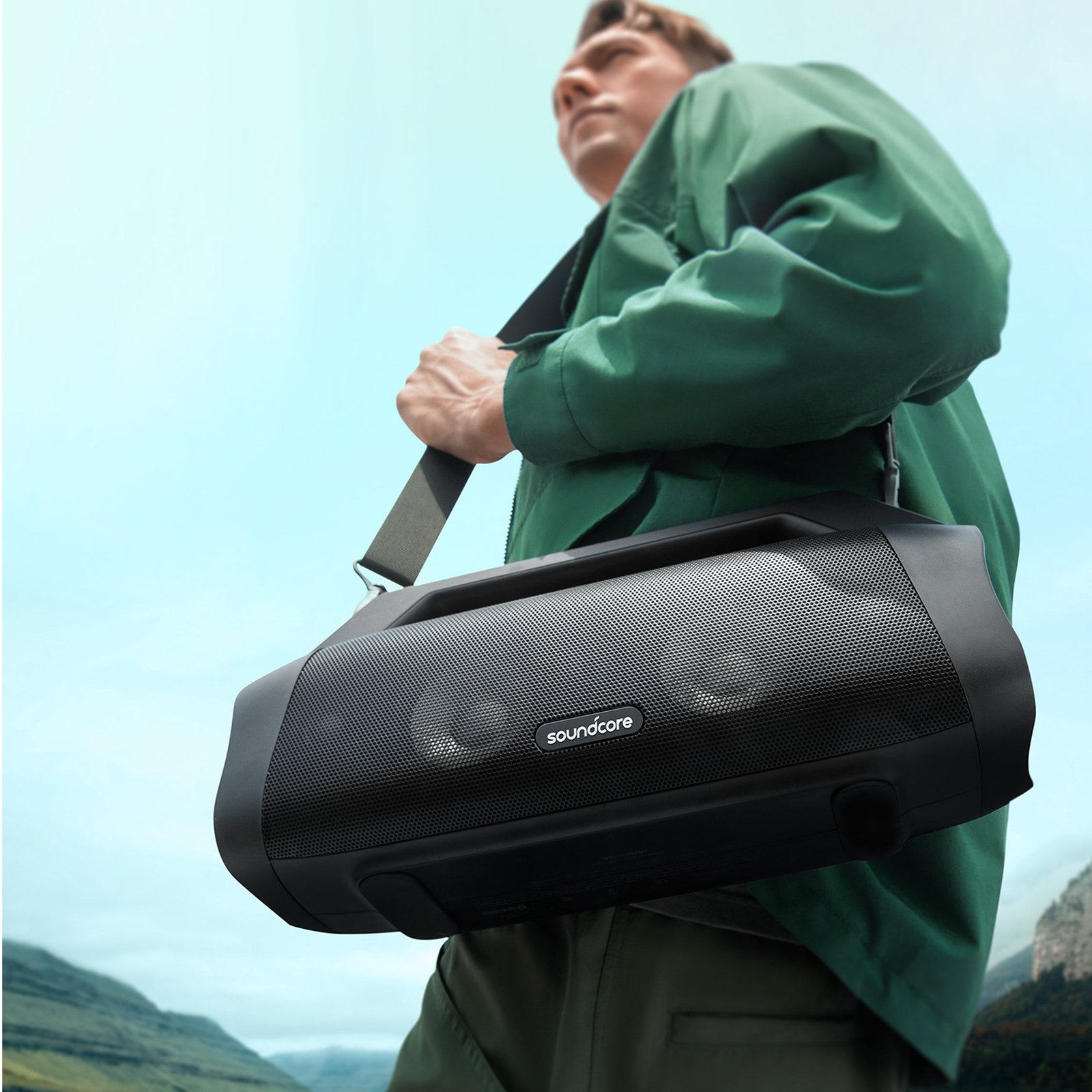
The Motion Boom Plus (2022) is the performance pick of the pair: 80W through four drivers, Bluetooth 5.3 with multipoint, PartyCast 2.0 for linking multiple speakers, an AUX input the original lacks, and an IP67 rating that adds dust protection. The article's advice stands — if the Plus is discounted near the original's price, it is the better buy for most people; verify the wattage (80W = Plus) on the listing before buying.
- 80W stereo output — 2x30W woofers + 2x10W titanium tweeters with BassUp
- Bluetooth 5.3 with multipoint, AUX input and PartyCast 2.0 multi-speaker linking
- IP67 dust and water resistance, it floats, and a detachable carry strap is included
Important limitation: Heavier (~2.4kg) and pricier than the original; its 20-hour battery rating is lower than the original's 24 hours; utilitarian plastics and button backlights that are hard to see in bright sun.
- Power: 80W — 2x30W woofers + 2x10W tweeters, BassUp
- Battery: 13,400mAh; up to 20h rated; USB-C in (~5.5h charge), USB-A PowerIQ 2.0 out
- Durability: IP67 waterproof and dustproof; floats
- Connectivity: Bluetooth 5.3 multipoint; AUX in; TWS + PartyCast 2.0; Soundcore app EQ
Best for: Buyers who want party-level volume outdoors and can stretch the budget
The acoustic package is dual titanium drivers with passive radiators and Anker's BassUp DSP, rated at 30W total. Independent testing (Cubed3) found the signature "unapologetically bold": treble extends with more sparkle than expected from a rugged speaker (rated to 40kHz), and BassUp engaged vs. disengaged is a night-and-day difference — basslines thump with real authority when it's on.
At moderate volumes the balance is pleasing, vocals and instruments cutting through cleanly. Push it to maximum and two things happen: the bass stays strong with minimal distortion (impressive), but the midrange recesses and vocals lose definition. Translation: it's a party and outdoors speaker, not a critical-listening speaker. For its intended use — filling a campsite, backyard, or large room — reviewers rate it excellent.
The EQ escape hatch: the Soundcore app offers EQ presets and custom curves, so if the stock tuning is too bass-heavy for your taste, you can tame it. That level of control is rare in the budget class.
Battery: the 24-hour claim, honestly assessed
The 10,000mAh battery is rated for up to 24 hours of playback. In practice, independent testing found a full day of moderate-volume use is realistic — and with BassUp engaged at high volume, expect more like 15–18 hours, which is still excellent. Charging is via USB-C and takes around four hours for a full charge.
The standout feature is the USB-A PowerIQ port: the Motion Boom doubles as a power bank, topping up a phone or earbuds. Reviewers confirmed it works as advertised — practical on camping trips where outlets don't exist. A small LED indicates battery status (flashing red when critically low, solid red when running down, white when healthy).
Long-term owners are the real battery test here: reviews written years after purchase keep mentioning that the battery "lasts so long I've only charged it a few times" with light weekly use. That's the kind of durability no lab test captures.
Features and app: more than the price suggests
Bluetooth 5.0 handles connectivity with a stable range around 30 metres. There's no Wi-Fi and no smart assistant — this is a deliberate simplicity play, and for many buyers it's a strength rather than a gap.
The Soundcore app adds genuine value: custom EQ, firmware updates, and device controls. TWS pairing links two Motion Booms as a stereo pair (dedicated button, though its purpose isn't obvious without the manual). Everyday usability details are well thought out: the power button needs a two-second press (no accidental shutoffs), the Bluetooth button flashes blue when pairing and goes solid when connected, and the central button handles play/pause reliably across apps.
What's missing vs. the competition: no RGB lighting (unlike Soundcore's own Flare line or Sony's XB33), no voice assistant, no Wi-Fi streaming. Anker kept the Motion Boom focused on sound and stamina — a defensible trade at this price.
Setup: From Box to Music in Minutes
The Motion Boom is refreshingly simple to get going — no accounts, no Wi-Fi passwords, no firmware gauntlet before first playback.
1. Charge it (or don't). Units typically arrive with enough charge to play immediately. For a full charge, USB-C takes around four hours; the LED glows white when healthy, solid red when running down, flashing red when critically low.
2. Pair it. Hold the power button for two seconds (the deliberate press prevents accidental shutoffs; a chime confirms). Press the Bluetooth button — it flashes blue while searching and goes solid blue once connected. Range is rated around 30 metres with Bluetooth 5.0.
3. Install the Soundcore app (optional but worth it). The app unlocks custom EQ, firmware updates, and device settings. Start with the presets before building a custom curve — most listeners land on a slightly tamed-bass setting for indoor use and full BassUp outdoors.
4. Pair two for stereo (optional). If you own a second Motion Boom, the dedicated TWS button links them as a left/right stereo pair. The button's purpose isn't obvious without the manual — now you know.
5. Learn the physical controls. The central button handles play/pause reliably across music and video apps; volume and BassUp have their own tactile buttons. You can run the whole speaker without touching your phone — useful with wet hands at the pool.
What Long-Term Owners Say (Years Later)
Spec sheets age; owner reviews don't lie about durability. The soundcore.com review corpus for the Motion Boom is unusually rich in long-term reports, and the themes are consistent:
Battery longevity is the standout praise. Multiple owners writing years after purchase report barely needing to charge it — "maybe a regular hour's use a week" with only a handful of charges in total. One owner took it camping where it "played music all day by the water." For a 2020 product, that kind of battery endurance report is the strongest reliability signal available.
Abuse tolerance is real. Owners describe units thrown in lakes, tossed around pools, taken to beaches, dropped repeatedly — "used and abused" — still working flawlessly years on. The IPX7 rating and floating design aren't marketing; they're the reason these stories exist.
The honest complaints are minor and useful. One owner reported a charging fault ("won't charge... expensive paperweight") that resolved after unplugging and reconnecting — worth knowing if yours ever plays dead: try the cable dance before panicking. Another cautioned "water resistant not proof" after two years of ownership — fair advice for any IPX7 device exposed to salt and sand: rinse it.
The generational debate, from owners: one detailed owner review compared the original against the newer model and chose the original deliberately — finding the newer one's build felt cheaper and the sound difference "hard to determine." Owner preference isn't universal, but it's a useful counterweight to the assumption that newer is always better.
Buying Guide: Is the Motion Boom Right for You?
1. Define "portable" honestly. The Motion Boom is carry-handle portable, not pocket portable. Measure your use case: car camping, backyard, workshop, beach with a tote bag — perfect. Hiking, cycling, carry-on-only travel — too big.
2. Decide how much bass you actually want. The BassUp-on signature is fun and physical. If your listening is mostly podcasts, audiobooks, or acoustic music, you'll run it with BassUp off or EQ'd down — in which case a more neutral speaker might suit you better.
3. Check the water rating against your reality. IPX7 (submersion) plus floating covers pool parties, kayaking, and rainstorms. You don't need more than this unless you're pressure-washing the thing (don't).
4. Count your charging needs. If your trips already involve a power bank, the Motion Boom's charge-out feature lets one device do two jobs. If you're always near outlets, it's a nice-to-have.
5. Set the Plus threshold. The Motion Boom Plus (80W, bigger battery of 13,400mAh, Bluetooth 5.3, PartyCast multi-speaker linking) is the natural step up. Decide your budget ceiling first: if the Plus is on sale near the original's price — which happens — the decision gets interesting (see the comparison below).
6. Verify the model before you buy. "Motion Boom," "Motion Boom Plus," and "Boom 2" are three different speakers. Listings, reviews, and even some retailers mix them up. Check the wattage (30W = original) and the product code on the listing.
7. Read the 3-star reviews, not the 5-star ones. Five-star reviews tell you what delighted people; three-star reviews tell you what annoyed them despite liking the product. For the Motion Boom, the recurring 3-star themes are bulk, the utilitarian plastics, and button backlights that wash out in sunlight (on the Plus) — all useful, none disqualifying.
8. Check what's in the box against your needs. The Motion Boom ships with a USB-C charging cable — but if your household has moved entirely to newer cable standards, confirm you have a compatible charger. And if stereo pairing appeals to you, price two units now rather than discovering the math later.
Where the Motion Boom Sits in Soundcore's Lineup
Motion Boom (this review, 2020): 30W, Bluetooth 5.0, 24-hour rated battery, IPX7 + floats, power-bank charging. The value pick — maximum durability-per-dollar.
Motion Boom Plus (2022): 80W (2×30W woofers + 2×10W tweeters), Bluetooth 5.3 with multipoint, 13,400mAh battery rated up to 20 hours, IP67, floats, USB-C in + USB-A PowerIQ 2.0 out, PartyCast 2.0 multi-speaker linking, ~2.4kg with handle and detachable strap. The performance pick — a true party speaker that Tech Advisor calls "great for the great outdoors."
The family logic: Anker kept the original on sale alongside the Plus because they serve different buyers — the original is the budget workhorse, the Plus is the flagship portable. Neither replaces the other, which is why both are still worth comparing in 2026.
The Step Up: Motion Boom Plus in Detail
Since the single most common buyer question is "original or Plus?", here's the Plus on its own terms — researched, not guessed.
What it is: the 2022 successor — 80W total from 2×30W woofers and 2×10W titanium tweeters, a 13,400mAh battery rated up to 20 hours (12–15 at high volume), Bluetooth 5.3 with multipoint pairing, USB-C input plus USB-A PowerIQ 2.0 output, AUX input, TWS stereo pairing and PartyCast 2.0 (link 100+ speakers), IP67 waterproofing that floats, and a handle plus detachable shoulder strap at ~2.4kg.
What reviewers found: Tech Advisor's verdict calls it "a great speaker for the great outdoors" — rugged, buoyant, loud even at high volumes, with genuinely useful app EQ (preset + 9-band custom) and USB-A charging. Cubed3's review adds texture: the plastics feel utilitarian next to premium rivals, button backlights are hard to see in bright sunlight, and at ~2.4kg it's "not quite as portable as some alternatives" — but volume, waterproofing, and value make it "a standout in its class."
Owner consensus: Target's syndicated soundcore.com reviews are enthusiastic — deep bass, crisp highs, customizable EQ, surviving lakes, pools, beaches, and drops over 2+ years of abuse. The recurring price note is telling: owners keep mentioning sub-$140 and $99–$120 sale prices as the reason it was "the best option."
Who should buy the Plus instead: anyone whose priority is maximum volume — parties, large outdoor spaces, groups. At 80W it's in a different loudness class from the original's 30W, and PartyCast makes it expandable in a way the original isn't.
Who should stick with the original: budget-first buyers, anyone who values the longer 24-hour battery rating, and buyers who find the Plus at full RRP (£169.99) — at that gap, the original's value proposition is overwhelming.
Head-to-Head Comparisons
Motion Boom vs Motion Boom Plus: the Plus is louder (80W vs 30W), newer (Bluetooth 5.3, multipoint, PartyCast 2.0), and heavier (~2.4kg). The original wins on battery rating (24h vs 20h) and usually on price — often substantially. Buy the Plus if volume is the priority and your budget stretches; buy the original if value is the priority. When the Plus drops to $99–$120 on sale (as widely reported), the gap narrows enough that the Plus becomes the better buy for most people — check both prices before deciding.
Motion Boom vs JBL Charge 5: the Charge 5 is the sleeker, more refined-sounding rival — slightly better tuning finesse, a more premium feel — but it costs more and independent comparisons give the Motion Boom the edge on sheer value. Choose JBL for design and brand polish; choose Soundcore for maximum speaker per dollar.
Motion Boom vs Sony SRS-XB33: Sony brings lighting effects and its Extra Bass tuning, but reviewers note shorter real-world battery life and a higher price. The Motion Boom counters with longer stamina, the power-bank trick, and floating. Party hosts who want lights: Sony. Everyone else: Soundcore.
5 Mistakes Buyers Make With Portable Bluetooth Speakers
1. Buying the wrong "Boom." Soundcore's naming — Motion Boom, Motion Boom Plus, Boom 2 — is a confusion engine. Sellers and review aggregators mix them freely. Always verify wattage and model before clicking buy.
2. Trusting battery ratings literally. "Up to 24 hours" means moderate volume, BassUp off, ideal conditions. Real party volume with bass boost: plan for 15–18 hours (still excellent — just not 24).
3. Ignoring the weight until it arrives. Spec sheets list dimensions; they don't convey heft. A 2.4kg speaker is fine until you're carrying it plus beach gear across sand. Check the weight figure, then imagine it.
4. Assuming waterproof means pool-proof chemistry. IPX7 handles submersion in fresh water. Salt water and chlorinated pools are harsher — rinse the speaker after exposure. Floating doesn't mean "designed as a pool toy."
5. Paying launch price for old models. The Motion Boom is a 2020 product in a category with frequent sales. Its street price moves constantly — never pay the first price you see without checking for the current deal, and compare against the Plus's sale price while you're at it.
SERP Danger Rebuttal: Bad Advice Ranking for "Soundcore Motion Boom"
Claim: supplier "review scores" presented as product reviews. The sourcing page accio.com ranks for this keyword with a table of "review scores" (4.2–4.8) attached to bulk-order listings — these are supplier fulfillment ratings for wholesale buyers, not product reviews, and the "prices" ($59.90–$85.99) are per-unit MOQ quotes. Treating them as consumer review data is flatly wrong. We do not use them.
Claim: thin "reviews" of the wrong model. The gsgmedia.co page ranking here is a promotional-style writeup of the Motion Boom Plus (80W, strap, 20-hour battery) filed under this keyword's orbit — its specs don't describe the original Motion Boom at all. Several other ranking pages similarly blend the two models' specs into one Frankenstein product. This review keeps the models separate and labels every spec by model.
Claim: "hands-on tested" with no evidence. Multiple ranking pages claim testing while showing no methodology, no measurements, no original photos — just rewritten spec sheets. We make no hands-on claims: every finding here is attributed to a named reviewer (Cubed3's bench testing, Tech Advisor) or to documented owner reviews, and the attribution is in the text.
Soundcore Motion Boom: FAQs
Is the Soundcore Motion Boom waterproof? Yes — IPX7, meaning it survives submersion, and unusually for its size, it floats. Owners report pool, lake, and beach use without issues. Rinse it after salt or chlorinated water.
How long does the battery really last? Rated up to 24 hours (10,000mAh). Independent testing found a full day at moderate volume realistic, dropping to ~15–18 hours at high volume with BassUp on. Full recharge via USB-C takes about four hours.
Can I pair two Motion Booms together? Yes — TWS (True Wireless Stereo) pairing links two Motion Boom units as a stereo pair via a dedicated button. The Plus model additionally supports PartyCast 2.0 for linking more speakers.
Does it work as a power bank? Yes. The USB-A port with PowerIQ charge-out tops up phones and earbuds — reviewers confirmed it works as advertised, making it genuinely useful on camping trips.
What's the difference between the Motion Boom and the Motion Boom Plus? The Plus (2022) is a different, bigger speaker: 80W vs 30W, Bluetooth 5.3 vs 5.0, 13,400mAh battery, PartyCast 2.0, ~2.4kg with strap. The original wins on battery rating and usually price; the Plus wins on outright volume. They're sold side by side — check which one a listing actually describes.
Does the Motion Boom have an app or voice assistant? It has the Soundcore app (custom EQ, firmware updates) but no voice assistant and no Wi-Fi — Bluetooth only. If you want Alexa/Google in a portable speaker, this isn't it.
Final Verdict
The Soundcore Motion Boom is the rare budget product that earned its reputation and kept it. Six years after launch, the formula — 30W of bold, bassy sound, a genuinely all-day battery, IPX7 waterproofing that floats, and power-bank charging — still beats most of what the budget class offers. Its weaknesses (bulk, recessed mids at full tilt, no smart features) are the honest trade-offs of a speaker built for volume and survival rather than refinement.
Buy the Motion Boom if you want the best cheap loud outdoor speaker and your budget is tight. Buy the Motion Boom Plus if you can stretch — it's the better speaker, and on sale the price gap often collapses. Either way, verify the exact model on the listing before you buy: in Soundcore's confusingly named lineup, that's the step that matters most.
Final Recommendations
Best Value Outdoor Speaker: Soundcore Motion Boom — 30W titanium-driver sound, a 24-hour rated battery and a floating IPX7 build for budget money
The Step Up: Soundcore Motion Boom Plus — The louder step up: 80W, PartyCast 2.0 and IP67 — and on sale the price gap to the original often collapses
Related Guides
- Best WiFi Speakers (2026): 7 Picks for Every Home. When you want network streaming and voice assistants instead of portable Bluetooth.
- Best Wireless Speaker System (2026): 7 Picks. Multi-room audio for the whole house.
- Best Headphones for Music Listening (2026): 7 Picks. Private listening when the party's over.