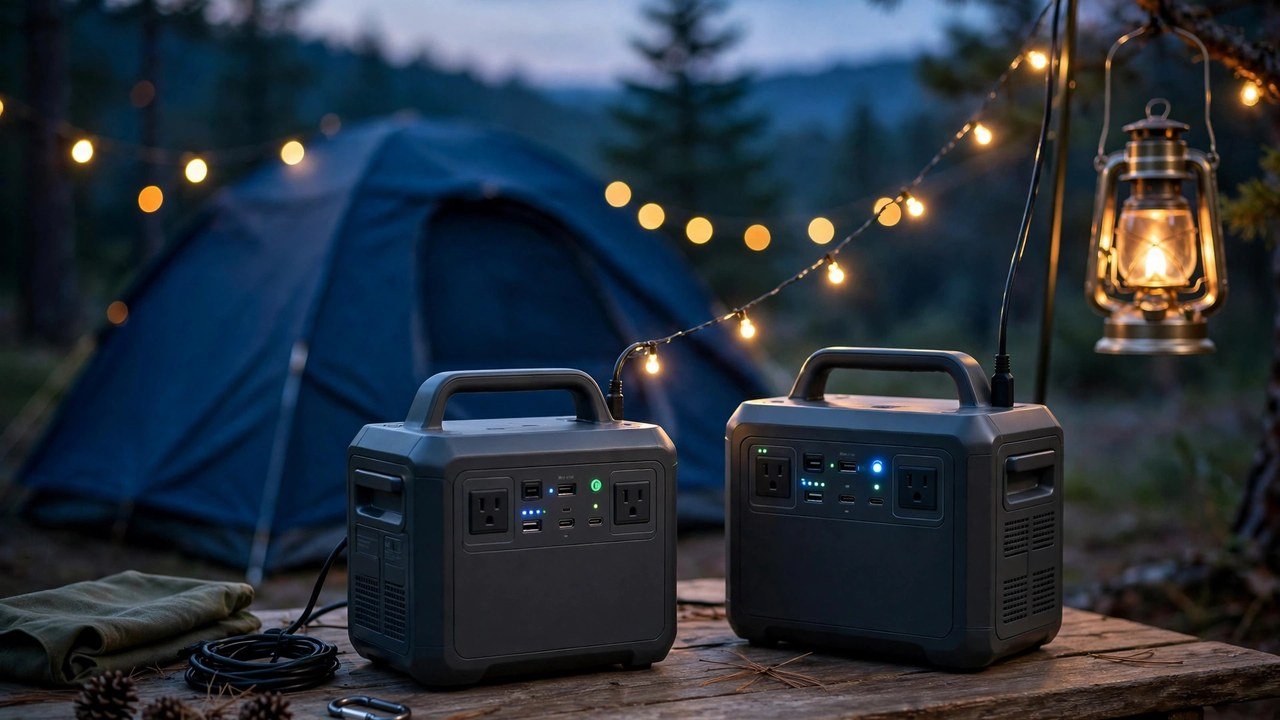
The one-paragraph version
The Bluetti Elite 100 V2 (1,024Wh, 1,800W) is the portable pick: half the weight of its bigger sibling at 25.3 lb, fast 45-minute 0–80% AC charging, and enough output for most camping and backup essentials. The Bluetti Elite 200 V2 (2,073.6Wh, 2,600W) is the home-backup pick: double the stored energy, 44% more continuous output, a 6,000-cycle battery rating versus the 100 V2's 4,000+, and the muscle for high-draw appliances — at 53.4 lb and a bigger footprint. And the keyword's literal question — two Elite 100 V2s vs one Elite 200 V2 — is closer than it looks: two 100 V2s store 2,048Wh (vs 2,073.6Wh) and give you redundancy and split-weight carrying, but cost more than one unit and can't combine their outputs into a single high-draw outlet.
Direct answer
Buy the Elite 100 V2 if portability matters most: car camping, road trips, RV overflow power, or a grab-and-go outage kit you can carry one-handed. Buy the Elite 200 V2 if you need genuine home backup: running a full-size fridge through an outage, powering 2,000W+ appliances, or covering a household's essentials for a day or more. Consider two Elite 100 V2s instead of one Elite 200 V2 only if you value redundancy (one can charge while the other runs) and splitting 50 lb across two handles over a single 53 lb unit — for most buyers, one Elite 200 V2 is the simpler, cheaper-per-watt-hour answer.
Quick Picks
Short on time? These are our top recommendations.
Bluetti Elite 100 V2 vs Elite 200 V2: spec comparison
Sources: BLUETTI official product pages (bluettipower.com) and BLUETTI-published manuals; third-party reviewer figures flagged where used. Mobile: table stacks to cards.
| Spec | Elite 100 V2 | Elite 200 V2 |
|---|---|---|
| Battery capacity | 1,024Wh (51.2V, 20Ah) | 2,073.6Wh (64.8V, 32Ah) |
| Battery chemistry | LiFePO4 | Automotive-grade LiFePO4 |
| Cycle life (to 80%) | 4,000+ cycles (~10-year claim) | 6,000+ cycles (17-year claim) |
| Continuous AC output | 1,800W pure sine wave | 2,600W pure sine wave |
| Power lifting (resistive loads) | 2,700W | 3,900W |
| Surge | 3,600W (per BLUETTI) | 5,200W (per user manual) |
| AC charging | 1,200W TurboBoost — 0–80% in ~45 min, 100% in ~70 min | 1,800W — 0–80% in ~50–60 min (TurboBoost) |
| Solar input | Up to 1,000W (12–60V, 20A MPPT) | Up to 1,000W |
| UPS switchover | ≤10ms | <15ms |
| Weight | 25.3 lb (11.5 kg) | 53.4 lb (24.2 kg) |
| Dimensions | 12.6" × 8.5" × 9.8" | 13.78" × 9.84" × 12.74" |
| AC outlets | 4 (per BLUETTI; 1,800W total) | 4 (2,600W total) |
| USB-C | 1× 140W + 1× 100W (per BLUETTI spec roundups) | 2× 100W |
| USB-A / DC | 2× USB-A, DC5521 ports, 12V/10A car port | 2× 15W USB-A, 12V/10A car port |
| App control | Wi-Fi + Bluetooth | Wi-Fi + Bluetooth |
| Noise | ~30 dB silent mode, 50 dB max (per spec roundups) | Silent charging mode available |
| Expandable | No | No |
| Warranty | 5 years | 5 years |
Cycle-life figures are BLUETTI's published ratings. Note the conflict flagged in our research: some third-party roundups credit the 100 V2 with 6,000 cycles, but BLUETTI's own product page states 4,000+ — we use the manufacturer's figure (see SERP danger rebuttal).
Detailed Reviews
1. Bluetti Elite 100 V2 in depth
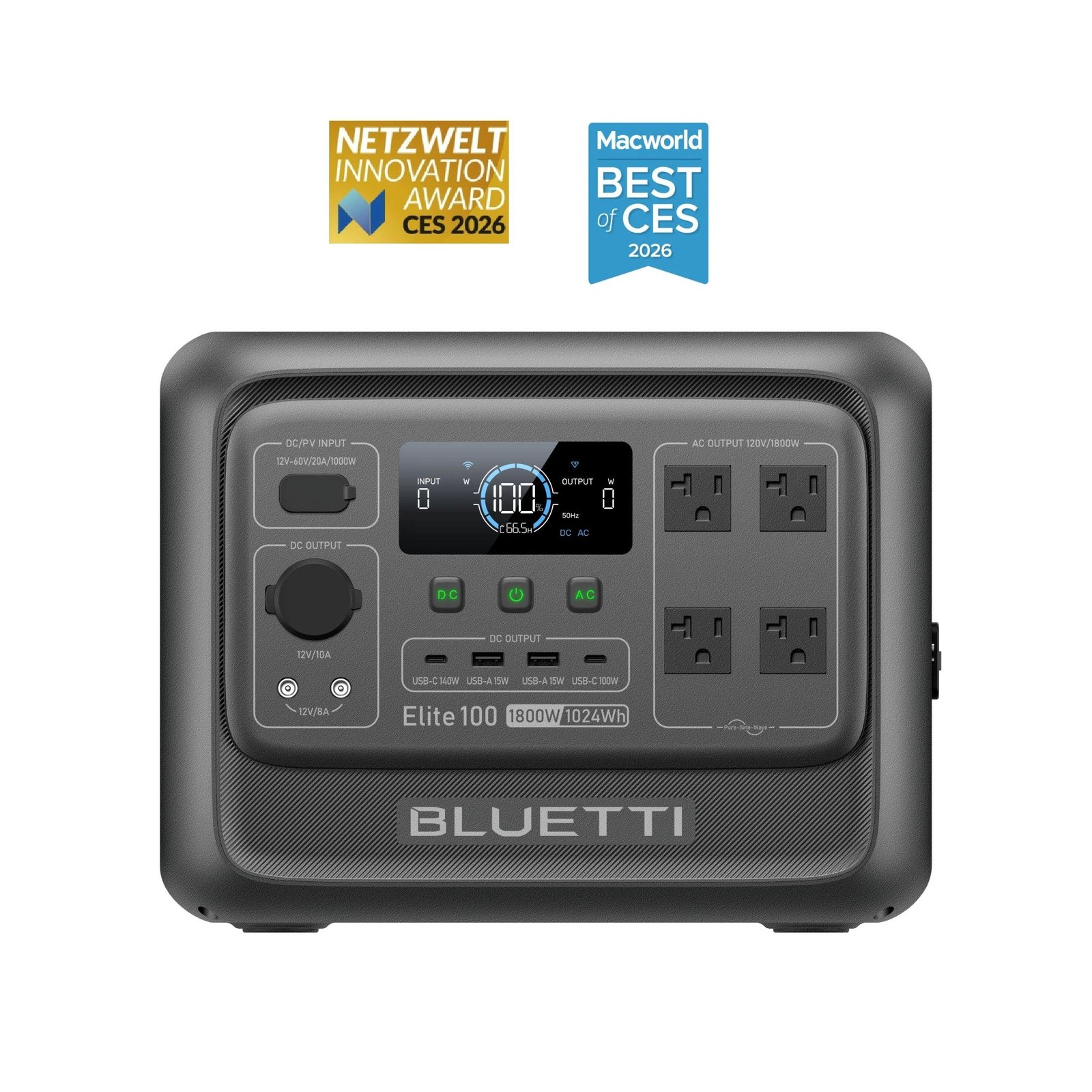
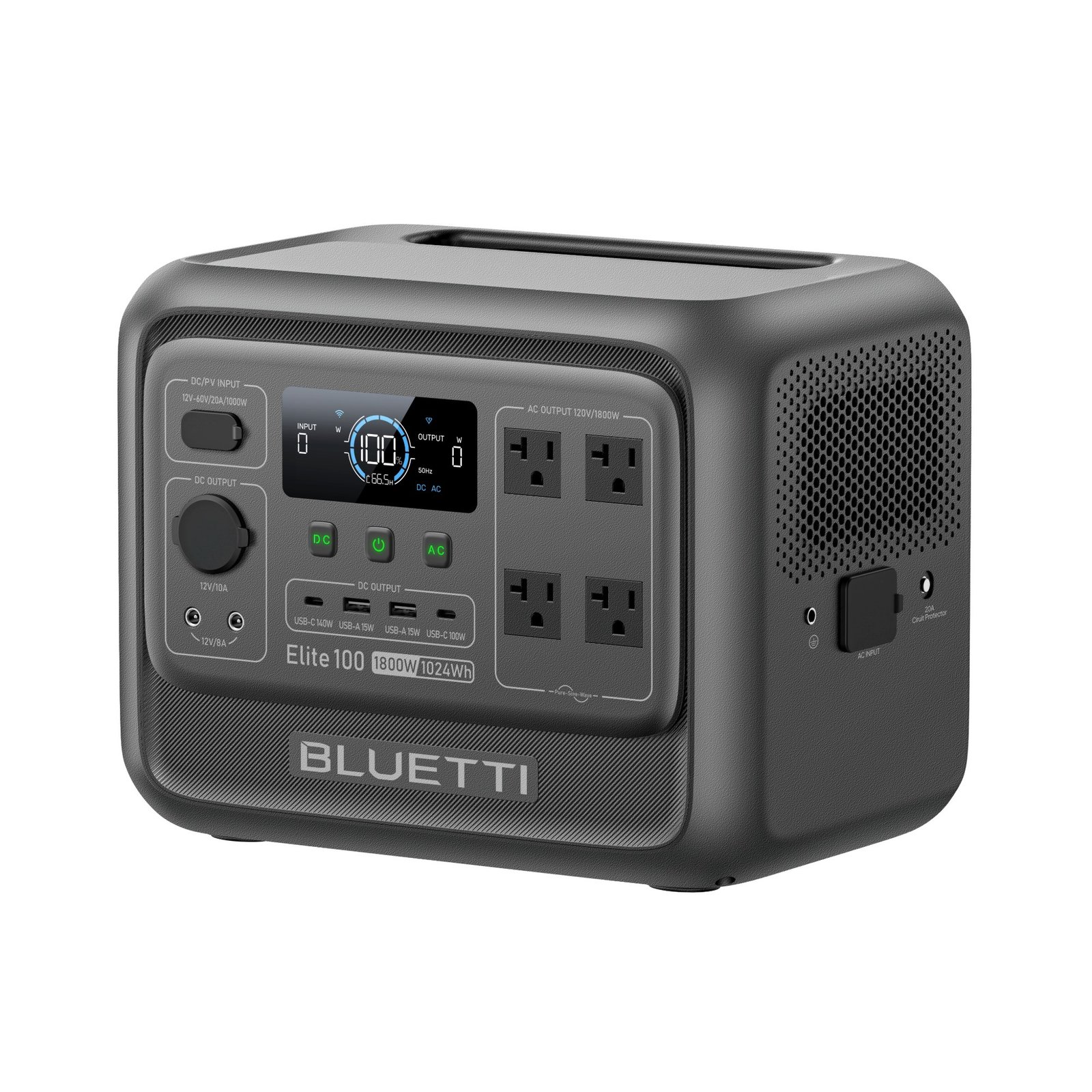
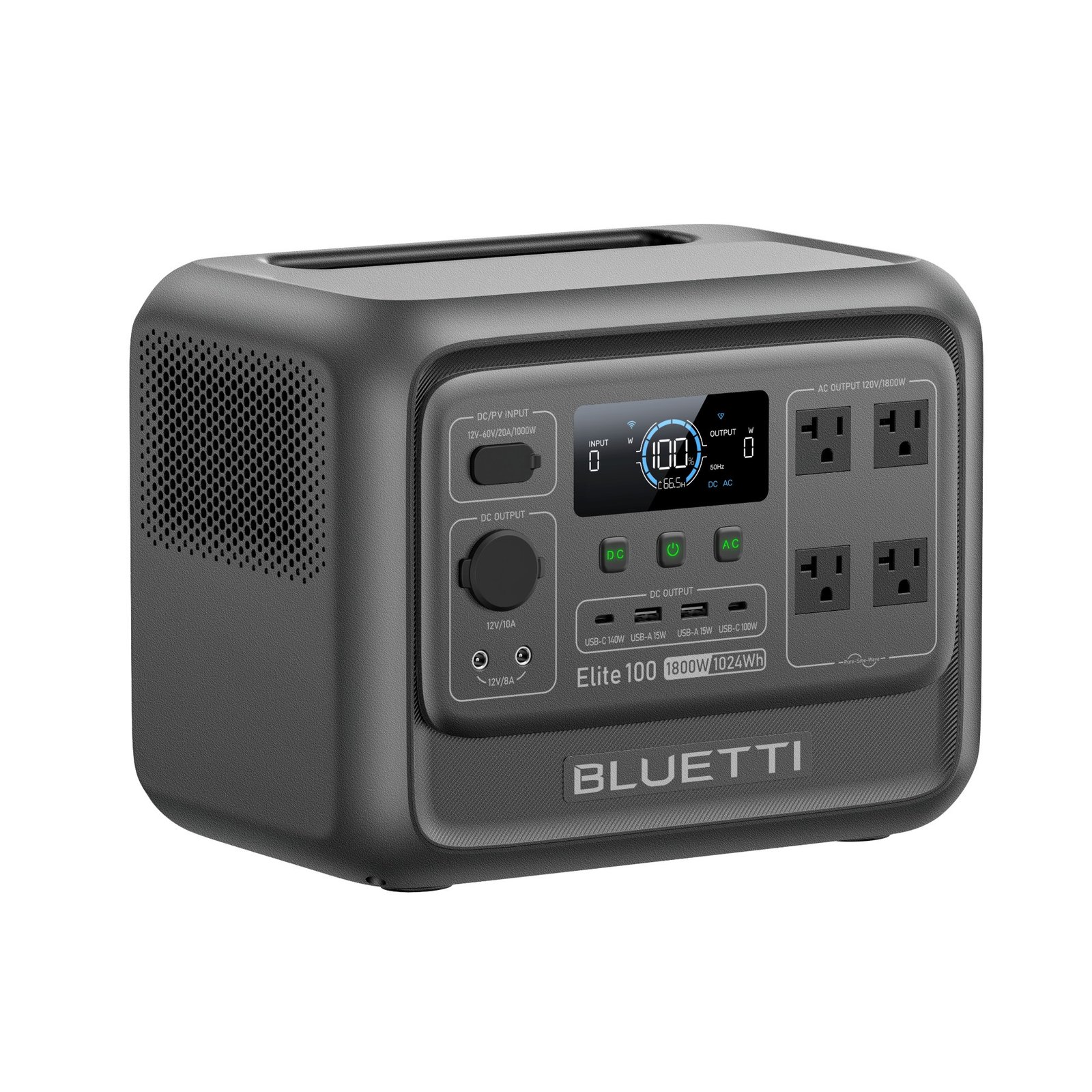
BLUETTI Elite 100 V2 Portable Power Station
BLUETTI's answer to the most common complaint about 1kWh-class stations: they're slow to recharge and heavy for what they store. At 25.3 lb it's genuinely one-hand portable, and the 1,200W TurboBoost AC charging — 0–80% in about 45 minutes, full in roughly 70 — means a lunch stop with a wall outlet meaningfully refills it. The 1,800W continuous inverter covers induction cooktops, power tools and most kitchen appliances, with a 2,700W lifting mode for brief resistive peaks.
- 25.3 lb one-hand carry — half the weight of the Elite 200 V2
- Fastest recharge here: 0–80% in ~45 min on 1,200W TurboBoost AC
- 140W USB-C port fast-charges a 16-inch laptop at full speed
Important limitation: 1,024Wh is about a day of light household essentials, not whole-home backup, and the 4,000+ cycle rating trails the 200 V2's 6,000+; no expansion-battery option.
- Capacity: 1,024Wh LiFePO4 (51.2V, 20Ah)
- AC output: 1,800W continuous; 2,700W lifting; 3,600W surge
- Weight / size: 25.3 lb; 12.6 × 8.5 × 9.8 in
- Charging: 1,200W AC TurboBoost (0–80% ~45 min); up to 1,000W solar
- Cycle life: 4,000+ cycles to 80% (BLUETTI rating)
- UPS: ≤10ms switchover
Best for: Buyers who carry their power: car camping, road trips, RV overflow, one-handed outage kit.
The Elite 100 V2 is BLUETTI's answer to the most common complaint about 1kWh-class stations: they're slow to recharge and heavy for what they store. At 25.3 lb it's genuinely one-hand portable, and the 1,200W TurboBoost AC charging — 0–80% in about 45 minutes, full in roughly 70 — means a lunch stop with a wall outlet meaningfully refills it. The 1,800W continuous inverter is the standout in its weight class: it covers induction cooktops, power tools, and most kitchen appliances short of the hungriest resistive loads, with a 2,700W lifting mode for brief resistive peaks.
The limits are physics, not flaws. 1,024Wh is about a day of light household essentials or a long weekend of camping loads — it is not whole-home backup, and the 4,000-cycle rating (vs the 200 V2's 6,000) reflects its smaller, harder-worked battery. BLUETTI also sells a bio-based housing variant of this model (TÜV-certified, ~25% lower CO₂ footprint per the manufacturer) — same specs, different shell.
Choose the 100 V2 if: you carry your power (camping, tailgating, mobile work), you want the fastest recharge in the class, or it's a secondary unit backing up a bigger system.
2. Bluetti Elite 200 V2 in depth
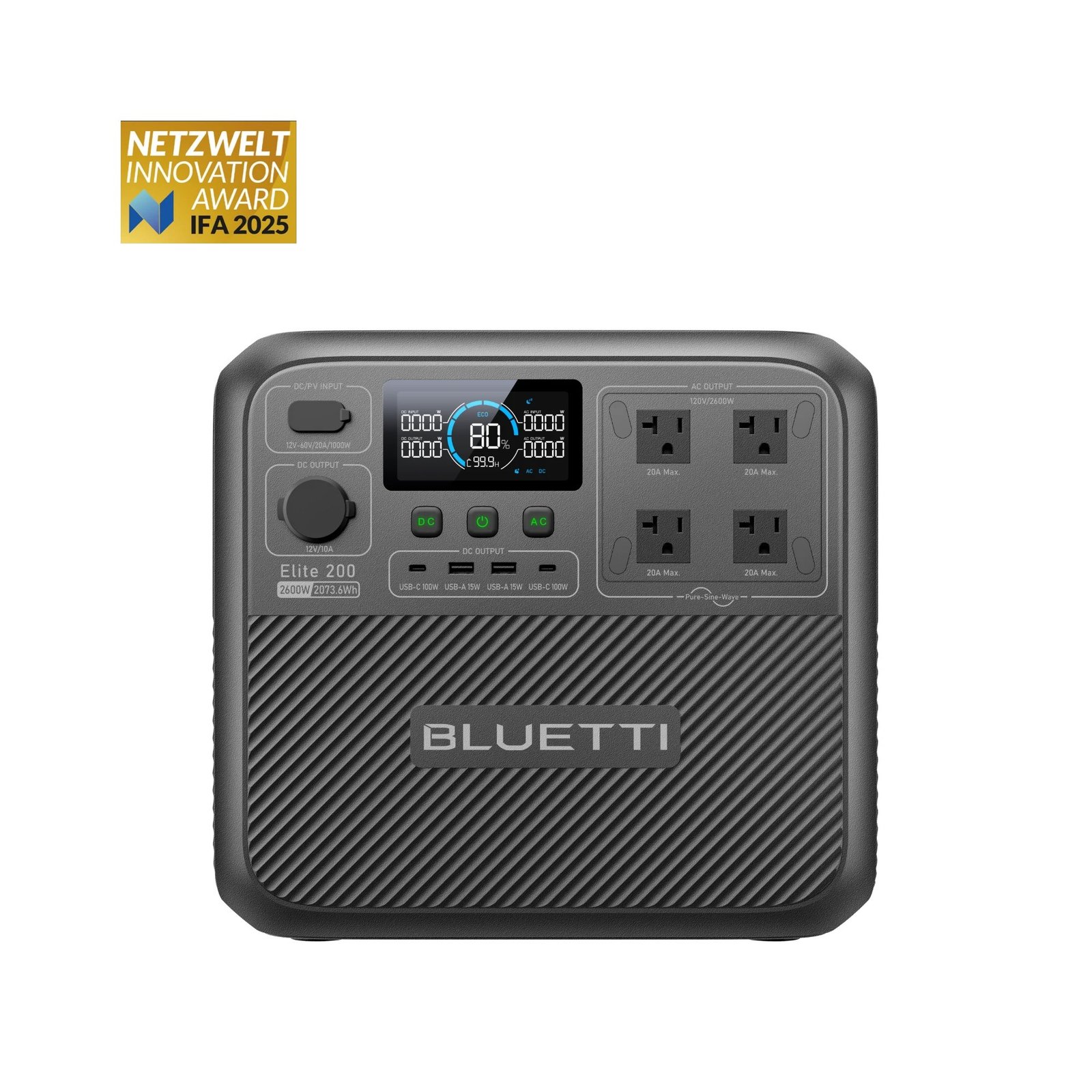
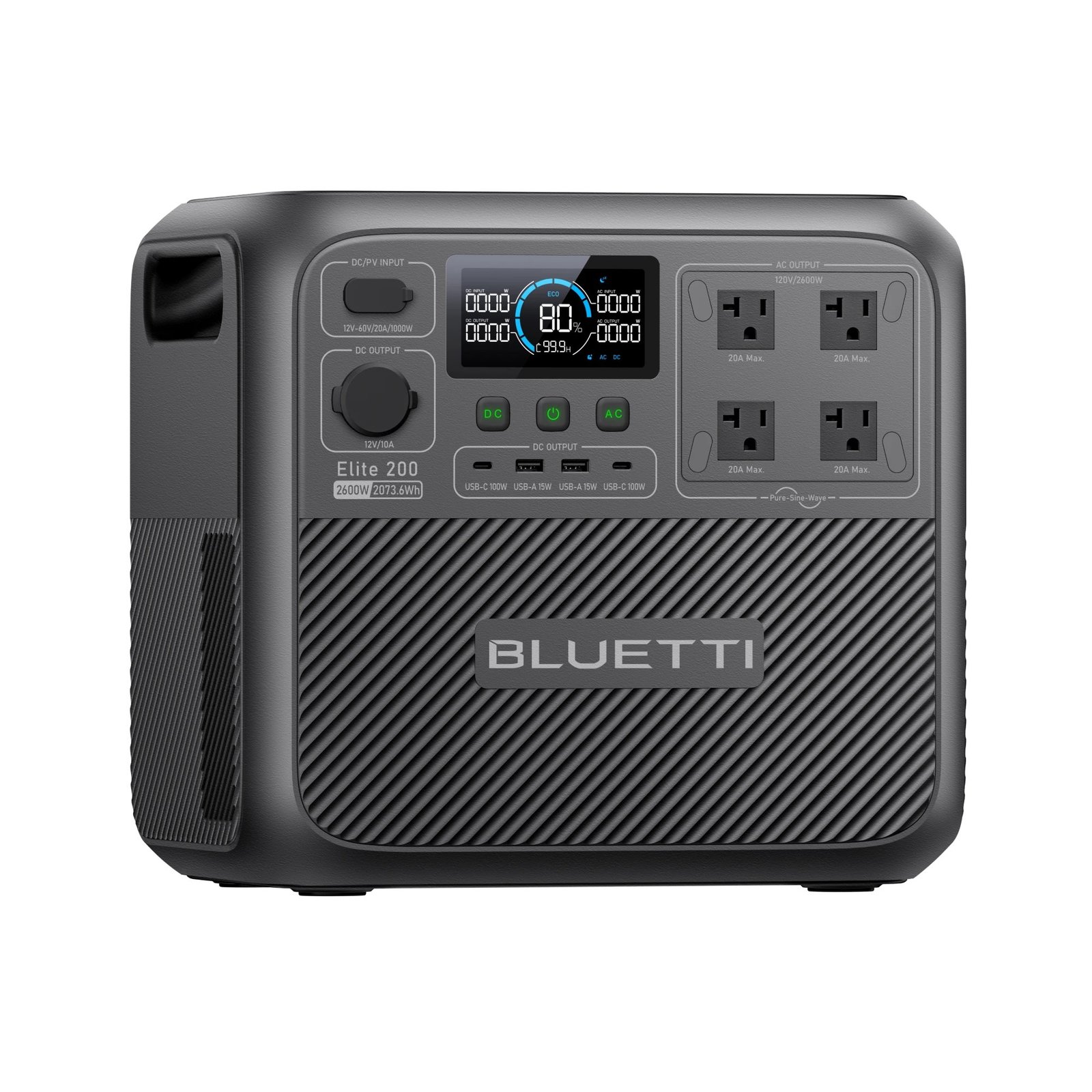
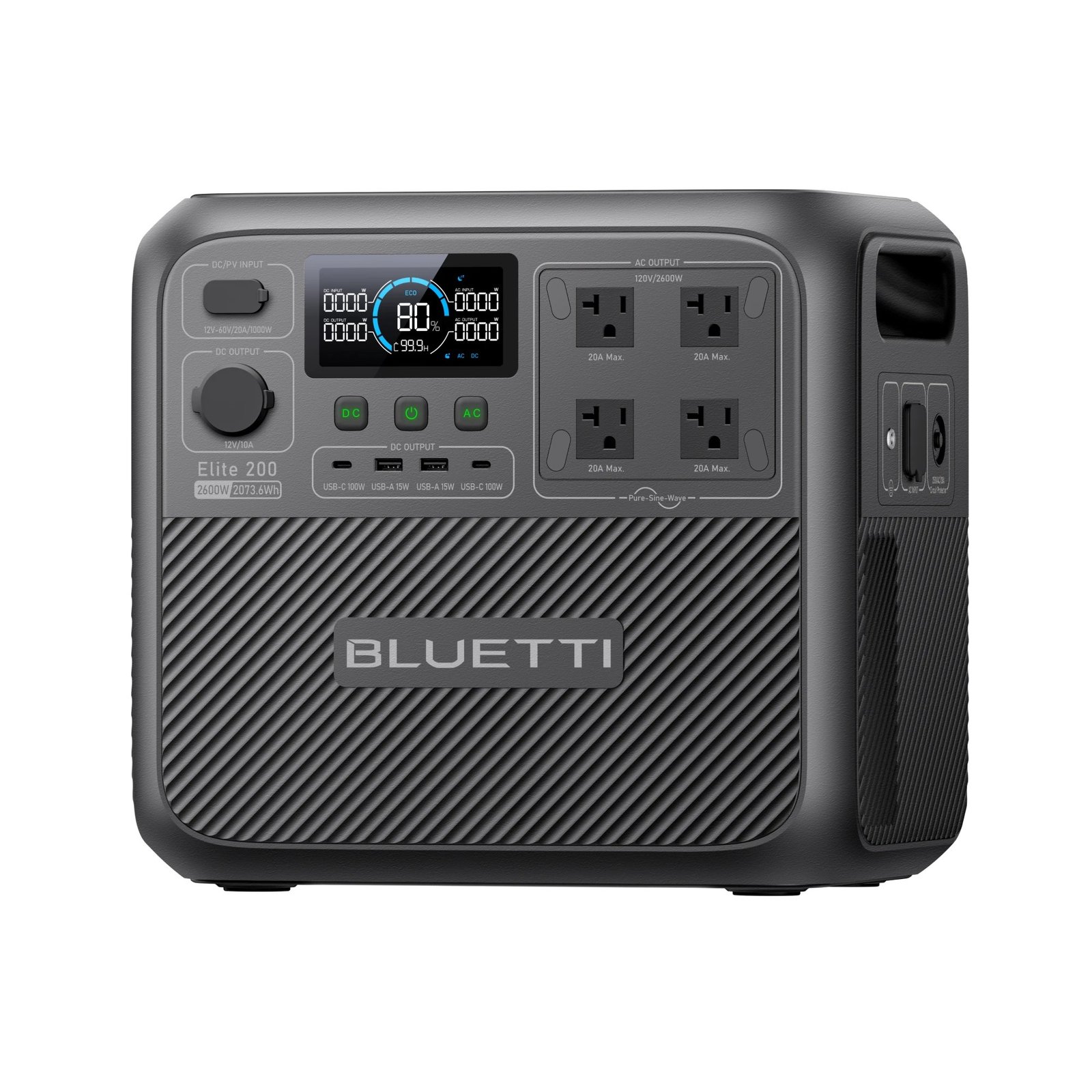
BLUETTI Elite 200 V2 Portable Power Station
The direct successor to the BLUETTI AC200P, packing 2kWh-class capacity into a unit BLUETTI says is 40% smaller by volume. The 2,073.6Wh capacity and 2,600W continuous output put it in genuine home-backup territory — a full-size refrigerator, a microwave or a window AC unit — with a 3,900W lifting mode for motor-startup surges. The 6,000-cycle automotive-grade LiFePO4 rating is the longest published cycle life in BLUETTI's portable lineup, and 1,800W AC charging refills 0–80% in roughly an hour.
- 2,073.6Wh — roughly double the 100 V2's stored energy
- 2,600W continuous output with 3,900W lifting for high-draw appliances
- 6,000+ cycle automotive-grade LiFePO4, 5-year warranty
Important limitation: 53.4 lb is a two-hand, planned lift — 'portable' here means car-to-campsite; no expansion-battery option, and solar input caps at 1,000W.
- Capacity: 2,073.6Wh automotive-grade LiFePO4 (64.8V, 32Ah)
- AC output: 2,600W continuous; 3,900W lifting; 5,200W surge
- Weight / size: 53.4 lb; 13.78 × 9.84 × 12.74 in
- Charging: 1,800W AC (0–80% ~50–60 min TurboBoost); up to 1,000W solar
- Cycle life: 6,000+ cycles to 80% (BLUETTI rating)
- UPS: <15ms switchover
Best for: Outage backup: full-size fridge, microwave, window AC, a day-plus of household essentials.
The Elite 200 V2 is the direct successor to the BLUETTI AC200P, packing the same 2kWh-class capacity into a unit BLUETTI says is 40% smaller by volume. The headline numbers — 2,073.6Wh and 2,600W continuous — put it in genuine home-backup territory: it will run a full-size refrigerator, a microwave, or a window AC unit (check your appliance's nameplate draw first), and the 3,900W lifting mode handles motor-startup surges on fridges and pumps. The 6,000-cycle automotive-grade LiFePO4 rating with CNAS certification is the longest published cycle life in BLUETTI's portable lineup, and the 5-year warranty matches the 100 V2.
Charging is a strength: 1,800W AC input refills 0–80% in roughly an hour in Turbo mode, with Standard and Silent modes for gentler or quieter top-ups, plus up to 1,000W of solar. The sub-15ms UPS switchover lets it serve as backup for a desktop PC or home network gear. The cost is mass and size: 53.4 lb is a two-hand carry, and "portable" here means car-to-campsite, not backpacking.
Choose the 200 V2 if: outages are the use case, you run high-draw appliances, or you want one unit to cover a household's essentials for a day-plus.
Two Elite 100 V2s vs one Elite 200 V2: the math
This is the literal reading of the search query, and it deserves a straight answer because the numbers are surprisingly close:
| 2× Elite 100 V2 | 1× Elite 200 V2 | |
|---|---|---|
| Total stored energy | 2,048Wh | 2,073.6Wh — effectively identical |
| Combined continuous output | 3,600W (as two separate 1,800W inverters) | 2,600W (single inverter) |
| Max single-appliance draw | 1,800W per unit | 2,600W (3,900W lifting) |
| Total weight | ~50.6 lb across two handles | 53.4 lb on one unit |
| Solar input total | 2,000W (1,000W each) | 1,000W |
| Cycle life | 4,000+ cycles each | 6,000+ cycles |
| Redundancy | Yes — one charges while the other runs; a failure leaves you half-powered | No — single point of failure |
The verdict on "two vs one": two 100 V2s win on flexibility and redundancy, and on paper their combined output is higher — but that output can't be combined into one outlet, so a single 2,400W appliance still needs the 200 V2. The 200 V2 wins on simplicity (one unit to charge, monitor and store), longer battery lifespan per BLUETTI's ratings, and lower total cost (two full units means two inverters, two BMS boards and two chargers — expect to pay more than for one larger unit). For most buyers, one Elite 200 V2 is the better buy; choose two 100 V2s only if you specifically need split-weight portability or redundancy (e.g., one lives in the RV, one in the garage).
Buying guide: how to choose between them
1. Size the battery to your outage, not your optimism
Estimate runtime with this formula: runtime (hours) ≈ capacity (Wh) × 0.85 ÷ load (W). The 0.85 accounts for inverter losses — a conservative, standard derating, not a manufacturer claim. Examples:
- A 150W full-size fridge (averaged draw): 100 V2 ≈ 5.8 hours; 200 V2 ≈ 11.7 hours.
- A 60W laptop + router + lights combo (~100W): 100 V2 ≈ 8.7 hours; 200 V2 ≈ 17.6 hours.
- A 1,500W space heater: 100 V2 ≈ 35 minutes (and near its 1,800W ceiling); 200 V2 ≈ 70 minutes.
These are estimates for planning — real draw varies by appliance duty cycle. If your essentials exceed ~8 hours of coverage on the 100 V2, you need the 200 V2 (or two 100 V2s).
2. Check continuous output against your hungriest appliance
Capacity is the fuel tank; output is the engine. List the running watts of everything you'll power simultaneously (nameplate or a plug meter), add 20% headroom, and compare: 1,800W covers most kitchen and tool loads; 2,600W covers the rest short of central AC and electric dryers. Motor-driven appliances (fridges, pumps, ACs) draw 2–4× their rated power for a second at startup — that's what surge and lifting modes absorb. When in doubt, the 200 V2's 3,900W lifting mode is the safer margin.
3. Weight is a use-case decision
25 lb is a one-hand carry up campsite steps; 53 lb is a planned lift. Be honest about how the unit moves: car-to-house once per outage (either works) vs in-and-out of a vehicle weekly (the 100 V2 wins decisively).
4. Charging speed matters more than it looks
Both recharge fast by class standards, but the 100 V2's 45-minute 0–80% on AC is exceptional — it changes how you use the unit on travel days. The 200 V2 counters with more input paths (1,800W AC, 1,000W solar, dual AC+DC). If you'll solar-charge primarily, note both cap at 1,000W — the 200 V2 takes roughly twice as long to fill from the same panels.
5. Cycle life and the long game
BLUETTI rates the 100 V2 at 4,000+ cycles to 80% (~10 years of daily use per the manufacturer) and the 200 V2 at 6,000+ cycles (17-year claim). For occasional outage backup, either outlives its warranty many times over; for daily cycling (off-grid, vanlife), the 200 V2's rating is materially better.
6. Safety: follow the manufacturer's ratings
Electrical safety claims in this guide are limited to what BLUETTI publishes: both units use LiFePO4 chemistry with a battery management system (overvoltage, overcurrent and thermal protections per BLUETTI), pure sine wave inverters, and 5-year warranties. Our guidance: never exceed the rated continuous output, keep ventilation clear, charge within the published 0–40°C window, and read the user manual's safety section before first use. We make no independent safety certifications or claims beyond the manufacturer's.
The Elite lineup: where these two sit
BLUETTI's portable "Elite V2" tier stacks by capacity: the Elite 30 V2 (288Wh / 600W) for phones, laptops and lights; the Elite 100 V2 (1,024Wh / 1,800W) as the portable all-rounder; the Elite 200 V2 (2,073.6Wh / 2,600W) as the home-backup flagship. None of the three accepts expansion batteries — buy the capacity you need upfront. (The older AC200L line is the expandable alternative; see below.)
Real-world runtime scenarios
Numbers beat adjectives. Using the 0.85-derated formula from the buying guide and typical appliance draws (verify your own appliances' nameplates — these are planning estimates, not measurements):
| Scenario | Load | Elite 100 V2 (1,024Wh) | Elite 200 V2 (2,073.6Wh) |
|---|---|---|---|
| Home internet + laptop + lights during outage | ~100W | ~8.7 hrs | ~17.6 hrs |
| Full-size fridge (averaged) | ~150W | ~5.8 hrs | ~11.7 hrs |
| CPAP through the night (no heated humidifier) | ~40W | ~21 hrs | ~44 hrs |
| 12V car fridge at campsite | ~45W avg | ~19 hrs | ~39 hrs |
| Power tools (circular saw, intermittent) | ~1,200W peaks | Runs it, but watch the 1,800W ceiling | Comfortable headroom |
| Window AC unit | ~1,000–1,500W | Too close to limits — not recommended | Feasible for hours (check nameplate) |
| Phones + cameras + drone batteries (camping) | ~60W | ~14.5 hrs | ~29 hrs |
The pattern: the 100 V2 covers a day of essentials or a long weekend of light loads; the 200 V2 covers a full outage day for a household or a week of light camping. Neither runs central air or an electric dryer — that's whole-home battery territory, not portable stations.
Ports, app and everyday usability
Spec sheets hide usability differences that matter daily. The Elite 100 V2's standout is its 140W USB-C port — enough to fast-charge a 16" laptop at full speed — alongside a 100W USB-C, while the 200 V2 offers two 100W USB-C ports. If your workflow is "laptop + everything else," the 100 V2's 140W port is a genuine edge; if it's "many devices at once," the 200 V2's four AC outlets and higher total output win.
Both run BLUETTI's app over Wi-Fi and Bluetooth for monitoring state of charge, toggling charging modes (Turbo/Standard/Silent on the 200 V2), and firmware updates. Both offer sub-15ms UPS switchover, making either a credible desk-side backup for a PC and router — the 100 V2's lighter weight actually makes it the nicer UPS for a home office, since it can live under a desk unnoticed.
Noise: BLUETTI rates the 100 V2 at ~30 dB in silent mode (50 dB max under heavy load/charging); the 200 V2 offers a dedicated silent charging mode. In practice, neither is silent while fast-charging — fans are physics — but both are quiet enough for a bedroom overnight on low loads, per reviewer consensus.
Related comparisons buyers also search
Elite 200 V2 vs Bluetti AC200L
The AC200L is the Elite 200 V2's expandable cousin: it accepts BLUETTI expansion batteries (B300-series) to grow beyond its base capacity, which the Elite 200 V2 cannot do. Choose the AC200L if you may want to scale toward multi-day off-grid capacity later; choose the Elite 200 V2 if you want the newer platform's longer cycle-life rating and have no expansion plans. (AC200L specs vary by bundle — verify the current listing before comparing line-by-line; treated as provisional here.)
Elite 200 V2 vs Bluetti Premium 200 V2
This one confuses buyers because the names are near-identical and both are real, current BLUETTI models. The Premium 200 V2 is a separate product line with the same 2,073.6Wh capacity but a 2,700W continuous inverter (vs 2,600W on the Elite 200 V2), 3,900W lifting, 1,000W solar, 6,000+ cycle LiFePO4 and a 5-year warranty, per BLUETTI-published specifications via authorized retailers. In practice they're the same platform tier with slightly different inverter tuning and industrial design — compare current pricing and availability between the two rather than agonizing over 100W.
Elite 100 V2 vs EcoFlow Delta 2 (context)
Reviewers frequently cross-shop the 100 V2 against EcoFlow's Delta 2 (also ~1,024Wh class). The Delta 2 counters with expansion-battery support, which the 100 V2 lacks; the 100 V2 counters with higher continuous output (1,800W) and faster AC charging. We haven't verified the Delta 2's current specs for this article — treat this as a pointer for your own comparison, not a verdict.
SERP danger rebuttal: the cycle-life confusion
Search results for these models contain a real spec conflict worth flagging: some third-party roundups credit the Elite 100 V2 with 6,000+ cycles, while BLUETTI's own product page states 4,000+ cycles to 80%. The 6,000 figure appears to be cross-contamination from the Elite 200 V2's rating. The rebuttal: for cycle life — the spec that determines a battery's lifespan — trust the manufacturer's published rating for the exact model, not a roundup table. We use 4,000+ for the 100 V2 and 6,000+ for the 200 V2 throughout this guide because those are BLUETTI's figures.
Common mistakes
- Buying on capacity alone. A 2,000Wh unit with a 1,000W inverter can't run your 1,800W appliance — match output first, capacity second.
- Assuming two units equal one bigger unit. Two 100 V2s can't combine outputs into a single 2,600W outlet. Parallel operation isn't supported — don't plan around it.
- Ignoring startup surge. Fridges and pumps spike at startup; size for surge/lifting, not just running watts.
- Trusting third-party cycle-life tables. See the rebuttal above — verify against BLUETTI's page for the exact model.
- Confusing the Elite 200 V2 with the Premium 200 V2. Different product lines, different inverters (2,600W vs 2,700W). Check the exact model name at checkout.
- Expecting expansion. Neither Elite V2 model accepts expansion batteries. If you might scale up, that's the AC200L decision.
- Forgetting recharge logistics. A big battery with only wall charging is a paperweight in a multi-day outage — plan solar or vehicle charging.
FAQs
Neither is universally better — they're different sizes. The 100 V2 (1,024Wh/1,800W, 25.3 lb) is better for portability; the 200 V2 (2,073.6Wh/2,600W, 53.4 lb) is better for home backup and high-draw appliances. Match the unit to the load, not the hype.
They can be used side by side for a combined 2,048Wh of energy and 3,600W of separate outputs — useful for redundancy or splitting loads across two locations. But they can't be paralleled into a single higher-wattage outlet, so any single appliance drawing over 1,800W still needs the Elite 200 V2.
Both are real 2,073.6Wh BLUETTI models. The Premium 200 V2 has a 2,700W continuous inverter vs 2,600W on the Elite 200 V2; both offer 3,900W lifting, 1,000W solar, 6,000+ cycle LiFePO4 and 5-year warranties. They're the same tier with different tuning — compare price and availability.
Per BLUETTI's positioning and reviewer testing, yes — a full-size fridge (~100–200W running draw) is well within its 2,600W output and 2,073.6Wh capacity, giving roughly 9–17 estimated hours depending on the fridge's duty cycle (using the 0.85 derating in our buying guide). Check your fridge's nameplate and startup surge.
Per BLUETTI: 0–80% in about 45 minutes on AC with 1,200W TurboBoost, ~70 minutes to full; solar up to 1,000W; also charges via car and generator.
Both support UPS mode: ≤10ms switchover on the 100 V2, <15ms on the 200 V2, per BLUETTI. That's fast enough for PCs and network gear; verify against your equipment's hold-up requirements for critical loads.
Final verdict
The Elite 100 V2 vs Elite 200 V2 isn't a "which is better" question — it's a "how much power do you carry" question. Get the Elite 100 V2 if you value portability above all: 25 lb, 45-minute fast charging, and 1,800W of clean output cover camping, road trips and light backup brilliantly. Get the Elite 200 V2 if the job is home backup or high-draw appliances: double the energy, 2,600W of output, and a 6,000-cycle battery make it the one-unit answer. And on the query's literal question — two 100 V2s vs one 200 V2 — one 200 V2 wins for most buyers on simplicity, lifespan and cost; two 100 V2s only win when you specifically need redundancy or split-weight carrying. Either way, buy the capacity you'll need on your worst day, not your average one.
Final Recommendations
Best for Portability: BLUETTI Elite 100 V2 Portable Power Station — 25.3 lb, 1,800W output, 0–80% charge in ~45 minutes
Best for Home Backup: BLUETTI Elite 200 V2 Portable Power Station — 2,073.6Wh, 2,600W output and a 6,000-cycle battery for real home backup
Related Guides
- portable power station cluster hub
- power station cluster article
- power station cluster article
- power station cluster article
- power station cluster article
- Best portable power stations for camping — planned guide
- What size power station do I need? (sizing calculator guide) — planned guide