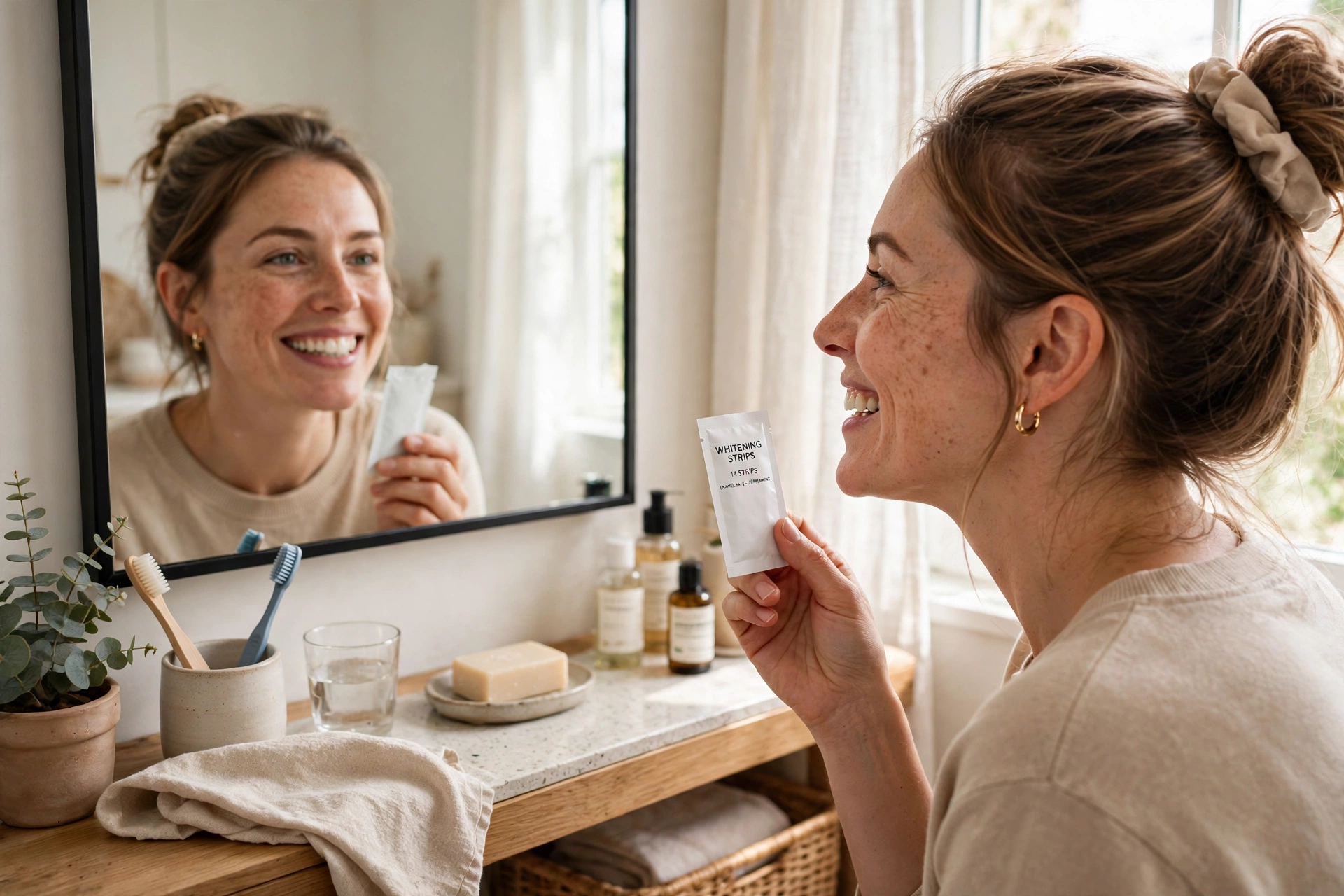
For most people, the best at home teeth whitening kit is a peroxide strip kit used exactly as directed, with a gentler plan if your teeth are sensitive. Strips give the best balance of price, evidence, and ease of use for everyday surface stains from coffee, tea, and wine. Prefilled trays dispensed through a dental office are the stronger at home step up. A light based kit is worth buying only if you like the kit format, because the gel does the whitening and the light adds little on its own. No home kit whitens crowns, veneers, bonding, or fillings, and no home kit reliably fixes deep colour change inside a tooth. If you have untreated decay, gum disease, a cracked tooth, or a single dark tooth, see a dentist before you buy anything.
The short answer by need
- If your teeth and gums are healthy and your stains come from food and drink: peroxide whitening strips, used daily for the full course stated on the pack.
- If your teeth are sensitive: start with the gentler plan in the sensitivity section, not with a stronger kit. Comfort first, strength second.
- If strips slip, miss crowded teeth, or give an uneven result: prefilled trays dispensed through a dental office, with a dental check before use.
- If price comes first: a store brand peroxide strip, if the label names hydrogen peroxide or carbamide peroxide as the active ingredient.
- If you like a full kit routine: a peroxide serum kit with a mouldable mouthpiece, chosen for the serum and the fit, not for the light.
- For keeping a result between courses only: a whitening pen or a whitening toothpaste for surface stain maintenance. Neither replaces a full bleaching course.
- Skip: charcoal powders and charcoal pastes, products with no bleaching agent that promise dramatic whitening, unregulated ultraviolet light kits sold through social media, and any plan that tells you to leave a product on far longer than directed.
Prices in this article are reported ranges from a 2026 dental practice guide accessed on 2 November 2026, not live retailer prices and not quotes. Prices change, product lines change, and the price you see at checkout may differ. Check the current price, pack size, and label before you buy. Prices, pack sizes, product lines, and insurance related rules where relevant must be rechecked at publication time because they change, and the reported ranges in this article must not be carried forward unchecked.
How at home whitening actually works
Effective whitening products use one of two bleaches: hydrogen peroxide or carbamide peroxide. Carbamide peroxide breaks down into hydrogen peroxide when it touches teeth. The peroxide breaks stain compounds into smaller, less visible pieces, so teeth look brighter. The American Dental Association resource MouthHealthy explains whitening in those terms and notes that over the counter products use a lower concentration than a dentist would use in the office.
That lower concentration is not a flaw. It means results build gradually and the risk of irritation is lower, provided you follow the directions. Contact time matters as much as concentration. A gel that stays evenly against the tooth for the stated time will usually do more than a stronger sounding product used briefly or unevenly.
Whitening toothpaste works differently. Most whitening toothpastes remove surface stain with mild abrasives and polishing agents. Products that carry the ADA Seal of Acceptance for stain removal have been assessed for safety and stain removal, but unlike bleaches they do not change the internal colour of teeth. That distinction explains why a whitening toothpaste can keep a result looking fresh but rarely creates the change of a strip or tray course.
Peroxide free products need the same plain language. A product without peroxide may remove surface stain, freshen breath, or help maintain a result, but it is not bleaching in the same sense. Oil based and so called natural kits that cause less sensitivity often do so because they do less bleaching. They can be reasonable for maintenance. They should not be sold, or bought, as a dramatic whitening treatment.
Homemade mixtures deserve a clear warning. Baking soda pastes, lemon, vinegar, charcoal scrubs, and household peroxide are not a safe substitute for a formulated whitening product. Abrasive scrubs can wear enamel, and enamel does not grow back. MouthHealthy lists homemade peroxide and baking soda ideas under fiction, not as recommended whitening. If a homemade recipe promises fast whitening, treat that promise as a warning sign, not as a selling point.
The types of at home kit, compared honestly
Whitening strips
Strips are thin, flexible strips coated in peroxide gel. You press one onto the upper teeth and one onto the lower teeth, leave them for the time stated on the pack, often 30 to 45 minutes a day, and repeat for 1 to 3 weeks. The competitor guide reports typical lightening of 2 to 5 shades for strips, with results varying by person and by stain.
Strips suit mild to moderate surface stains and flat front teeth best. They are also the easiest type to judge on value, because the course length and the number of treatments are usually stated on the pack. Their weakness is fit. Crowded or overlapping teeth can receive uneven contact, so crowded spots may lighten less. That is a fit problem, not proof that the gel failed.
Crest 3DWhitestrips are the most widely discussed strip example in dental practice guides, and the competitor guide names them as its most frequent recommendation. A Crest strip line includes the first whitening strips to earn the ADA Seal of Acceptance, and later Seal products in the same family are also reported in professional education material. That history matters, but it does not make every Crest variant right for every person. A gentler variant trades speed for comfort, and a higher strength variant trades comfort for speed. Read the variant label, not just the brand name.
Prefilled trays
Prefilled trays are ready to wear trays already filled with gel. They cover more tooth surface than a flat strip and can suit people who find strips hard to place. The competitor guide reports typical lightening of 2 to 4 shades for over the counter trays, and a higher result for dentist dispensed prefilled trays.
Opalescence Go is the dentist dispensed example named in the competitor guide, with 10 to 15 percent hydrogen peroxide and a reported result of 3 to 6 shades over 5 to 10 days for typical surface staining. The higher price, reported as roughly 100 to 150 dollars through a dental office, buys two things at once: a stronger gel and a professional check that your teeth and gums are healthy enough to whiten. If you have sensitivity, restorations, or gum problems, that check is often worth more than the gel itself.
Custom trays from a dentist
Custom trays are made to fit your teeth after impressions or scans. They are not strictly an over the counter kit, but they are the fair comparison point for any premium home kit. The gel contacts every surface more evenly, less gel reaches the gums, and the same trays can be refilled for touch ups. The competitor guide reports custom take home trays at 200 to 500 dollars nationally, and 300 to 600 dollars in the San Francisco Bay Area, with results lasting 1 to 2 years with touch ups. If you find yourself buying three or four premium over the counter kits a year, ask a dentist to compare that yearly spend with custom trays before you buy another kit.
Whitening pens
Pens brush a small amount of peroxide gel directly onto teeth. They are useful for a spot touch up, for travel, and for a single tooth that stains faster than its neighbours. They are not a full course treatment. The competitor guide reports typical lightening of 1 to 2 shades for pens. Buy a pen to maintain a result, not to create one from scratch.
Light kits and LED kits
Light kits pair a peroxide serum with a mouthpiece and a light. The mouthpiece can help, because it holds gel against teeth and gives a fixed daily routine, often about 10 minutes a day. The light itself is the weak part of the claim. Studies of light acceleration show minimal added benefit compared with the same gel without light, according to the competitor guide and ADA linked reporting. Colgate Optic White ComfortFit LED is the kit format example named in the competitor guide, reported at around 50 dollars, with a typical result of 2 to 4 shades over 2 to 3 weeks. Judge any light kit by its serum, its peroxide ingredient, its fit, and its daily time, not by the brightness of the light.
Ultraviolet light kits are a different matter. Unregulated ultraviolet exposure to gums and lips carries real risk for minimal added whitening benefit. Avoid kits that rely on ultraviolet light, especially kits sold only through social media with no clear manufacturer, ingredient list, or safety information.
Whitening toothpaste and maintenance products
Use whitening toothpaste between courses to slow stain return. Do not expect it to replace a course. If your teeth are sensitive, a whitening toothpaste with stronger abrasives or peroxide can make sensitivity worse, so a desensitising toothpaste is usually the better daily choice during and after whitening. Mouthwash with peroxide, whitening foam, and stain removal rinses sit in the same maintenance group: helpful for surface stain, not a substitute for bleaching.
Charcoal and abrasive powders
Skip charcoal powders and charcoal toothpastes as whitening treatments. Abrasion is not whitening. Scrubbing removes surface stain while risking permanent enamel wear. Most dentists advise against charcoal products entirely, and the competitor guide takes the same position. If a product promises whitening but lists no peroxide and no other bleaching agent, treat it as a stain removal product at best, however dramatic its before and after photos look.

Match the kit to your stain type
Start with the question a kit cannot answer for you: does this colour need an examination, or can a home product sensibly be tried first? Use the three groups below as a triage check, not as a diagnosis. Anything in the examination group is a reason to book a dental check before spending money on a kit.
Get an examination first
- Pale spots that stand out after braces or after early fluoride exposure: whitening can make those spots stand out more, so get an assessment first. Dental practice material discusses microabrasion, resin infiltration, or bonding, depending on what caused the spots.
- A single tooth that has gone dark after an injury or after root canal treatment: do not treat that tooth with a general kit on its own. Internal bleaching or a crown may be relevant, and only a dentist can judge that tooth.
- Colour that sits inside the tooth and looks grey or brown, for example after tetracycline in childhood, after fluorosis, or after injury: peroxide bleaching usually does not fix this. Veneers or bonding give a uniform result in many such cases, but that is a dental treatment decision, not a kit choice.
- Natural teeth that sit beside crowns, veneers, bonding, or fillings and do not match them: whitening does not change restorations. If natural teeth are whitened without planning for restorations, the result can look uneven. Plan whitening and restoration shades together with your dentist.
A home kit may be reasonable
- Everyday colour from coffee, tea, red wine, and other food and drink: this is the situation where strips or trays do their best work, because the colour sits mainly on the surface.
- Yellowing that comes with ageing enamel: peroxide can help, but the change may be partial. Professional trays or in office whitening give a more meaningful change for many people in this group.
A kit is the wrong tool
- Heavy staining built up over decades of smoking: over the counter kits help only minimally. In office whitening, often over multiple cycles, is the more realistic route.
- Dullness caused by buildup and tartar: a kit treats the wrong problem. A professional cleaning often makes teeth visibly brighter on its own, because it removes buildup that no gel can dissolve.
As a rough guide, yellow toned colour tends to respond best to peroxide, because it often reflects surface staining or enamel that has thinned with age. Grey or brown colour responds far less. If you cannot tell which group you are in, that uncertainty alone is a reason to get a check before buying.
Safety, sensitivity, and enamel
Temporary tooth sensitivity is the most common side effect of whitening. Peroxide can reach the dentin layer through enamel and irritate the nerve, and the effect usually settles within 24 to 48 hours after stopping treatment, according to the competitor guide. Gum irritation is the other common short term effect, usually from gel touching gums or from a tray or strip that fits poorly.
When used as directed, dentist recommended whitening strips with ADA recognised ingredients are generally considered safe for enamel in ADA linked reporting. Overuse is where risk rises. Leaving strips on longer than directed does not whiten faster. It mainly increases sensitivity and gum irritation. Using courses back to back without a break has the same problem: more irritation, no better final shade.
Before the plan, apply a stop or continue rule. Continue only if sensitivity stays mild, fades quickly after a session, and affects teeth broadly rather than one tooth alone. Stop the course and contact a dentist if sensitivity is severe, if it lasts more than a few days, or if pain is centred on one tooth. That rule comes first, so it is not left as an afterthought at the end of a list.
A gentler plan for sensitive teeth, in a different order from the usual product first advice, looks like this:
- Shorten sessions if the pack allows a shorter option, or whiten every other day instead of daily, so teeth get recovery time between sessions.
- Choose a lower strength product, or a gentler strip variant, rather than the strongest variant on the shelf.
- Use a potassium nitrate or stannous fluoride toothpaste for two weeks before you start whitening, and keep using it during the course.
- Avoid very hot or very cold drinks straight after a session, when teeth are most reactive.
Sensitivity that is severe, sudden, lingering, or limited to one tooth is not normal whitening sensitivity. It can signal decay, a crack, gum disease, or another problem that toothpaste and whitening will not fix. Do not push through that kind of pain with a stronger kit.
Before whitening, check for untreated cavities, cracked teeth, active gum disease, and existing restorations. Whitening over an untreated problem can cause significant pain and may worsen the underlying issue. A dental checkup and cleaning before whitening also has a practical benefit: cleaning alone removes surface buildup, so you start from a brighter baseline and you avoid bleaching over tartar.
At home whitening compared with professional whitening
Professional whitening is faster, stronger, and more uniform, because it uses a higher peroxide concentration, a custom fit, and professional oversight. It also costs far more. The competitor guide reports the following national ranges, with San Francisco Bay Area figures where the guide gives them. All figures are reported ranges accessed on 2 November 2026, not quotes, and prices change.
- Over the counter kits, including strips, trays, and light kits: 20 to 150 dollars nationally. Results typically last weeks to a few months.
- Custom take home trays from a dentist: 200 to 500 dollars nationally, and 300 to 600 dollars in the San Francisco Bay Area. Results typically last 1 to 2 years with touch ups.
- In office professional whitening: 300 to 1000 dollars or more nationally, and 500 to 1200 dollars in the San Francisco Bay Area. Results typically last 1 to 3 years with maintenance.
The useful comparison is yearly cost, not pack price alone. Three or four premium over the counter kits a year can cost about the same as custom trays that last for years, with less even results. On the other hand, a single strip course that meets your goal, followed by maintenance toothpaste, is far cheaper than any professional treatment. The right choice depends on your stain type, your sensitivity, and how long you want the result to last, not on which option sounds most premium.
How often can you whiten? The competitor guide suggests one full over the counter course every 4 to 6 months as a reasonable ceiling for most people. Touch up products such as pens and whitening toothpaste can bridge between courses. If you feel you need constant whitening to maintain a result, talk to a dentist about the staining source or the method, because frequent bleaching mainly adds sensitivity without a better result.
How long do results last? Over the counter results typically last a few weeks to several months, depending on diet, smoking, oral hygiene, and maintenance. Coffee, tea, red wine, and tomato sauce can restain teeth quickly while enamel pores are temporarily more open after treatment, so it helps to limit those foods and drinks during a course. Professional results last longer, often 1 to 3 years, especially with touch ups and with reduced staining habits.
Budget, value, and what a fair price looks like
The cheapest kit is not always the best value, and the most expensive kit is not always the strongest. Compare kits on the same basis:
- Total course price, not the price of one strip or one pen.
- Number of treatments in the pack, and whether the pack covers upper and lower teeth.
- Peroxide ingredient on the label. If the label names no hydrogen peroxide and no carbamide peroxide, the product cannot bleach, however strong its marketing sounds.
- Fit for your teeth. A cheap strip that slips, folds, or misses crowded teeth wastes gel and gives an uneven result.
- Sensitivity cost. A stronger kit that forces you to stop early is worse value than a gentler kit you can finish.
- Maintenance cost. Budget for a desensitising toothpaste if you are sensitive, and for a maintenance toothpaste or pen between courses if you want the result to last.
Store brand peroxide strips, reported at roughly 20 to 30 dollars in the competitor guide, use the same active chemistry as name brands at lower concentrations and lower prices. Results are slower, with a reported typical change of 1 to 3 shades over 2 to 3 weeks, but the direction is the same. That makes a store brand a sensible budget test: if a store brand strip course meets your goal, you do not need a premium kit. If it does not, the reason may be stain type rather than brand, so get advice before moving to a stronger product.
Reported pack ranges from the competitor guide, accessed on 2 November 2026, are:
- Store brand peroxide strips: roughly 20 to 30 dollars.
- Crest 3DWhitestrips: roughly 45 to 80 dollars, depending on variant and retailer.
- Colgate Optic White ComfortFit LED kit: around 50 dollars.
- Opalescence Go prefilled trays through a dental office: roughly 100 to 150 dollars.
These are reported ranges, not current retailer prices. Retailers, pack sizes, and promotions change, so the price at checkout may be higher or lower. Never judge a kit by a single sale price without checking how many treatments the pack contains.
A note on reviews and rankings: reviews help with practical questions such as fit, taste, slipping, and gum irritation, but shade promises in reviews vary widely because stain type, starting shade, and consistency vary too. A list that ranks ten products without explaining stain type, peroxide ingredient, and fit is not a reliable buying guide, even if it uses the words top rated or best on the market. Use this article's type comparison first, then use reviews to check practical complaints about the specific variant you are considering.
A note on brand reputation and ingredients: a well known brand is not proof of a good result for your teeth, and an unknown brand is not proof of a bad result. The label is more useful than the logo. Look for a named peroxide ingredient, a clear course length, a clear daily time, a sensitivity warning, and a manufacturer contact. If any of those are missing, choose a product that provides them. Top quality ingredients in this context means a clearly labelled peroxide gel at a stated concentration, used as directed, not a long list of added botanicals or flavourings.
How to use a kit correctly
Read the pack before you start, even if you have used strips before, because course lengths and daily times differ by variant.
- Get a dental checkup and cleaning first if you have not had one recently, and ask about restorations, sensitivity, and gum health.
- Brush and floss normally before a session, and dry the front teeth lightly if the pack instructs you to do so, so strips adhere well.
- Place strips, trays, or gel exactly as directed, keeping gel off the gums as far as possible.
- Leave the product on for the stated time only. Do not extend the time to chase a faster result.
- Remove the product, rinse as directed, and avoid staining food and drink straight after treatment.
- Use a desensitising toothpaste during the course if you are sensitive, and space sessions out if sensitivity appears.
- Finish the full course before judging the result, unless sensitivity or gum irritation forces you to stop and seek advice.
- Maintain the result with a whitening toothpaste or pen, and plan the next full course no sooner than the interval in the previous section unless a dentist advises otherwise.
Common mistakes are easy to avoid once you name them: whitening over tartar, whitening a single dark tooth as if it were surface stain, extending session times, stacking two bleaching products at once, and buying a stronger kit after a gentler kit failed for a stain type reason. If a full course gives no visible change, the next step is advice, not a stronger pack.
What to check on the label before you buy
- Active ingredient: hydrogen peroxide or carbamide peroxide, with a stated concentration if the manufacturer provides one.
- ADA Seal of Acceptance, where claimed. Check that the Seal applies to the exact variant you are buying, not just to the brand family in general.
- Course length and daily time, and whether the pack covers upper and lower teeth.
- Sensitivity guidance, including whether the manufacturer suggests a desensitising toothpaste or a gentler variant.
- Warnings for restorations, pregnancy, age limits, and existing dental problems, as stated by the manufacturer.
- Expiry date and storage instructions. Expired or badly stored gel may underperform.
- Manufacturer name and contact details. Avoid products with no identifiable maker.
If you cannot find the active ingredient, the course length, or the maker, that missing information is itself a reason to choose another product.
Frequently asked questions
Judge cheap and premium on the same three tests: does the kit match your stain type, does it fit your teeth well enough to finish the course, and can you tolerate it without stopping early. A low priced peroxide strip that fits, that you finish, and that suits surface stains will beat a premium kit that slips, irritates your gums, or gets abandoned halfway. Move to a stronger or dentist dispensed option only after a full, correctly used course has failed and a dentist has checked that your stain type suits bleaching.
Whitening agents act on natural tooth enamel only. Crowns, veneers, bonding, fillings, and dentures keep their colour. Whitening natural teeth in isolation can therefore leave an uneven smile. Talk to a dentist before starting, so the shade of natural teeth and the shade of any restoration can be planned together.
The gel is doing the whitening work in an LED kit, and studies of light acceleration show minimal added benefit compared with the same gel without light. That does not make an LED kit harmful on its own, but it does mean you are paying for the serum and the kit format, not for extra whitening from the light. Avoid ultraviolet light kits.
Strips used exactly as directed, with ADA recognised ingredients, are generally considered safe for enamel in ADA linked reporting. Risk rises with overuse, with sessions left on longer than directed, and with abrasive charcoal products, because charcoal abrasion can wear enamel over time and enamel does not regrow.
Think in terms of a strategy rather than a single strong product. The sensitivity section sets out a gentler plan built around a desensitising toothpaste, a lower strength product or gentler variant, shorter or spaced sessions, and a stop rule. Peroxide free products cause less sensitivity because they do less bleaching, so they suit maintenance better than a first course.
Effectiveness at home tracks even contact time more than branding. Higher strength strips and dentist dispensed prefilled trays give the strongest at home results, typically reported as 2 to 5 shades for strips and 3 to 6 shades for dentist dispensed prefilled trays in the competitor guide. Custom fitted trays from a dentist outperform over the counter options because the gel contacts every surface evenly.
For surface stains, yes. A peroxide kit used for a full course can lift everyday food and drink colour by several shades for many people. That success depends on stain type and severity, peroxide concentration, contact time, fit, and consistency. Deep colour inside a tooth is a different problem, and kits are much weaker there.
The competitor guide names Crest 3DWhitestrips as its most frequent over the counter recommendation, on the grounds that the product family is peroxide based, long established, and includes Seal products. For stronger at home results, dentists often dispense Opalescence Go prefilled trays. Across dental sources the consistent advice is the same: choose a peroxide based product and get an exam first if you have restorations, sensitivity, gum disease, or untreated decay.
Yellow is the colour peroxide handles best, because it often reflects surface staining or enamel thinning with age. Grey or brown colour from tetracycline, fluorosis, or trauma responds far less and often needs veneers or bonding for a uniform result. A dentist can tell you which type you have.
The decision in one paragraph
If your stains are surface stains, your teeth and gums are healthy, and you can follow a daily routine for 1 to 3 weeks, start with peroxide strips. If strips slip, miss crowded teeth, or give an uneven result, consider prefilled trays. If sensitivity stops you, switch to a gentler plan rather than a stronger kit. If your colour change is grey or brown, centred on one tooth, or beside a crown or veneer, do not buy a stronger kit first. Get a dental examination, because the right treatment in those cases is rarely another pack of strips. That sequence, stain type first, product second, and professional advice before a stronger step, is what separates a good value purchase from a repeated purchase that never addresses the real cause.
Sources used for the factual claims in this article are listed in the supporting files for this article, including the ADA MouthHealthy whitening resource, ADA linked whitening reporting, and the competitor practice guide used for gap analysis. The competitor guide is not copied here. Its structure, examples, and tables were not reproduced. Its reported price ranges and shade ranges are attributed as reported ranges, accessed on 2 November 2026, and they are not presented as live prices or as guaranteed results.
*This article is general information only. It is not a diagnosis and not a substitute for dental advice. If you have pain, swelling, a cracked tooth, gum disease, or sensitivity that is severe, sudden, lingering, or limited to one tooth, contact a dentist promptly.*