Affiliate disclosure: This article contains affiliate links. If you buy through a link on this page, MoleMarket may earn a commission at no extra cost to you — commissions never influence our recommendations. As an Amazon Associate I earn from qualifying purchases. Read our full Affiliate Disclosure.
Two 2kWh LiFePO4 power stations, two different philosophies. The BLUETTI Elite 200 V2 is built around maximum output and the longest battery lifespan in its class; the Anker Solix C2000 Gen 2 is built around portability, fast charging, and room to grow. Both are excellent. This is genuinely a "which strength do you need" decision, not a good-vs-bad one.
Buy the BLUETTI Elite 200 V2 if you want maximum output and longevity: 2,600W of continuous power (the highest in this class), a 6,000-cycle battery rated for years of daily use, and the strongest pure home-backup proposition of the two. Buy the Anker Solix C2000 Gen 2 if you want the lighter, more portable station: it's roughly 12 pounds lighter, charges from empty in just over an hour on AC, supports capacity expansion batteries, and earned a strong independent review from Notebookcheck as one of the most attractive 2kWh stations on the market.
The Two Stations at a Glance
| Station | Best for | Capacity | Continuous output | Weight | |
|---|---|---|---|---|---|
| BLUETTI Elite 200 V2 | Power and longevity | 2,073.6Wh LiFePO4 | 2,600W | 53.4 lb | Check Price |
| Anker Solix C2000 Gen 2 | Portability and expansion | 2,048Wh LiFePO4 | 2,400W | 41.7 lb | Check Price |
Best for Power and Longevity: BLUETTI Elite 200 V2
BLUETTI Elite 200 V2
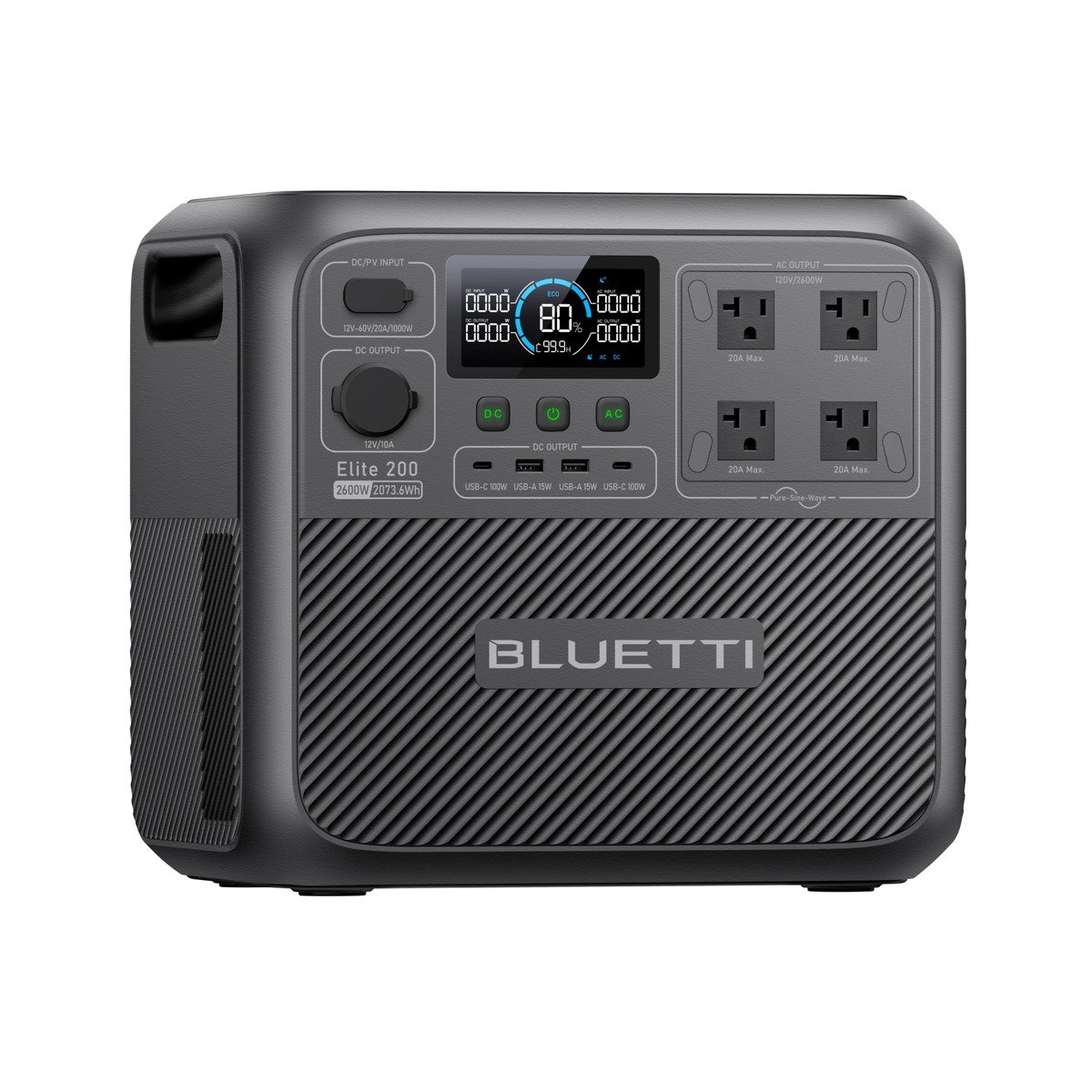
The Elite 200 V2 is the direct successor to BLUETTI's AC200P, one of the best-selling power stations of the early 2020s, re-engineered around two strengths: output and lifespan. Its 2,600W continuous inverter is the most powerful in the 2kWh class, and the 3,900W Power Lifting mode handles pure resistive loads (kettles, heaters, power tools) that would trip lesser stations. The headline number is cycle life: 6,000+ cycles to 80% capacity, roughly 50% more rated cycles than the Anker.
Reasons to Buy
- 2,600W continuous AC output (the highest in the 2kWh class), plus a 3,900W Power Lifting mode for resistive loads like kettles, heaters and power tools.
- 6,000+ cycle LiFePO4 battery (to 80% capacity): roughly 50% more rated cycles than the Anker, which matters for daily solar cycling over a decade.
- 1,000W maximum solar input, the highest here, for serious fixed or portable panel arrays.
- Fast AC charging: TurboBoost (1,800W AC) reaches about 80% in roughly an hour, or about 50 minutes with dual AC+DC input (2,400W max).
- Five-year warranty and a <15ms UPS switchover that keeps computers and routers alive through outages.
Reasons to Avoid
- At 53.4 lb it is a two-hand carry, noticeably heavier than the Anker for camping and road trips.
- Not expandable: 2,073.6Wh is the ceiling, with no expansion-battery option if your needs grow.
- USB-C tops out at 2× 100W, behind the Anker's 2× 140W ports for fast laptop charging.
- No TT-30 RV outlet on the US model, where the Anker includes one.
- Capacity: 2,073.6Wh LiFePO4
- AC output: 2,600W continuous (3,900W Power Lifting for resistive loads)
- AC charging: 1,800W input, ~80% in about 1 hour (TurboBoost); ~50 min with dual AC+DC (2,400W)
- Solar input: 1,000W max (MPPT)
- Cycle life: 6,000+ cycles to 80% capacity
- Outlets: 4× AC, 2× USB-C 100W, 2× USB-A 15W, car port (9 total)
- UPS switchover: <15ms
- Weight: 53.4 lb (24.2 kg)
- Warranty: 5 years
- In the box: Elite 200 V2 power station, solar charging cable, AC charging cable, grounding screw, user manual
Best for: Home backup and daily off-grid or cabin use, where output headroom and cycle life pay off.
Price & availability on Amazon
The Elite 200 V2's output advantage is practical, not just a spec-sheet trophy. The extra 200W of continuous output over the Anker, plus the gap between its 3,900W resistive-load mode and Anker's 3,000W SurgePad, is the difference between confidently running a high-draw appliance and wondering whether the inverter will trip. If your use case includes power tools, heaters, or a well pump, that headroom matters every time you plug in.
The cycle-life advantage compounds in the same way. For emergency backup that cycles a few times a year, both stations will outlive their warranties. For daily solar cycling (an off-grid cabin, a workshop that runs off panels every day), the BLUETTI's 50% cycle-life advantage is real money over a decade, because the battery is the component that ultimately wears out. BLUETTI frames 6,000 cycles as up to 17 years of daily use; even discounting the marketing framing, it is the longest-rated lifespan in this class.
Charging and connectivity round out a home-backup-first design. The 1,800W AC input with TurboBoost hits 80% in about an hour (about 50 minutes with dual AC+DC charging at up to 2,400W), and the 1,000W solar input is the highest here, a meaningful advantage if you're building a serious solar setup rather than topping up from a single portable panel. Nine total outlets (4× AC, 2× 100W USB-C, 2× USB-A, car port) cover most scenarios, and BLUETTI's companion app handles mode switching (including the TurboBoost fast-charge toggle and Power Lifting mode) and shows real-time input and output draw, useful for learning which of your appliances are the power hogs. The honest trade-offs are weight and the fixed capacity: at 53.4 lb it's a two-hand carry, and unlike the Anker it can't take an expansion battery, so 2,073.6Wh is all you will ever have.
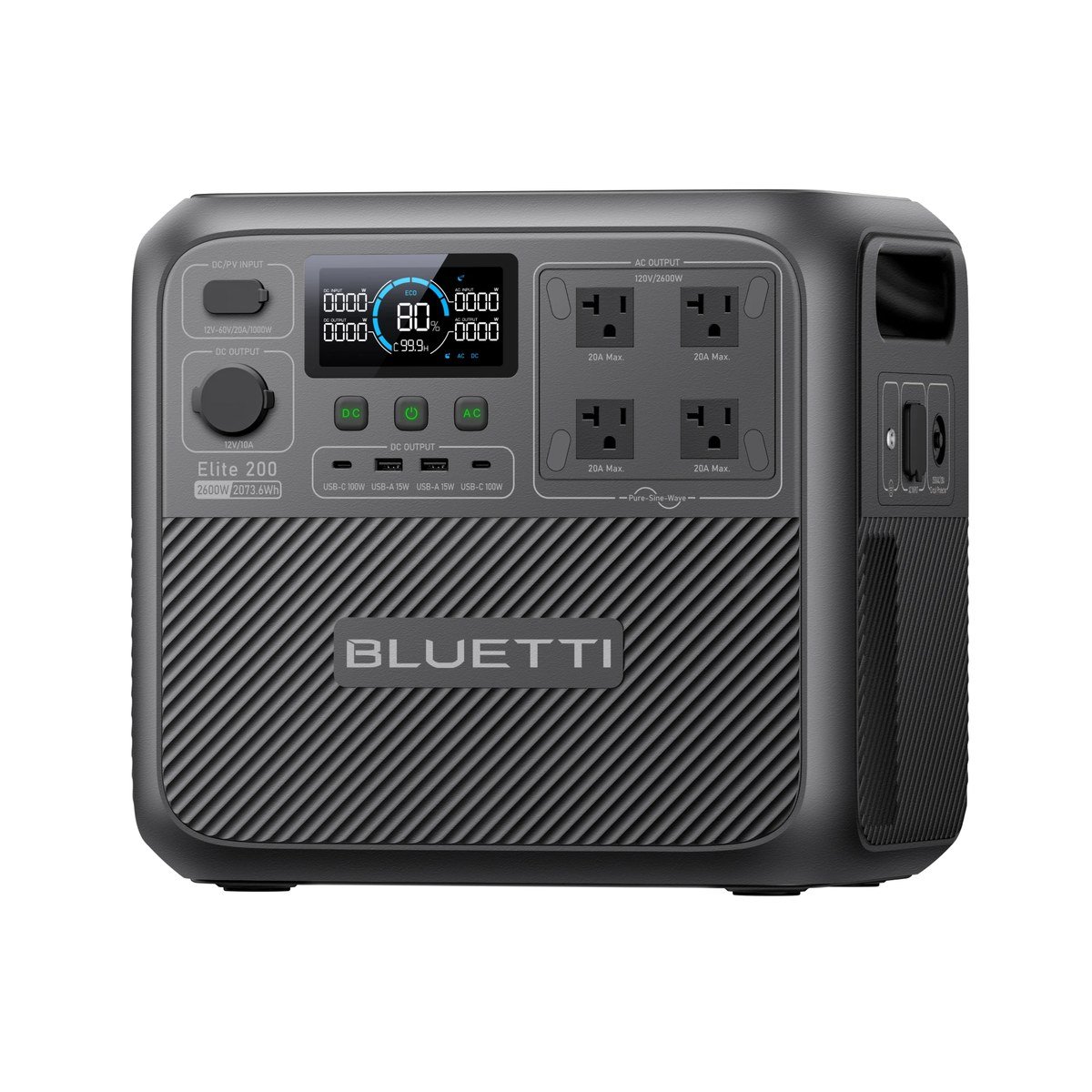
In outage duty, the numbers translate into roughly a day of essentials: a full-size fridge cycling at around 150W average runs for about 11–12 hours on the usable capacity, a router for five days or more, and a CPAP (without humidifier) for 40-plus hours. The front panel is laid out for that always-ready role: the display, DC/PV solar input (12–60V, up to 1,000W) and 12V car output sit alongside the four AC sockets, so everything you need to check or plug in is on one face. Kept plugged in as a UPS, the <15ms switchover is fast enough that a desktop PC, router or NAS rides through a grid drop without rebooting; just remember that a station held at 100% charge full-time ages its battery faster than one cycled occasionally, and for long storage BLUETTI's chemistry is happiest at 50–80%.
Best for Portability and Expansion: Anker Solix C2000 Gen 2
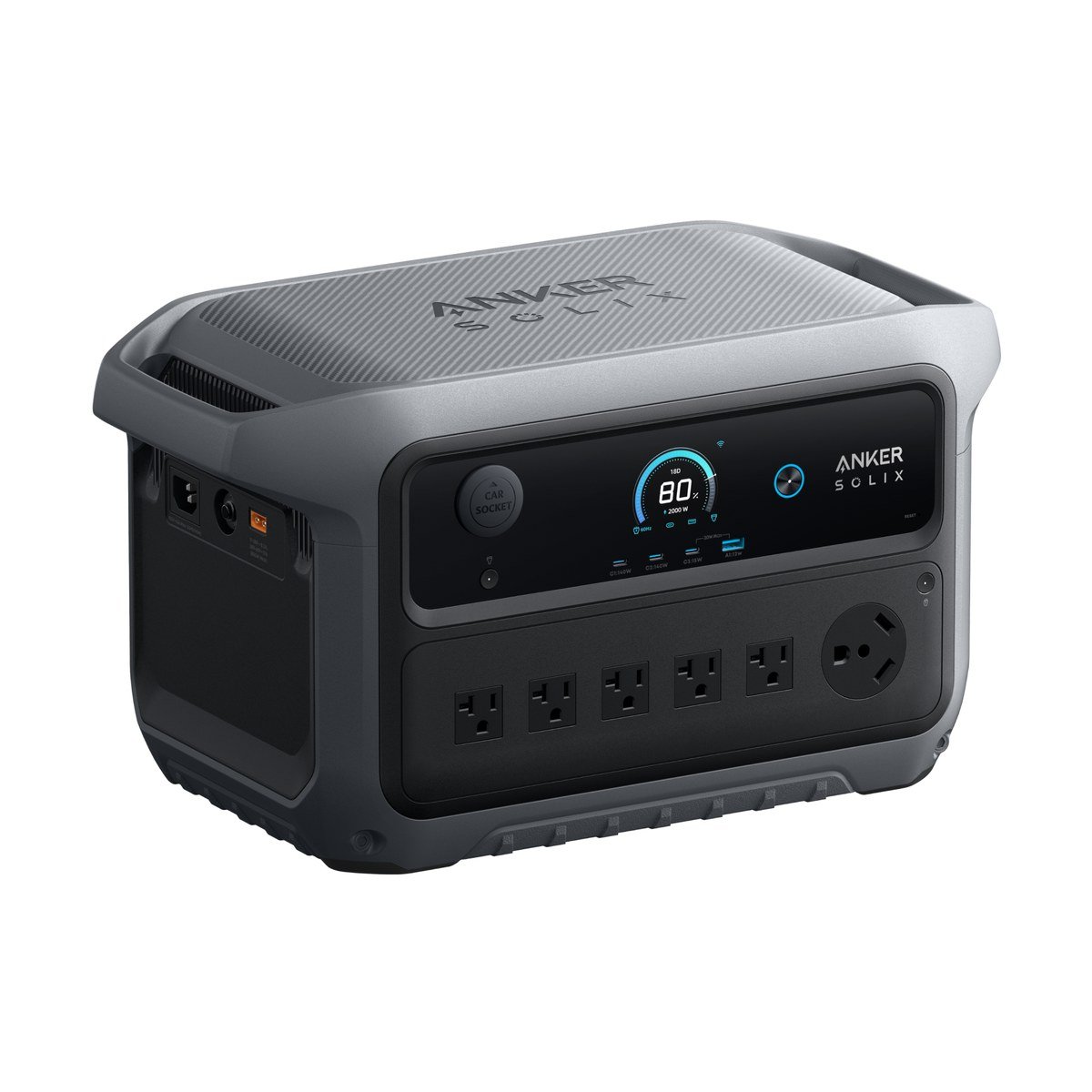
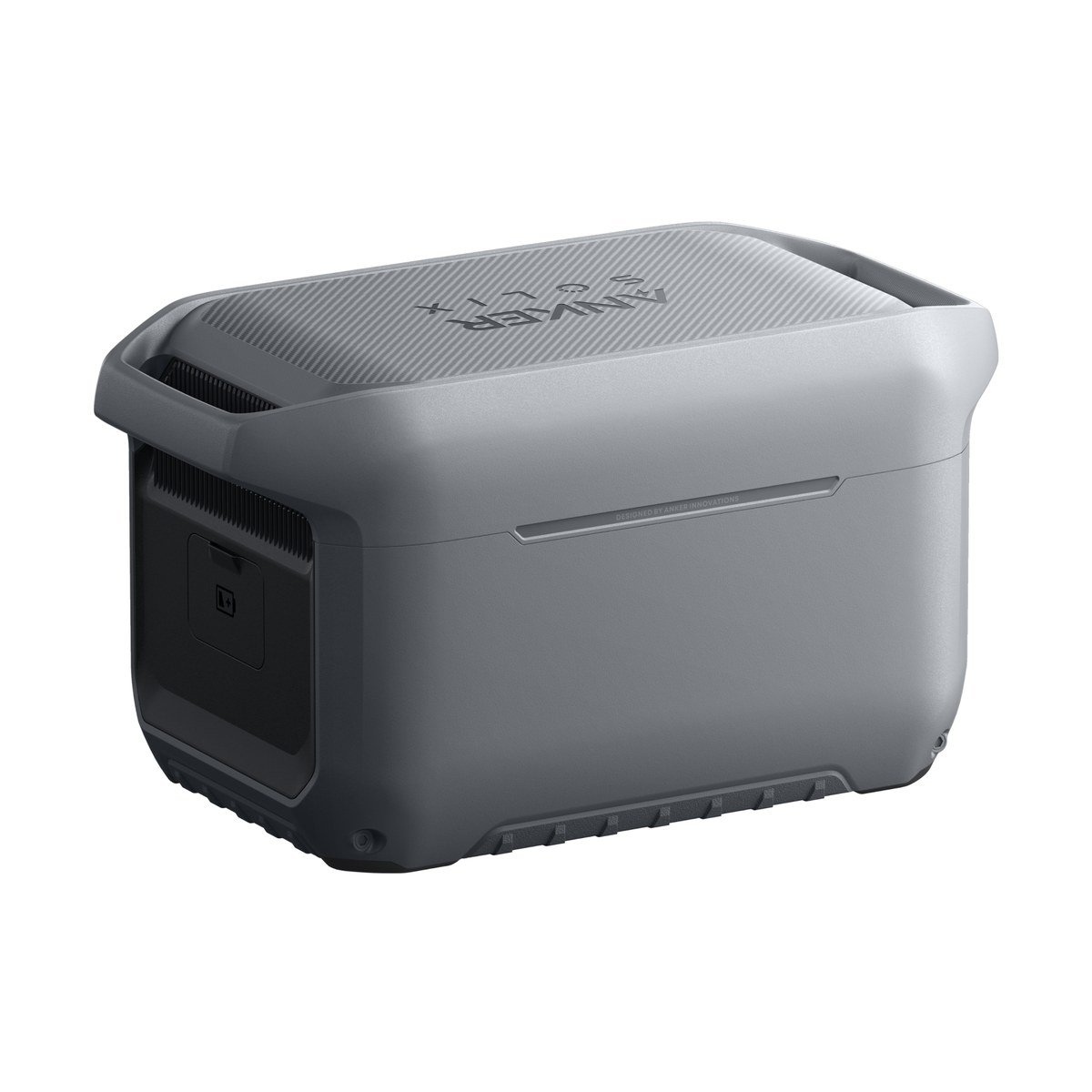
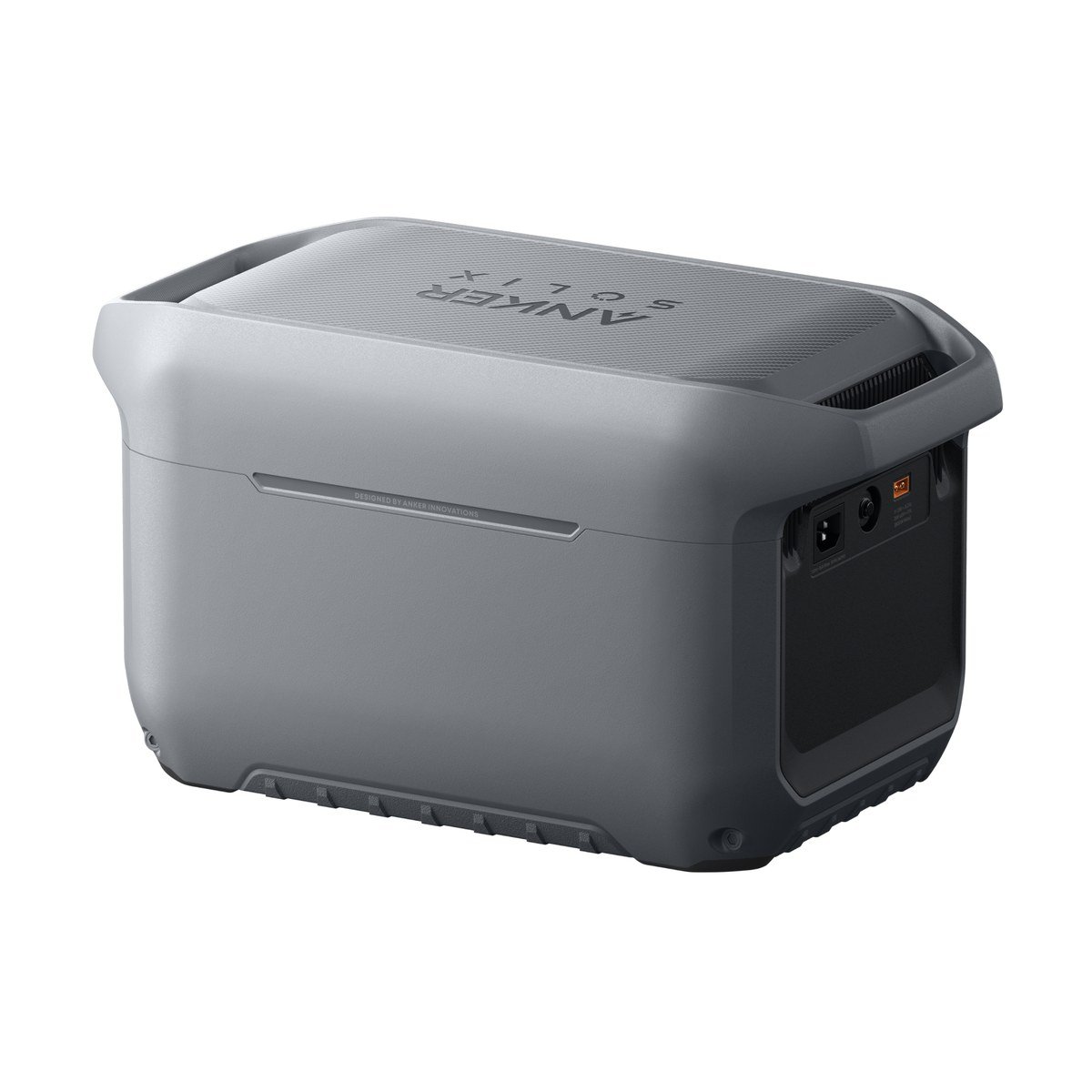
Anker Solix C2000 Gen 2
Anker rebuilt its 2kWh station from the ground up for the Gen 2, and the headline achievement is weight: 41.7 lb (18.9 kg), a 38% reduction from its F2000/PowerHouse 767 predecessor, achieved while keeping the same 2,048Wh capacity and 2,400W output. Notebookcheck's independent review called it "one of the most attractive 2 kWh power stations on the market," and noted it runs quieter and more responsively than its predecessor.
Reasons to Buy
- 41.7 lb, roughly 12 lb lighter than the BLUETTI, makes it the station one person can comfortably carry to a campsite, job site or tailgate.
- Fastest charging here: up to 2,300W AC input fills the battery in about 63 minutes (just over an hour); adding solar alongside AC (2,600W combined) cuts that to about 58 minutes.
- Expandable with Anker's BP2000 Gen 2 battery, so capacity can grow to roughly 4–5kWh instead of replacing the whole unit.
- Quickest UPS switchover here (<10ms) and a generous USB array: 2× 140W USB-C plus a 15W port, enough to fast-charge two laptops at once.
- US version includes a TT-30R RV outlet alongside its standard AC outlets, and carries a five-year warranty.
Reasons to Avoid
- 800W solar ceiling is lower than the BLUETTI's 1,000W: fine for portable panels, but limiting for big fixed arrays.
- 4,000-cycle battery rating is excellent but a third lower than the BLUETTI's 6,000 for daily-cycling duty.
- Only one USB-A port, and Anker dropped the built-in LED light the previous model had.
- 2,400W continuous output trails the BLUETTI, so check SurgePad limits before relying on it for the hungriest resistive loads.
- Capacity: 2,048Wh LiFePO4 (model A1783)
- AC output: 2,400W continuous, 4,000W peak (3,000W SurgePad for resistive loads)
- AC charging: up to 2,300W input, full charge in about 63 minutes (just over an hour); about 58 minutes with AC + solar combined (2,600W)
- Solar input: 800W max (XT60i connector)
- Cycle life: 4,000 cycles to 80% capacity
- Outlets (US): 6 AC outlets (5 standard plus TT-30R RV port), 2× USB-C 140W, 1× USB-C 15W, 1× USB-A 12W, car socket
- UPS switchover: <10ms
- Weight: 41.7 lb (18.9 kg)
- Dimensions: 459 × 250 × 257 mm
- Warranty: 5 years
- In the box: Solix C2000 Gen 2 power station, AC charging cable, car charging cable, quick start guide, safety manual, warranty card
Best for: Camping, RVs, road trips, and first-time buyers who want a 2kWh start with an expansion path.
Price & availability on Amazon
Charging speed is the Anker's party trick: up to 2,300W of AC input fills the battery in about 63 minutes (just over an hour, the fastest in this comparison), and adding solar alongside AC (2,600W combined) cuts that to about 58 minutes. On the road that changes how you use the station: a one-hour stop at a campsite hookup or a friend's house nearly refills it, rather than buying you a partial top-up. The Anker app covers the essentials, including charge-speed limiting (slower charging is gentler on the battery when you're not in a hurry), UPS mode configuration, and firmware updates.
Expandability is the structural difference buyers most often underestimate. The C2000 Gen 2 accepts Anker's BP2000 expansion battery (reported totals run roughly 4–5kWh depending on configuration), so a station bought for weekend camping can grow into a more serious home-backup setup. The BLUETTI offers no equivalent path, and buying a second station later costs far more than an expansion battery. If there is any chance you'll outgrow 2kWh, this upgrade path is close to decisive on its own.
The honest compromises are at the edges. The 800W solar ceiling is lower than the BLUETTI's 1,000W: ample for portable 200–400W panels, but limiting for a large fixed array. Cycle life is rated at 4,000 cycles, excellent by any normal standard and more than a decade of weekly use, just not the BLUETTI's 6,000. And the front panel's six AC outlets (five standard US outlets plus the TT-30R RV port) come with only a single USB-A socket, a small annoyance if your cable drawer is still mostly USB-A. None of these undercut the core proposition: this is the 2kWh station you will actually take places.
The physical design explains why. At 459 × 250 × 257 mm the C2000 Gen 2 is a compact, single-piece unit with integrated handles rather than a box you strap to a trolley, and the weight saving over its predecessor came without shrinking the battery: same 2,048Wh, same 2,400W class output, 38% less mass. Solar charging at the full 800W input refills the station in roughly three hours of ideal sun, and the box includes both AC and car charging cables, so road-trip top-ups don't need extra accessories. Two practical notes for panel owners: the solar input uses Anker's XT60i connector, so check cable compatibility before buying third-party panels, and, as with any LiFePO4 station, charging is throttled or blocked around freezing to protect the cells, so a cold garage is a discharge-only home in winter.
Head-to-Head Spec Comparison
All figures are manufacturer-published specifications. Where sources conflicted, we used the majority figure and flagged the conflict. See the note on conflicting specs below.
| Feature | BLUETTI Elite 200 V2 | Anker Solix C2000 Gen 2 |
|---|---|---|
| Battery capacity | 2,073.6Wh LiFePO4 | 2,048Wh LiFePO4 |
| Continuous AC output | 2,600W (5,200W surge) | 2,400W (4,000W surge) |
| Resistive-load boost | 3,900W Power Lifting mode | 3,000W SurgePad |
| AC charging input | 1,800W (80% in ~1 h, TurboBoost; ~50 min dual AC+DC, 2,400W) | Up to 2,300W AC (full charge ~63 min; ~58 min with AC + solar, 2,600W combined) |
| Max solar input | 1,000W (MPPT) | 800W (XT60i) |
| Cycle life (to 80%) | 6,000+ cycles | 4,000 cycles |
| Expandable | No | Yes (BP2000 Gen 2 expansion battery) |
| UPS switchover | <15ms | <10ms |
| AC outlets | 4 | 6 (US version: 5 standard plus TT-30R RV port) |
| USB-C | 2× 100W | 2× 140W + 1× 15W |
| USB-A | 2× 15W | 1× 12W |
| Weight | 53.4 lb (24.2 kg) | 41.7 lb (18.9 kg) |
| Warranty | 5 years | 5 years |
| App control | Yes (BLUETTI app) | Yes (Anker app) |
The 7 Differences That Actually Matter
1. Continuous output: 2,600W vs 2,400W. The BLUETTI's extra 200W, plus its 3,900W resistive-load mode vs Anker's 3,000W SurgePad, is the difference between confidently running a high-draw appliance and wondering. If your use case includes power tools, heaters, or well pumps, the BLUETTI's headroom matters.
2. Battery lifespan: 6,000 vs 4,000 cycles. For emergency backup that cycles a few times a year, both will outlive their warranties. For daily solar cycling, the BLUETTI's 50% cycle-life advantage is real money over a decade.
3. Weight and portability: 41.7 lb vs 53.4 lb. Nearly 12 pounds is the difference between one person comfortably carrying it and a two-person job. The Anker is the camping/road-trip station; the BLUETTI is the garage station.
4. Charging speed. The Anker's ~63-minute full AC recharge (about 58 minutes with AC + solar combined) is the fastest here; the BLUETTI's TurboBoost reaches 80% in about an hour on AC alone (roughly 50 minutes with dual AC+DC input). On mains power alone, the Anker completes a full recharge in about the time the BLUETTI needs to reach 80%. Both are dramatically faster than older-generation stations.
5. Solar input: 1,000W vs 800W. The BLUETTI accepts 25% more solar, which is relevant for fixed cabin installations with large arrays. For portable 200–400W panels, both are ample.
6. Expandability. Anker yes (BP2000 expansion battery), BLUETTI no. If you might need 4kWh later, the Anker's upgrade path is decisive, because buying a second station later costs far more than an expansion battery.
7. UPS switchover: <10ms vs <15ms. Both are fast enough for computers and networking gear (the 20ms threshold is what matters for most electronics). The Anker's edge is marginal but real for sensitive equipment.
What Can 2kWh Actually Run? Honest Runtime Math
Watt-hours are abstract until you do the division. The formula is simple: runtime (hours) ≈ usable Wh ÷ device watts, with roughly 10–15% lost to inverter inefficiency on AC loads. Using ~1,750Wh of usable AC energy (a conservative estimate for a 2,048–2,074Wh station):
| Device | Typical draw | Approximate runtime |
|---|---|---|
| Wi-Fi router | 10W | 5+ days |
| Laptop (working) | 60W | ~29 hours |
| Full-size fridge (cycling) | 150W average | ~11–12 hours |
| 55" LED TV | 100W | ~17 hours |
| CPAP (no humidifier) | 40W | ~40+ hours |
| Microwave | 1,000W | ~1.7 hours |
| Space heater | 1,500W | ~1.1 hours |
| Power drill (charging/working) | 500W | ~3.5 hours |
Two lessons fall out of this table. First: low-draw essentials (comms, medical devices, lighting) run for days, and that's the real emergency value. Second: heating and cooling are brutally expensive in watt-hours; a space heater empties either station in about an hour. Size your expectations, and your station, around your highest-draw must-run appliance, not the average. (Figures are estimates from typical appliance ratings; check your devices' nameplates.)
The Price Question (Answered Honestly)
Both brands discount aggressively and frequently: sale prices, bundles with solar panels, and holiday events move these numbers by hundreds of dollars. Treat any printed price as stale: check the live listings via the buttons in this article, and compare bundle prices (station + panels) rather than bare-unit prices if you're going solar.
Which Should You Buy? Four Scenarios
Home backup for outages: BLUETTI Elite 200 V2. The higher output, longer cycle life, and 1,000W solar input suit a station that sits ready and works hard when the grid fails. Pair it with panels for multi-day resilience.
Camping, RVs, and road trips: Anker Solix C2000 Gen 2. Lighter to carry, faster to recharge at a campsite hookup, and the expansion battery covers longer trips.
Daily off-grid or cabin use: BLUETTI Elite 200 V2. Daily cycling is where 6,000 cycles pays off, and the bigger solar input harvests more on short winter days.
A first station on a budget, with room to grow: Anker Solix C2000 Gen 2. Start at 2kWh, add the expansion battery later instead of replacing the whole unit.
Alternatives worth knowing: the EcoFlow DELTA 2 Max (2,048Wh, 2,400W continuous per published comparison data) is the other heavyweight in this class, with the broadest panel and accessory ecosystem. It trades blows with the Anker on most specs, so buy whichever is cheaper when you're ready. The Jackery Explorer 2000 Plus is the output king of the wider set at 3,000W continuous with large expansion potential, at the cost of weight and recharge time; choose it if raw output beats portability (workshops, food trucks, events); our Jackery vs Anker comparison covers that brand matchup. And if you like the BLUETTI but want a head-to-head within the family, see our published BLUETTI Elite 100 V2 vs Elite 200 V2 comparison. If 2kWh is overkill, both brands sell ~1kWh siblings at lower prices and weights. A 1kWh station runs the essentials table above for roughly half the durations, plenty for phones, laptops, and lights through a one-night outage.
How We Chose
MoleMarket doesn't run a power-station test bench, so this comparison is research-based. Every specification comes from manufacturer-published figures (BLUETTI's official pages, Anker via authorized retailers) and established reviewers, notably Notebookcheck's independent C2000 Gen 2 review and Solar Waypoint's spec comparisons, checked in October 2026. We compared the two stations on the criteria that decide real purchases: continuous and surge output, cycle life, charging speed, solar input, expandability, UPS switchover, port count, weight, and warranty. Where sources conflicted (Anker's max solar input: 800W per most retailers and launch coverage vs 1,000W per one review site; expansion-battery totals), we used the majority figure and logged the conflict; see the note below. Prices are excluded as stale-by-design; check live listings instead.
How to Choose: 5 Mistakes to Avoid
1. Buying watt-hours without checking watts. A 2,000Wh station with a 1,500W inverter won't run your 1,800W kettle. Match the inverter output to your hungriest appliance first, capacity second.
2. Ignoring the solar math. "Solar generator" only works with panels. A 2,000Wh station needs roughly 400W of panels for a full recharge on a good solar day, so budget panels separately and check the station's max solar input (1,000W vs 800W here). For portable use, a single 200W panel keeps either station topped up across a sunny day of light use; for home backup, 600–800W of panels can refill either station in a good solar day, and the BLUETTI's higher ceiling gives it more headroom. Stay within the station's voltage window (over-voltage can damage the charge controller), and note the Anker uses an XT60i solar connector, so check cable compatibility with third-party panels.
3. Storing it dead. LiFePO4 is tough but not immortal: don't leave any station at 0% for months. Charge to 50–80% for storage and top up every few months.
4. Forgetting the weight. 53 lb doesn't sound bad until you're carrying it across a campsite. If portability matters, the scale is a spec: read it.
5. Assuming expansion later. Only some stations accept expansion batteries (the Anker does; the BLUETTI doesn't). If you think you'll need more capacity, confirm the upgrade path before you buy, because you can't retrofit it.
Frequently Asked Questions
Neither is objectively better. They're optimized differently. The BLUETTI offers more continuous output (2,600W vs 2,400W), longer battery lifespan (6,000 vs 4,000 cycles), and higher solar input (1,000W vs 800W). The Anker is lighter (41.7 vs 53.4 lb), charges faster on AC (~63 min full; ~58 min with AC + solar combined), and supports expansion batteries. Choose by use case: home backup favors BLUETTI; portability favors Anker.
A standard full-size refrigerator draws roughly 100–200W while running (with higher startup surge), which is well within the Elite 200 V2's 2,600W continuous output, but runtime depends on the fridge's duty cycle and the 2,073Wh capacity. Expect on the order of a day of runtime for an efficient fridge; check your appliance's rated wattage and do the math before relying on it.
Per Anker's published figures, about 63 minutes (just over an hour) for a full charge on AC alone (up to 2,300W input), or about 58 minutes when AC and solar are combined (2,600W shared input), and roughly 3 hours on the maximum 800W solar input in ideal sun. Real-world times vary with temperature and input conditions.
It covers essentials (fridge, phones, laptops, lights, router) for roughly a day, depending on loads. It won't run central air conditioning or an electric water heater for long. For whole-home backup, you need a larger system than either station here.
Not strictly. Both stations charge fast from a wall outlet. Panels matter for off-grid use and multi-day outages, where they're the only way to refill. If you buy panels, confirm connector compatibility (the Anker uses XT60i) and stay within the station's max solar input.
Yes. Both have dedicated UPS modes with switchover under 20ms (<15ms BLUETTI, <10ms Anker), fast enough that a desktop PC, router, or NAS won't notice the grid dropping. Keep the station plugged in between the wall and your gear full-time. Note this means the battery sits at 100% constantly, which ages LiFePO4 faster than occasional cycling; that is fine for the protection it buys, but don't be surprised if a UPS-duty station shows more wear than a closet-kept one.
LiFePO4 batteries dislike charging below freezing: most stations (including these) throttle or block charging around 0°C to protect the cells, while discharging works to lower temperatures. If your station lives in an unheated garage, bring it inside to charge in winter, or check the manual's temperature specs before relying on it.
Different tools. A gas generator runs indefinitely as long as you have fuel, and powers far heavier loads, but it's loud, produces carbon monoxide (never indoors), and needs maintenance. A power station is silent, safe indoors, and instant, but finite. Many households end up with both: the station for quiet overnight essentials, the generator for heavy daytime loads. Neither of these 2kWh stations replaces a generator for whole-home, multi-day backup on its own.
A Note on Conflicting Specs
Two figures in this comparison deserve transparency. Anker's max solar input is listed as 800W by Anker's launch coverage and most retailers, but one review site claims 1,000W. We used 800W (the majority figure) and recommend confirming on Anker's spec page before sizing a panel array. Anker's expansion total is reported anywhere from ~4kWh to ~5.1kWh depending on the retailer and battery configuration, so we described it as "roughly 4–5kWh" rather than picking a number we couldn't verify. When sources disagree, we'd rather show you the disagreement than pretend at certainty.
Final Verdict
Buy the BLUETTI Elite 200 V2 for maximum power and the longest battery life in the class. It's the home-backup champion. Buy the Anker Solix C2000 Gen 2 for the lighter, faster-charging, expandable all-rounder. It's the station you'll actually take places. Both carry 5-year warranties, both use long-lived LiFePO4 chemistry, and both are honestly excellent; the wrong choice here is barely wrong. Pick the strength that matches your life: garage or road.
Final Recommendations
Best for Power and Longevity: BLUETTI Elite 200 V2: 2,600W output, 6,000+ cycles and 1,000W solar input for home backup and daily cycling
Best for Portability and Expansion: Anker Solix C2000 Gen 2: 41.7 lb, ~63-minute full AC recharge (~58 minutes with AC + solar) and a BP2000 expansion path
Product photos: manufacturer-published images from BLUETTI's and Anker's official store product galleries, showing the exact variants reviewed.
Related Guides
- BLUETTI Elite 100 V2 vs Elite 200 V2: the Elite 200 V2 against its smaller sibling
- Jackery vs Anker: the wider brand matchup in portable power
- The best portable power stations, all sizes ranked
- Anker Solix C2000 Gen 2 full review
- The best portable solar generators
- Portable power stations for home backup