
Full mouth dental implants in the United States usually cost tens of thousands of dollars, and the single most important detail in any price you see is whether it covers one arch or both arches. A price for one arch can look far lower than a price for a full mouth, even when both describe the same kind of treatment. Once you keep that distinction in view, the rest of the cost picture becomes much easier to compare.
The short answer on full mouth cost
For one arch, published cost guides commonly report All on 4 treatment in a broad range of about 20,000 dollars to 50,000 dollars per arch. For both arches, that logic doubles the arch count, so a full mouth total commonly falls in a broad range of about 40,000 dollars to 100,000 dollars before any insurance contribution, depending on the number of implants, the type of final teeth, bone grafting, extractions, sedation, and laboratory work.
Those ranges are wide on purpose. A straightforward case with healthy bone and a standard final bridge will sit differently from a complex case that needs grafting, sinus work, or a premium material for the final teeth. Treat any single number advertised without a per arch label, a list of inclusions, and a note about your own examination as a starting point for questions, not as a final price.
Per arch versus both arches
Dentists divide the mouth into two arches: the upper arch and the lower arch. Full mouth treatment replaces the teeth in both arches. Full arch treatment replaces the teeth in one arch only.
That distinction explains most confusing totals:
- A price labelled per arch covers one arch only. Double it, in rough terms, for both arches, then adjust for the fact that the two arches may not need identical work.
- A price labelled full mouth or full set should cover both arches. If it does not say so clearly, ask.
- A price for the upper arch alone answers a different question from a price for a full mouth. The upper arch cost is useful if only the upper teeth need replacement, but it is not a full mouth total.
When you compare quotes, write the arch count next to every price. A quote that looks cheaper but covers one arch is not cheaper than a higher quote that covers both.
All on 4 pricing and what it means
All on 4 is a well known approach in which four implants support a full arch bridge. The name describes the implant count in the standard plan, not a guarantee that four implants suit every mouth. Some patients need more implants for stability, bone reasons, or the design of the final teeth, and that changes the price.
All on 4 pricing is therefore best read as a per arch price for a specific plan, not as a universal full mouth price. Ask whether the quoted price includes:
- The implants themselves and the abutments that connect implants to the bridge
- Extractions of remaining teeth, if needed
- Bone grafting or other preparatory work, if needed
- Scans and planning
- A temporary bridge and the final bridge
- Sedation or anaesthesia, if used
- Follow up visits and adjustments in the first months
A quote that leaves out grafting, the final bridge, or sedation can look much lower than a quote that includes them, even for the same patient.
Average cost, full set cost, and full teeth replacement cost
Readers often search for an average cost for full mouth dental implants, a full set implants cost, or a full teeth replacement cost. Those phrases all point to the same reader question: what will it cost to replace all of my teeth with implant supported teeth?
There is no single average that fits every patient, because the average hides the arch count, the implant count, the material, and the preparatory work. A more useful way to use an average is as a sanity check. If a quote falls far below the broad ranges above, ask what is excluded. If a quote falls far above them, ask what extra work or premium material explains the difference. In both cases, the written item list matters more than the headline total.
Full mouth reconstruction is a broader phrase than full mouth implants. Reconstruction can include crowns, bridges, implants, gum work, and bite correction in various combinations, so a full mouth reconstruction price is not automatically an implant price. If a clinic uses that phrase, ask which treatments are included and which are implant work.
Cost with insurance
Full mouth dental implants cost with insurance is a common question, and the answer is usually disappointing in a specific way: dental insurance often covers part of the treatment, but rarely covers the whole total.
Many dental plans have an annual maximum, often in the low thousands of dollars, and may classify implant work, crowns, or related surgery differently. Some plans cover a portion of the crown or bridge but not the implant itself. Others apply waiting periods or exclusions for missing teeth that were lost before cover began.
Before you rely on insurance, ask for a written predetermination or benefit estimate from the clinic and your insurer, showing:
- Which parts of the plan are covered and at what percentage
- Whether an annual maximum applies and how much of it remains
- Whether a missing tooth clause or waiting period applies
- What you would still owe after the insurance contribution
Do not treat a verbal insurance estimate as a final figure. Get it in writing, with the arch count and item list attached.
What drives the price up or down
Several factors move a full mouth implant price more than the implant brand name does:
- Number of implants per arch. Four per arch is the standard All on 4 plan, but six or more per arch is common in some cases.
- Bone quantity and quality. Grafting adds cost and time.
- Remaining teeth. Extractions add cost, and complex extractions add more.
- Final teeth material. Acrylic, composite, porcelain, and zirconia options differ in cost, durability, and appearance, and the choice should be discussed with your dentist rather than chosen on price alone.
- Sedation choice. Local anaesthetic alone costs less than sedation options.
- Laboratory work. A custom final bridge made to fit your bite and smile costs more than a standard option.
- Location and clinic experience. Prices vary by region and by the team involved, which is one reason a national average cannot replace a local written quote.
Affordability questions about full arch clinics are understandable, given the size of these totals. Payment plans, staged treatment where clinically appropriate, and treatment in phases are sometimes discussed, but any staged plan should be based on a clinical assessment, not on price alone. Be cautious about offers that promise a full mouth result at a small fraction of the usual range without explaining what is excluded.
How to compare quotes fairly
Use the same checklist for every clinic:
- Arch count covered: one arch or both arches
- Implant count per arch
- Abutment cost included or listed separately
- Temporary teeth included or not
- Final teeth material and type
- Extractions, grafting, scans, and sedation included or listed separately
- Follow up and adjustment period included
- What happens if an implant fails or a bridge needs repair, and for how long
Ask for the total in writing, with each line item shown. If two quotes differ by a large amount, the item list will usually explain why. If it does not, ask again before you decide.
Questions to ask your dentist
- Is my case suitable for four implants per arch, or do I need more?
- What does the quoted price include, arch by arch?
- What preparatory work might I need, and what would it add?
- What material do you recommend for my final teeth, and why?
- What are the risks and maintenance needs for implant supported teeth in my case?
- What would I owe after any insurance contribution, in writing?
This article gives general information only. It is not a diagnosis and it is not a treatment plan. Only a dentist who has examined you, reviewed your scans, and discussed your health history can advise whether full mouth implants suit you, how many implants you need, or what your own cost will be.
Frequently asked questions
In the United States, published guides commonly report about 20,000 dollars to 50,000 dollars per arch for All on 4 style treatment, and about 40,000 dollars to 100,000 dollars for both arches, before insurance. Your own quote depends on your case and what it includes.
A full set usually means both arches. Use the both arches range above as a starting point, then replace it with a written quote that lists the arch count, implant count, and inclusions.
That is the same question as full mouth cost. The whole mouth means both arches, so do not compare a whole mouth question with a per arch price.
Sometimes in part, rarely in full. Ask for a written benefit estimate showing covered items, percentages, annual maximums, and exclusions before you rely on it.
An abutment is the connector between an implant and the crown or bridge above it. Its cost is sometimes included in a package price and sometimes listed separately. A companion article in this series explains abutment cost as a separate line item in detail. See the internal links section for the planned link.
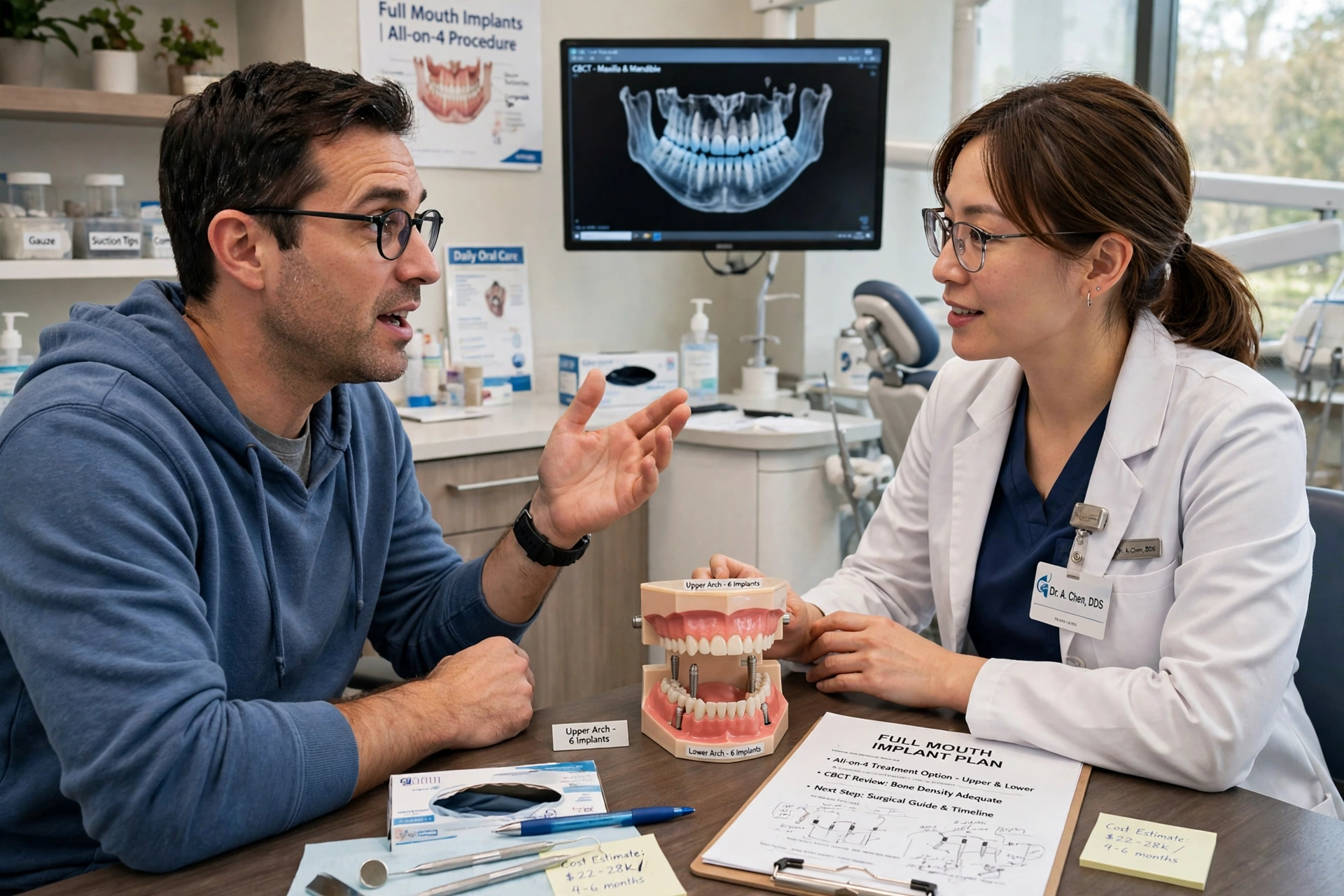
- Image: An adult patient talking with a dentist in a dental office about a full mouth implant plan, with a dental model on the desk between them. AI generated image in a photorealistic style. It is not a photograph of a real person.*

- Image: An adult smiling confidently in natural light, showing a full set of natural looking teeth. AI generated image in a photorealistic style. It is not a photograph of a real person.*