
"All terrain scooters" means different things to different searchers. Some pages list powerful two-wheel electric off-road scooters with fat tires and dual motors; others list seated four-wheel mobility scooters built for riders who need stability on uneven ground. Both are real answers to the same keyword, and this guide covers both, so you buy the right machine for your terrain, not someone else's.
This is a research-based review. We did not ride or lab-test these scooters; every specification below comes from the manufacturer's own published materials or from established review and retail sources. One rule shapes this guide: we only attach a buying link to a product whose exact Amazon listing we could verify against two independent non-Amazon sources. For 2026, exactly one of the six models we researched cleared that bar, the Segway ZT3 Pro. The other five are covered in full below as unlinked comparisons, because they are sold through their makers and dealers, or their listings could not be verified to our standard. We would rather show you one honest link than six doubtful ones.
The Short Answer
If safety certifications and smart features matter more to you than raw speed, the Segway ZT3 Pro is the all-terrain scooter we can point you to with a verified link: UL 2272 and UL 2271 certification, 11-inch off-road tubeless tires, dual suspension, and a 43.5-mile claimed Eco-mode range. If you ride steep, loose terrain and need dual-motor power, the Kaabo models covered below are the stronger machines on paper, but you will buy them direct from the maker or a dealer. And if you need a seated, stable machine, for farm work, mobility, or heavy cargo, skip the two-wheelers entirely and look at the four-wheel options below.
The single most important buying truth: suspension and tires decide off-road ability far more than motor watts do. A high-watt scooter on solid tires will rattle your fillings loose on a rocky trail, while a modest machine with big pneumatic tires and real suspension will glide over the same ground. Buy the suspension, not the wattage badge.
Segway ZT3 Pro at a Glance
| Spec | Segway ZT3 Pro (manufacturer-published) |
|---|---|
| Motor | 650W nominal, 1,600W peak, rear wheel |
| Top speed | 24.9 mph |
| Battery | 597Wh (46.8V, 12.75Ah) |
| Claimed range | 43.5 miles (Eco), about 31 miles (Drive), 18.6 miles (Sport) |
| Charge time | About 4 hours (Flash Charge) |
| Tires | 11-inch off-road tubeless |
| Suspension | Front dual telescopic fork, rear spring |
| Brakes | Dual disc brakes plus electronic brake |
| Weight / capacity | 65.5 lbs / 265 lbs |
| Water resistance | IPX5 body, IPX7 battery pack |
| Certifications | UL 2272 and UL 2271 certified |
| Smart features | AirLock unlocking, Apple Find My, Segway app, traction control |
| Amazon Link | Check Price on Amazon |
All figures are manufacturer claims, not independent test results. The other models researched for this guide (Kaabo Mantis King Pro, Kaabo Wolf Warrior X GT, iScooter iX7Pro, EZRaider HD4, Afiscooter Breeze S4) are compared in prose below, with no buying links, for the reason given in the introduction.

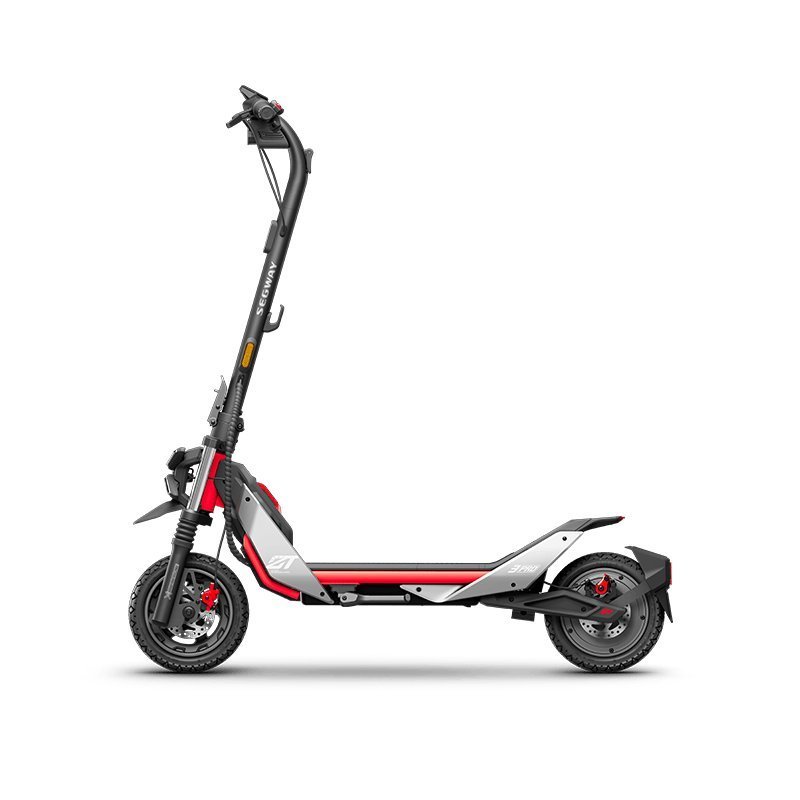

Segway ZT3 Pro
Segway's ZT3 Pro takes a different route to off-road credibility: less brute force, more engineering discipline. The headline that matters most here is not a watt figure. It is the UL 2272 and UL 2271 safety certifications, which cover the electrical system and the battery respectively. For a category with a history of battery fires, a certified pack from a major brand is a genuine differentiator, and it is the main reason this scooter, alone among the six we researched, anchors this guide.
The numbers: a 650W nominal motor with 1,600W peak output driving the rear wheel, a 24.9 mph top speed, and a 597Wh (46.8V, 12.75Ah) battery. Claimed range is 43.5 miles in Eco mode, dropping to about 31 miles in Drive and 18.6 miles in Sport, a useful reminder that range figures are always mode-dependent, and a scooter ridden hard off-road will land near the bottom of that spread. Climbing is rated at up to a 25% grade under Segway's own 75 kg test condition; heavier riders on loose surfaces should expect less. Flash Charge brings a full charge down to about 4 hours, which is quick for this class.
The chassis pairs 11-inch off-road tubeless tires with a dual telescopic front fork and rear spring suspension, plus dual disc brakes with electronic braking assist. Tubeless matters off-road: the tires resist pinch flats and can run the lower pressures that grip loose surfaces. At 65.5 lbs with a 265-lb capacity, the ZT3 Pro is lighter than the big dual-motor machines but still no featherweight, and folding helps with storage rather than with lifting. Water resistance is IPX5 on the body and IPX7 on the battery pack, so rain is fine and deep standing water is not.
The smart layer is unusually complete for the class: AirLock proximity unlocking, Apple Find My integration for anti-theft tracking, Segway app connectivity, a traction control system for slippery surfaces, and an enlarged 3-inch display. One caution worth flagging honestly: Segway also sells a China-market ZT3 Pro variant with notably different figures (around 40 km of claimed range at a much lower launch price). The listing our link points to is the global version reviewed here, with the 43.5-mile Eco range and UL certifications. Check that any listing you compare matches those figures, because the spec differences between regional versions are real.
- UL 2272 and UL 2271 certified electrical system and battery
- 11-inch tubeless off-road tires with dual suspension
- Honest, mode-by-mode range figures (43.5 Eco / 18.6 Sport miles)
- AirLock, Apple Find My and traction control built in
- About 4-hour Flash Charge, fast for the class
Reasons to avoid
- Electronically limited to about 24.9 mph; dual-motor rivals are far faster
- Single motor: less traction and hill headroom than dual-motor machines
- 65.5 lbs is still heavy to carry up stairs
- Real-world off-road range lands near the Sport-mode figure, not the Eco headline
- Motor: 650W nominal, 1,600W peak
- Battery: 597Wh, 46.8V 12.75Ah
- Top speed: 24.9 mph
- Tires: 11-inch off-road tubeless
- Brakes: dual disc plus electronic brake
- Weight: 65.5 lbs; capacity 265 lbs
- Certifications: UL 2272, UL 2271
Best for: Commuters on rough pavement and gravel paths, riders who want certified electrical safety, and anyone who values app features and anti-theft tracking.
How We Chose
Every specification in this guide comes from the manufacturer's own published materials or from established review and retail sources, and no scooter here was ridden or lab-tested by us. The deciding step was link verification: a product only carries a buying link when its exact Amazon listing could be confirmed by two independent non-Amazon sources printing the same ASIN for the same variant. The Segway ZT3 Pro (global version) passed. The five models below did not, for the reasons stated with each one, so they appear as comparisons without links. That is a publishing standard, not a quality judgment: several of them are excellent machines sold through direct and dealer channels.
Also Researched: Five Models Without Verified Links
Kaabo Mantis King Pro
The most completely documented performance scooter in our research: dual 1200W motors (3,360W peak), a 60V 18Ah battery, a claimed 37 mph top speed and 50-mile range, 132mm of adjustable hydraulic suspension travel front and rear, 10 x 3.0-inch pneumatic tires, and 140mm hydraulic disc brakes with ABS, per Kaabo's own published spec sheet. At 75 lbs it is a transport-it, not carry-it, machine. Why no link: Kaabo sells this model direct and through dealers, and we found no Amazon listing whose exact variant could be verified to our dual-source standard. Buy it from Kaabo USA or an authorised dealer if it fits your terrain.
Kaabo Wolf Warrior X GT
The power pick: reported figures of about 3,500W maximum output and a 69-mile claimed range on 10-inch air-filled hybrid tires, aimed at steep, loose climbs and heavy loads. An honesty note: those figures reached us through a single retail roundup and we could not confirm them against a manufacturer spec page, and no verifiable Amazon listing was found. Treat the numbers as provisional, check the current manufacturer spec, and buy through Kaabo's own channels.
iScooter iX7Pro
The value dual-motor option: dual 1000W motors (2,000W total), a claimed 38 mph top speed and up to 50 miles of range, 10-inch off-road tubeless tires, dual suspension, and dual disc brakes with EABS, per iScooter's published manual and store pages. Why no link: only one independent non-Amazon source prints an ASIN for this model, which falls short of our two-source rule. It remains a reasonable budget buy direct from iScooter; just verify the exact variant (iX7 Pro Standard) before ordering.
EZRaider HD4
Not really a kick scooter at all: a stand-on four-wheel electric ATV with 4x4 drive, a retailer-claimed combined 18,000W, up to 25 mph, up to 50 miles of range, 9.6 inches of ground clearance, a 280-lb dry weight and a 441-lb payload. Treat the power figure with skepticism (it is retailer-published, not independently tested), and treat the machine as private-land equipment for farms and worksites. It is sold through specialty dealers, not Amazon, so it carries no link here.
Afiscooter Breeze S4
The seated mobility alternative, from an established mobility retailer's all-terrain roundup: a dual-seat machine with a 450-lb weight capacity, an advanced suspension system, pneumatic wheels, and a control display showing speed, battery and distance. Mobility scooters are heavy and slow by design, and Medicare Part B may cover part of the cost when a doctor determines one is medically necessary, which is a conversation for your doctor, not a retailer. Sold through mobility dealers; no verified Amazon listing was found, so no link.
How to Choose an All-Terrain Scooter
- Start with the surface, not the spec sheet. Broken pavement, gravel and dirt fire roads suit two-wheel scooters; sand, mud and snow push you toward four-wheel machines; getting around your property with limited mobility points to the seated category.
- Suspension and tires before motor watts. Look for pneumatic tires at least 10 inches across, tubeless if you can get them, and real suspension travel with stated figures. Hydraulic suspension with published travel beats unnamed "shock absorption" every time.
- Understand nominal versus peak watts. Nominal power is sustained; peak is the short burst for hills. A "3,500W max" scooter and a "1,600W peak / 650W nominal" scooter are not directly comparable unless you know which number each quotes.
- Range claims are mode-dependent, always. The ZT3 Pro's own spread (43.5 Eco, 18.6 Sport miles) is the honest template. If your regular loop is 20 miles of trail, do not buy a scooter claiming 22 miles.
- Brakes are safety equipment. Prioritise hydraulic discs where offered, and ABS or electronic brake assist, which prevent the wheel lockup on loose gravel that causes most off-road scooter crashes.
- Weight is a real constraint. The two-wheelers here weigh 65 to 75 lbs; the EZRaider is 280 lbs dry. Folding helps storage, not lifting.
- Check safety certifications. UL 2272 (electrical system) and UL 2271 (battery) certifications exist because cheap lithium packs have caused fires. A certified pack from an established brand is worth real money.
- Know your local laws. Speed limits, where you may ride, and helmet and registration rules vary by state and city. A 37-mph scooter is a serious vehicle; make sure you can legally ride what you buy.
The Four Types of All-Terrain Scooter
Dual-motor off-road electric scooters are the performance core: two driven wheels, real suspension, 10-inch-plus pneumatic tires (Kaabo Mantis King Pro, Wolf Warrior X GT). Single-motor trail-capable scooters are lighter, cheaper and often smarter, usually capped around 25 mph (Segway ZT3 Pro; the iScooter iX7Pro is the dual-motor value exception). Four-wheel ATV-style vehicles like the EZRaider HD4 are stand-on quads for private land, farms and worksites. All-terrain mobility scooters like the Afiscooter Breeze S4 are seated, stable, low-speed machines with high weight capacities, a medical-equipment category with its own buying logic. Do not cross-shop the categories against each other.
Common Mistakes Buyers Make
- Trusting anonymous high-spec listings. Generic pages advertise big watt and range figures with no brand, no spec sheet and no company behind them. If a listing cannot show a real manufacturer spec sheet, a real warranty and real safety certifications, its figures are marketing copy, not data.
- Buying watts instead of suspension. A powerful scooter on solid tires is miserable off-road; a modest scooter on 11-inch tubeless tires with real suspension is a joy. Read the chassis specs first.
- Confusing the two product categories. "All terrain scooter" spans 37-mph stand-up machines and seated mobility equipment. Decide which rider you are before you compare models.
- Ignoring weight until delivery day. A 75-lb scooter at the bottom of three flights of stairs becomes a coat rack. Measure your carry, your trunk and your storage first.
- Assuming the claimed range is your range. Manufacturer figures assume Eco modes, light riders and flat pavement. Budget for the bottom of the claimed spread.
- Skipping the legal check. Speed, helmet and where-you-may-ride rules vary by jurisdiction. Check yours before buying, not after a ticket.
Frequently Asked Questions
Generally yes: two driven wheels keep traction when one slips on gravel, sand or wet surfaces, and climb grades that stall single motors. The trade-off is weight, cost and complexity. For occasional gravel paths, a good single-motor scooter with real suspension, like the Segway ZT3 Pro, is plenty.
It varies widely by design: the Segway ZT3 Pro is electronically limited around 24.9 mph, the Kaabo Mantis King Pro claims 37 mph, and high-performance models go faster. Speed is a poor proxy for off-road ability; suspension, tires and brakes matter more on rough ground.
The two-wheelers in this guide are rated around 265 lbs (rider plus cargo); the EZRaider HD4 claims a 441-lb payload; seated mobility scooters like the Afiscooter Breeze S4 go up to 450 lbs. Riding near the limit reduces range and acceleration on every machine.
No, water-resistant is the honest term. Ratings like IPX5 and IPX6 cover rain and splashes, and IPX7 on a battery pack covers brief immersion, but none of these machines should be submerged or ridden through deep standing water.
Anywhere from about 4 hours (the Segway ZT3 Pro's Flash Charge claim) to about 10 hours on a standard charger for larger packs, with optional fast chargers cutting that substantially. Bigger batteries mean longer rides and longer charges.
Medicare Part B may cover part of the cost of a mobility scooter when a doctor determines it is medically necessary. That applies to the mobility category (like the Afiscooter Breeze S4), not to stand-up electric scooters. Discuss it with your doctor, not a scooter retailer.
Large pneumatic tires, 10 to 11 inches at minimum on two-wheelers, tubeless where available. They absorb impacts that solid tires transmit straight to the rider and grip loose surfaces far better. Check tire pressure weekly if you ride rocky or muddy trails.
Final Recommendations
Best for Certified Safety and Smart Features: Segway ZT3 Pro: UL-certified 597Wh pack, 11-inch tubeless tires, dual suspension, Apple Find My
Whatever you choose: buy the suspension before the watts, budget for the bottom of the claimed range, wear a helmet, and check your local laws before the first ride. Specifications are manufacturer or retailer claims compiled from the sources in our research notes, not independent test results. Product photos: Segway manufacturer photography.