
The Nitecore NB10000 Gen 3 is the power bank ultralight hikers keep recommending: a full 10,000mAh in a carbon-fiber shell that weighs 150 grams (5.29 oz), with two USB-C ports, 22.5W fast charging, and an IPX5 splash-proof rating. It is also a premium-priced bank in a market full of cheaper 10K bricks, and a Gen 4 has just been announced. So the real question is whether this specific generation is the one to buy, or whether the older Gen 2, a bigger sibling, or the incoming Gen 4 is the smarter move.
A transparency note up front: this review is research-based, not hands-on tested. We have not carried, charged, or dropped this unit ourselves. Every specification below comes from Nitecore official documentation or reputable review publications (CleverHiker, Pack Hacker, Trail Hiking), and every performance observation is attributed to the reviewer who reported it. Prices are deliberately not stated as fixed figures; they move, so check the current price before you buy.
The Short Answer
The Nitecore NB10000 Gen 3 is worth it if you count grams. At 150 g it is among the lightest true 10,000mAh banks you can buy, with dual USB-C ports (18W in, 22.5W out), pass-through charging, and an IPX5 rating that shrugs off trail rain. CleverHiker named it their best power bank overall after measured testing; Pack Hacker scored it 8.4/10. Skip it if you just need a desk-drawer phone charger: cheaper mainstream 10K banks do that job for less, and the Gen 3 premium is really a weight-and-durability tax. Gen 2 owners should only upgrade if they want the dual USB-C ports and softer corners; everyone else should read the Gen 4 note in this review before buying, because the successor exists.
Nitecore NB10000 Gen 3 at a Glance
| Spec | Detail (manufacturer-published) |
|---|---|
| Capacity | 10,000mAh 3.85V (38.5Wh), Li-ion |
| Rated energy (usable) | 5,400mAh at 5V (typical 2A) |
| Input | USB-C: 5V 2A / 9V 2A / 12V 1.5A (18W max), either port |
| Output | USB-C: 5V 3A / 9V 2.22A / 12V 1.87A (22.5W max) per port; dual ports 5V 3A combined |
| Ports | 2x USB-C (input and output on both), USB-C to USB-A adapter included |
| Weight | 150 g (5.29 oz) |
| Dimensions | 121.9 x 59 x 10.6 mm (4.80 x 2.32 x 0.42 in) |
| Water resistance | IPX5 (sustained low-pressure water jets) |
| Charge indicator | 4 blue LEDs |
| In the box | NB10000 Gen 3, USB-C to USB-A adapter |
| Amazon Link | Check Price on Amazon |
All figures from Nitecore official documentation for the NB10000 Gen 3, cross-checked against published reviews. No prices or availability claims are made in this review.
Nitecore NB10000 Gen 3
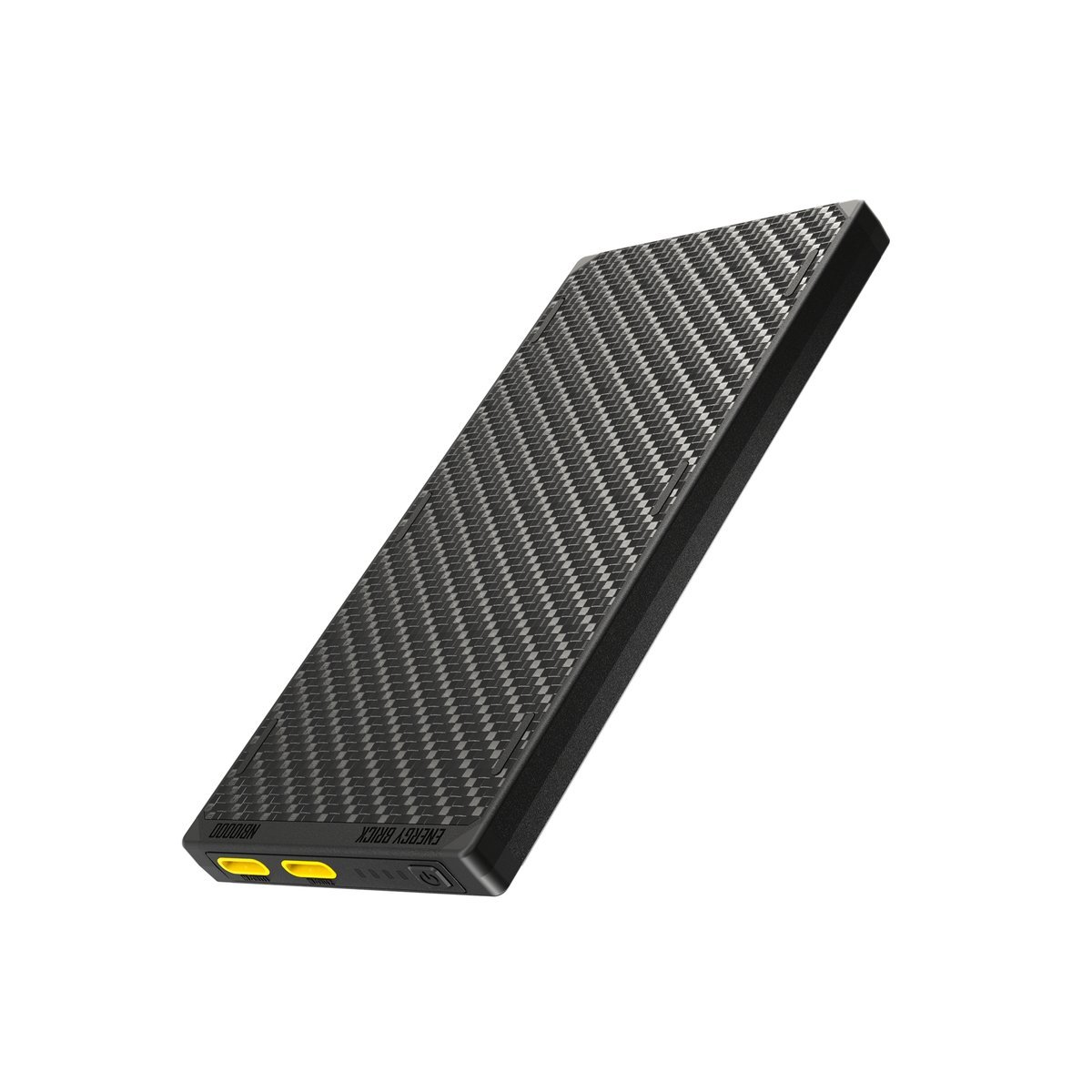
The NB10000 Gen 3 is Nitecore third take on the same idea: cram a genuine 10,000mAh of lithium-ion capacity into the smallest, lightest, toughest package physics allows. The carbon-fiber-reinforced polymer frame is the whole trick. It lets Nitecore hit 150 g (5.29 oz) and a 10.6 mm thickness, roughly 40 percent lighter than a conventional 10,000mAh bank according to Nitecore own comparison. At 4.80 by 2.33 by 0.42 inches, it is thinner than most phones.
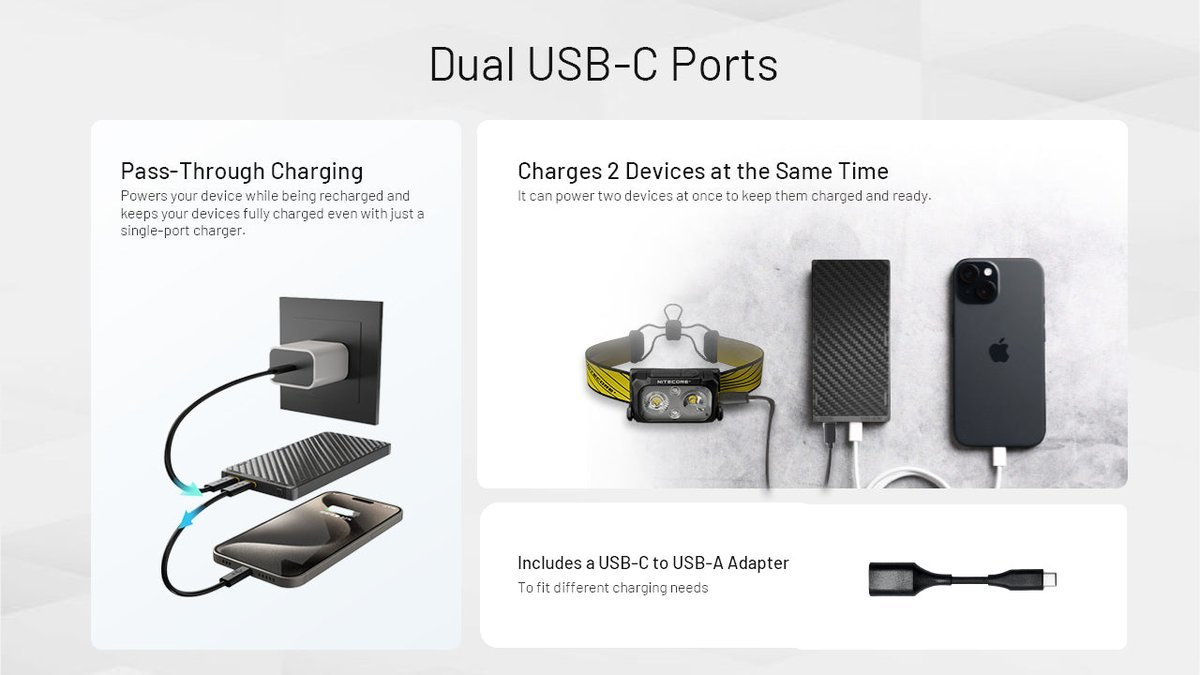
The ports are the Gen 3 real upgrade. It carries two USB-C ports, and each one handles both input and output. Either port recharges the bank at up to 18W; either port charges your devices at up to 22.5W, with combined output capped at 5V 3A when both are in use. Two practical consequences follow, both confirmed across multiple reviews: you can charge two devices at once (phone plus headlamp, the classic backcountry pair), and pass-through charging works, so one wall outlet and one cable handle your whole kit at a hostel or airport. The box includes a USB-C to USB-A adapter, which matters because there is no native USB-A port; as Trail Hiking notes, the adapter is small and easy to misplace.
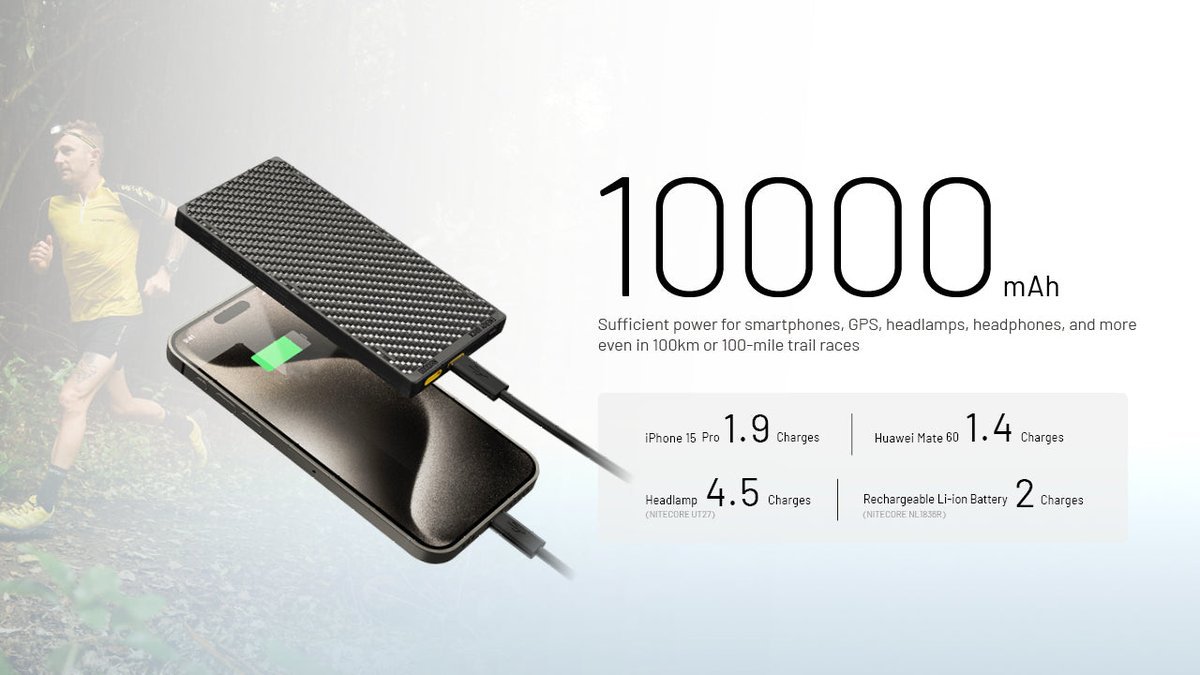
The headline says 10,000mAh. The honest number is the rated energy: 5,400mAh at 5V, Nitecore official figure for what the bank actually delivers after conversion losses. That is not a defect; every power bank loses energy to voltage conversion and heat. What is notable is that Nitecore publishes the figure at all, because most brands do not. In phone terms, Backpacking Routes reports about two full charges for a modern smartphone after real trail use, and recharge time for the bank itself is about 4 hours from empty, reported independently by both CleverHiker (measured) and Trail Hiking.
The carbon shell earns its keep. CleverHiker put the Gen 3 on their scale at 5.3 oz, found it the lightest 10,000mAh bank they tested, and, using a multimeter and dummy load, the most power per ounce of anything in their comparison. Pack Hacker highlights the Gen 3-specific fix: soft corner cushions. The Gen 1 and Gen 2 had genuinely sharp carbon-fiber edges that caught on mesh pockets; Nitecore finally padded them. The IPX5 rating means the bank resists sustained low-pressure water jets: rain, splashes, a spilled drink. It is not submersible; that is IPX7, exactly what the announced Gen 4 upgrades to. The four blue LEDs show remaining charge in coarse bands, and multiple reviewers call that the bank weakest detail at this price.
- Class-leading 150 g weight for a true 10,000mAh bank
- Dual USB-C ports with 22.5W output and pass-through charging
- Publishes its rated energy (5,400mAh at 5V), the figure most brands hide
- IPX5 water resistance and cushioned corners for trail use
Considerations
- Premium price for the 10,000mAh category
- No native USB-A port; the included adapter is easy to lose
- Coarse 4-LED fuel gauge instead of a percentage display
- Reduced efficiency in cold weather, as with all lithium banks
- Capacity: 10,000mAh 3.85V (38.5Wh)
- Rated energy: 5,400mAh at 5V (TYP 2A)
- Output: up to 22.5W per USB-C port
- Input: up to 18W USB-C
- Weight: 150 g (5.29 oz)
- Dimensions: 121.9 x 59 x 10.6 mm
- Rating: IPX5
Best for: Ultralight backpackers, trail runners and travel minimalists who count grams and carry USB-C kit.
How the Alternatives Compare
Nitecore NB10000 Gen 2. The same 10,000mAh idea with an older port layout, USB-A plus USB-C instead of dual USB-C, roughly 20W-class output as documented by reviewers, and the sharp carbon corners the Gen 3 fixed. If you own a Gen 2 and it still holds charge, there is no compelling reason to upgrade. Critical buying note: Gen 2 and Gen 3 are separate listings and separate SKUs, so check the port layout in the listing photos (two USB-C ports means Gen 3) before checkout.
Nitecore NB20000. Double the capacity (20,000mAh) at roughly double the weight (325 g), with USB-A and USB-C ports, PD and QC 3.0 fast charging and IPX5. Pack Hacker scored it 8.0/10. Choose it when your trip is measured in days, not hours; for a weekend hike it is overkill next to the Gen 3.
Nitecore NB Air 5000. Half the capacity (5,000mAh, 3,300mAh rated energy), a feathery 3.14 oz (89 g) and one USB-C port. Backpacking Routes verdict after trail use: enough for about one phone charge, perfect for day hikes and trail runs where the Gen 3 second charge would be dead weight.
Nitecore Carbo 10000. Pack Hacker rates it 8.3/10 and describes it as squeezing 10,000mAh into an exceptionally slim package, ideal for the efficient traveler. Consider it if pocketability matters more than trail toughness. We could not verify its full spec sheet from a credible source, so treat this as a review-based mention and check the listing specs before buying.
The Gen 4 question. Nitecore has announced the NB10000 Gen 4: silicon-carbon cells, 10,000mAh at 39Wh, about 5.0 oz, IPX7 submersion resistance, dual 22.5W USB-C ports and illuminated ports for night use. On paper it improves on the Gen 3 in every dimension that matters. The honest catch: at the time of writing, no official price had been announced and retail availability was spotty. If you need a bank for a trip next week, buy the Gen 3. If your purchase can wait a season, watch the Gen 4 price and availability first. We are not linking the Gen 4 because we cannot verify you can actually buy one.
Gen 3 vs Gen 2: Head-to-Head
Ports: the Gen 3 has two USB-C ports, each for input and output; the Gen 2 has USB-A plus USB-C. Max output: 22.5W on the Gen 3, about 20W on the Gen 2 per reviewer documentation. Corners: cushioned bumpers on the Gen 3, sharp carbon edges on the Gen 2. Water resistance is IPX5 on both, and weight is the same 150 g class. Bottom line: the Gen 3 is objectively the better product, but it is an evolution, not a revolution. Gen 2 owners gain little; new buyers should get the Gen 3, or wait for Gen 4 pricing.
How to Choose a 10,000mAh Power Bank
Rated energy beats nominal capacity
The 10,000mAh figure is the size of the cells inside. Rated energy is what reaches your phone. Two banks with identical mAh ratings can deliver very different real charges, and most brands never publish the rated figure. When a brand does publish it, that is a point in its favor.
Match wattage to your devices
22.5W with USB Power Delivery covers phones, headlamps, satellite communicators and earbuds, and fast-charges a modern phone. It will not meaningfully charge a laptop; that needs a 65W-class bank, a different product category. Check that both cable and device speak the same fast-charging language.
Weigh the weight
A conventional 10,000mAh bank runs 200 to 250 g; the Gen 3 is 150 g. On a multi-day hike, 50 to 100 g saved on every carried item is the ultralight philosophy in action. For a commuter bag, it is irrelevant; buy the cheaper brick.
Read the IP rating correctly
IPX5 (Gen 3) survives water jets and rain. IPX7 (Gen 4) survives 30 minutes under a meter of water. Neither covers saltwater. Match the rating to reality: IPX5 is plenty for hiking; paddlers should want IPX7.
Cold weather and airline rules
Lithium cells lose usable capacity in the cold; Trail Hiking measured roughly 9 percent less from the Gen 3 after a cold night, so sleep with the bank in your bag or pocket. At 38.5Wh, the Gen 3 sits far below the widely used 100Wh carry-on threshold; power banks fly in carry-on only, never in checked baggage.
Nitecore NB10000 Gen 3 FAQs
How many times will the Gen 3 charge my phone?
About twice for a modern smartphone, per Backpacking Routes trail use, consistent with Nitecore own conservative estimates. Expect closer to 1.5 charges for very large phones; conversion losses mean you never get the full 10,000mAh.
What does rated energy 5,400mAh mean?
It is Nitecore official figure for usable energy delivered at 5V, what actually reaches your devices after conversion losses. The 10,000mAh figure is raw cell capacity. Rated energy is the number to compare when shopping.
Can it charge two devices at the same time?
Yes. Both USB-C ports output power, so you can charge a phone and a headlamp simultaneously. Combined dual-port output is capped at 5V 3A, so two devices share the power budget.
Can I recharge the power bank while it charges my phone?
Yes, pass-through charging is supported. Plug the bank into a wall charger and your device into the second port; one outlet handles both overnight.
Is the NB10000 Gen 3 waterproof?
It is IPX5 rated: protected against sustained low-pressure water jets, so rain, splashes and spills. It is not rated for submersion. The announced Gen 4 upgrades to IPX7.
How long does it take to recharge the Gen 3 itself?
About 4 hours from empty over USB-C at up to 18W input, as measured or reported by CleverHiker and Trail Hiking. Overnight charging is the practical routine.
What is in the box?
The NB10000 Gen 3 itself and a USB-C to USB-A adapter for legacy cables. Some retailers bundle a short cable; Nitecore official package centers on the adapter, so confirm with the listing.
Can I take it on a plane?
Yes, in carry-on baggage. At 38.5Wh it is well under the commonly applied 100Wh limit for lithium batteries. Never pack power banks in checked luggage, and confirm current rules with your airline.
Should I buy the Gen 3 or wait for the Gen 4?
If you need a bank now, buy the Gen 3: it is proven, widely reviewed and available. The Gen 4 looks better on paper but had no announced price and unsettled availability at the time of writing. If your trip is months out, wait and compare.
Is the Gen 3 worth it over the Gen 2?
For new buyers, yes: dual USB-C and the corner fix are meaningful. For Gen 2 owners, there is no urgent need: same capacity, same weight class, same water rating.
Final Recommendations
Our pick: Nitecore NB10000 Gen 3, measurably the lightest honest 10,000mAh bank in its class, with dual USB-C and published usable-energy figures.
Buy it if you backpack, travel or commute ultralight, your kit is USB-C, and you want a rain-proof bank from a brand that documents its specs. Skip it if you just need a cheap desk-drawer top-up bank, you already own the Gen 2, you need laptop charging, or your purchase can wait for Gen 4 pricing. Check the current price, confirm the listing is the exact Gen 3 variant (dual USB-C ports, cushioned corners), and it will keep your kit charged for years of trails.
Photo credits: product photography published by Nitecore for editorial review use.