
The Direct Answer: Which Canister Filter Should You Buy?
A canister filter sits outside your tank, usually in the cabinet below, and pushes water through stacked media baskets: mechanical media traps debris, biological media houses the beneficial bacteria that convert ammonia into less harmful nitrates, and chemical media (like activated carbon) polishes the water. Because the media volume is far larger than a hang-on-back filter can hold, canisters are the standard choice for tanks from about 40 gallons up, for messy fish, and for aquarists who want quiet, out-of-sight filtration.
The decision tree:
- Most tanks, 40–70 gallons: Fluval 307. The best balance of flow, media capacity, quiet operation, and serviceability in its class.
- Tanks around 50–100 gallons: Fluval 407. Same design language, bigger everything: 383 GPH pump, 4.2L of basket volume.
One compatibility rule before you shortlist: a canister filter must sit below the aquarium (they are gravity-fed on the intake side), needs clearance for hose routing, and must be matched to your tank's actual stocking, because a heavily stocked cichlid tank needs far more filtration than the same gallons of lightly stocked community fish. The buying guide covers sizing properly.
Quick Picks
Quick Picks
Short on time? These are our top recommendations. Each button takes you to the exact product on Amazon.
| Product | Key Specs | Best Use Case | Standout Feature | Amazon Link |
|---|---|---|---|---|
| Fluval 307 Performance Canister Filter (07 Series, A446) Best Overall |
303 GPH · 40–70 gal · 3.1 L baskets | The default canister for most home aquariums | EZ-Lift baskets; AquaStop valve | Check Price |
| Fluval 407 Performance Canister Filter (07 Series, A449) Best for 100-Gallon Tanks |
383 GPH · 50–100 gal · 4.2 L baskets | Large home tanks where the 307 runs out of headroom | Extra media volume; 07-series serviceability | Check Price |
Specs in this guide are drawn from manufacturer manuals and established aquarium retailers.
Detailed Reviews
1. Fluval 307: Best Overall Canister Filter
The 307 is the middle of Fluval's 07 series, the seventh generation of the best-selling canister line in the hobby, and it hits the sweet spot most buyers actually need. The headline spec is a 303 GPH pump pushing through 3.1 litres of basket volume, with Fluval rating it for 40–70 gallon aquariums. In practice, the number that matters more is the 206 GPH filter circulation figure, the flow with media installed and hoses attached, which is the honest measure of what your tank experiences.
The 07 series' real advantages are in daily ownership. The EZ-Lift media baskets lift out as a single stack with one finger on the centre handle, so you never have to empty the canister of water to service media. The AquaStop valve is twice as strong as the previous generation's and shuts off both hoses with one motion for drip-free disconnection. A vertical pre-filter cartridge with its own access panel catches the coarse debris before it reaches the main stack, which stretches service intervals. Fluval's eTEC pump design runs up to 25% quieter than the previous generation, with enlarged rubber feet for vibration damping, which matters if the tank is in a living room. The filter ships with a full media set (Bio-Foam, Bio-Foam+, carbon, BIOMAX rings, Quick Clear), and Fluval backs it with a 3-year warranty plus a 2-year extension on registration.
Limitations: the 307's 40–70 gallon rating assumes moderate stocking, so heavily stocked or messy-fish tanks at the top of that range should step up to the 407. Replacement media and parts cost more than generic brands'. And like all canisters, it needs cabinet space (9.5" × 7" × 16.5") and below-tank placement. For the mainstream freshwater or marine tank in the most common home sizes, nothing beats this combination of flow, quiet, and serviceability.

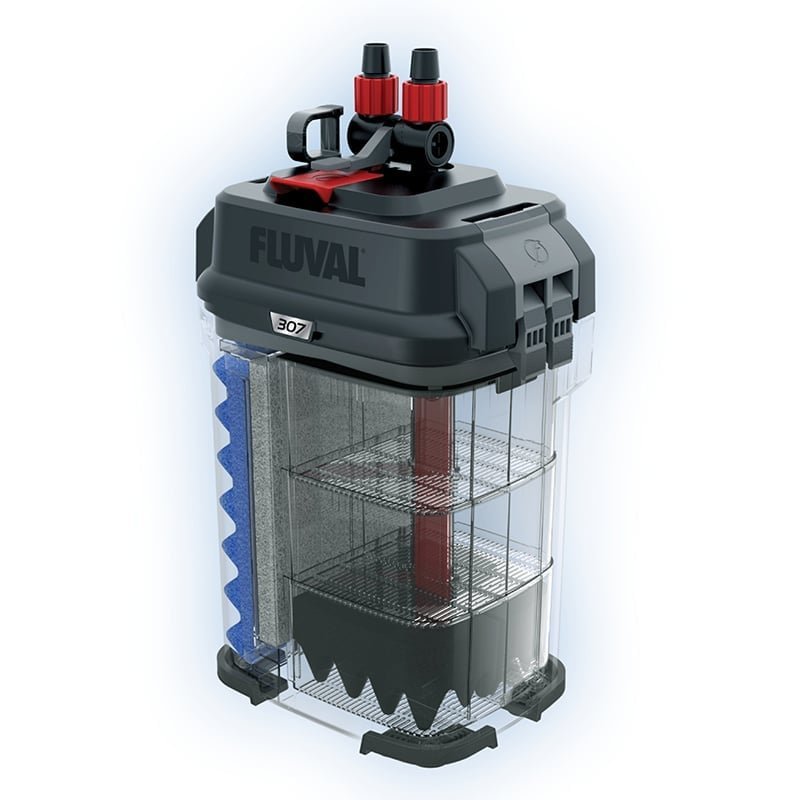
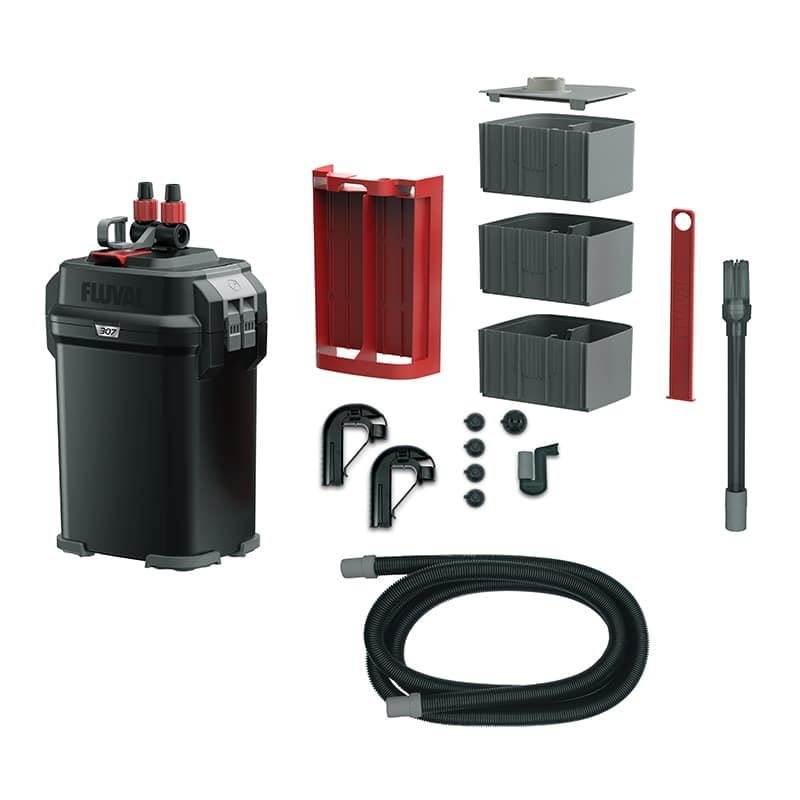
Fluval 307 Performance Canister Filter (07 Series, A446)
The sweet-spot pick for most aquariums: a 303 GPH pump through 3.1 litres of basket volume, EZ-Lift media baskets, an AquaStop valve for drip-free maintenance, and a 3-year warranty.
- 303 GPH pump, rated for 40–70 gallon aquariums
- EZ-Lift media baskets + vertical pre-filter with independent access
- eTEC pump up to 25% quieter than the previous generation; full media set included
Important limitation: The 40–70 gallon rating assumes moderate stocking; heavily stocked tanks at the top of that range should step up to the 407. Replacement media and parts cost more than generic brands, and it needs cabinet space with below-tank placement.
- Model: 307 (07 series, A446)
- Pump output: 303 GPH (206 GPH filter circulation)
- Tank size: 40–70 gallons
Best for: Mainstream freshwater or marine tanks in the most common home sizes
2. Fluval 407: Best Canister Filter for 100-Gallon Tanks
The 407 is the 307's bigger sibling in every dimension: rated for 50–100 gallons, a 383 GPH pump (245 GPH filter circulation), 4.2 litres of basket volume, and a larger vertical pre-filter (1,074 cm² vs 803 cm²). Everything good about the 307 (EZ-Lift baskets, AquaStop valve, Quick Primer, the included media set, the 3-year warranty) carries over.
Buy the 407 when your tank sits at the top of the 307's range, when you keep messy fish (large cichlids, goldfish, turtles) in a 55–75 gallon tank, or when you simply want longer intervals between cleanings, because the extra media volume is the real benefit, not just the extra flow. The cost is size (9.5" × 7" × 19.3"), 23W power draw, and a higher price for capability you may not need on a lightly stocked 55. For tanks genuinely in the 75–100 gallon band, this is the default recommendation.
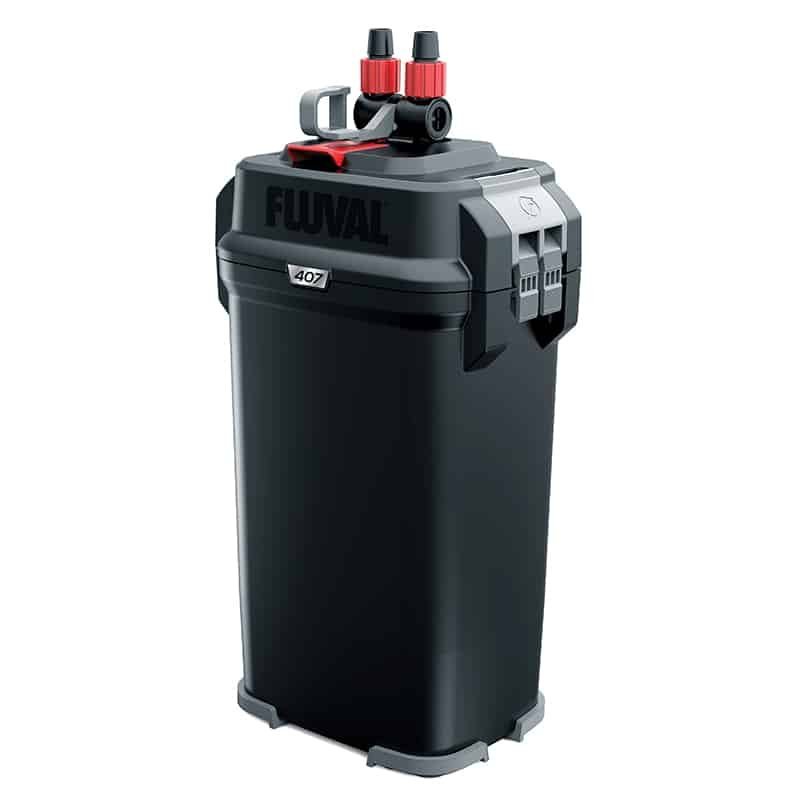
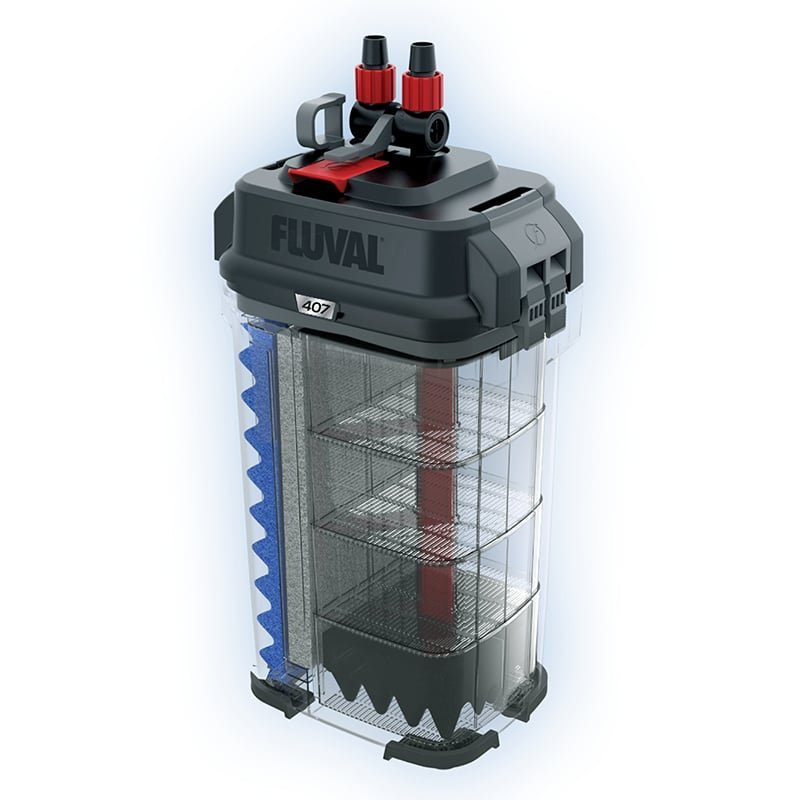
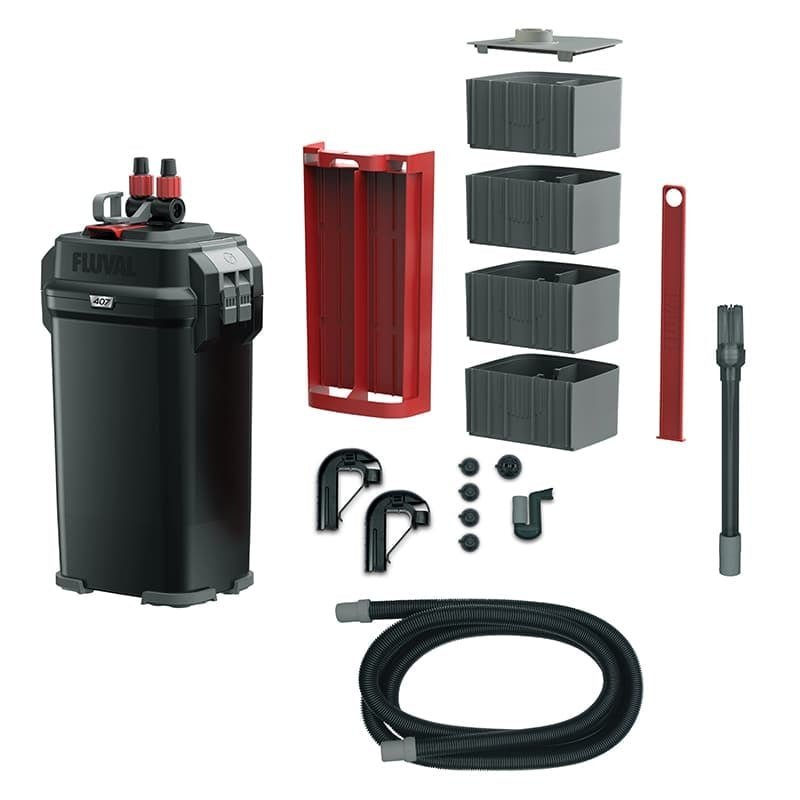
Fluval 407 Performance Canister Filter (07 Series, A449)
The 307's bigger sibling in every dimension: 383 GPH, 4.2 litres of basket volume, rated for 50–100 gallons. It is the default recommendation for genuinely large home tanks.
- 383 GPH pump (245 GPH filter circulation), rated for 50–100 gallons
- 4.2 L basket volume for longer intervals between cleanings
- Same EZ-Lift baskets, AquaStop valve and 3-year warranty as the 307
Important limitation: Big and pricier than needed for lightly stocked 55s; size and cost are the trade-offs. Its 23W power draw is higher than smaller filters.
- Model: 407 (07 series, A449)
- Pump output: 383 GPH (245 GPH filter circulation)
- Tank size: 50–100 gallons
Best for: 75–100 gallon tanks and messy fish in 55–75 gallon tanks
How We Selected These Filters
We did not run these filters on test tanks. Claiming otherwise would be fabrication, and this guide says so plainly. We selected them from manufacturer manuals and spec sheets, established aquarium retailers (Bulk Reef Supply, Sevenports), and the most rigorous independent canister review available (Aquarium Store Depot's 2026 tested roundup, which cut units for noise and build-quality failures), then matched each filter to a distinct buyer: the mainstream tank and the 100-gallon tank. Every spec in this guide traces to manufacturer documentation or an established aquarium retailer; advertised tank-size ratings are reported as stated but sanity-checked against real-world flow in the reviews. Anything a source did not publish is marked as such.
Buying Guide: How to Choose a Canister Filter
Sizing: treat advertised maximums as ceilings
This is the most misunderstood number in filtration. Manufacturers rate filters by tank size, but those ratings assume light stocking and ideal conditions. The honest way to size is by flow relative to your actual bioload:
- Lightly stocked community tank: the manufacturer's rating is roughly honest.
- Moderately stocked tank: size the filter for a tank 25–50% larger than yours (a "70-gallon" filter for a 50-gallon tank).
- Heavily stocked, messy fish (cichlids, goldfish, turtles), or planted tanks with CO2: go one full size up, or run two filters.
Treat every advertised maximum as a ceiling: a filter rated to 92 gallons on the box can deliver real-world flow suited to half that once media and hoses are fitted. When in doubt, oversize. You can always throttle flow down with the valves, but you cannot make an undersized filter grow.
Pump GPH vs. filter circulation: know which number you're reading
Pump flow is the bare pump's output with no media and no hoses. Filter circulation is the flow with media installed, and it is the number your tank actually gets. Fluval publishes both (307: 303 GPH pump, 206 GPH circulation); most brands publish only the bigger number. When comparing across brands, mentally discount pump-only figures by about a third.
Media capacity: the real measure of a filter
More media volume means more surface area for beneficial bacteria, which means a more stable nitrogen cycle and longer intervals between cleanings. Basket volume (Fluval's litres of basket volume) tells you more about real capability than GPH alone. This is why the Fluval 407's 4.2L of baskets matters more than its extra 80 GPH over the 307.
The three filtration stages (and what media does what)
- Mechanical: sponges and pads trap particles. The pre-filter stage (Fluval's vertical cartridge) catches the coarse stuff first and is the part you clean most often.
- Biological: porous media (ceramic rings, sintered glass) house nitrifying bacteria that convert toxic ammonia → nitrite → less-harmful nitrate. Never replace all biological media at once, or you would crash the cycle.
- Chemical: activated carbon removes dissolved organics, odours, and discolouration; it exhausts in weeks and needs replacing. Resins (phosphate removers etc.) are task-specific.
Priming: how the filter starts (and restarts)
Canister filters must be full of water and air-free to start. Self-priming filters (Fluval 07 series Quick Primer, FX Smart Pump) make this a few pumps of a handle. Manual-prime filters need you to fill the canister and establish the siphon yourself: simple once learned, fiddly the first time. If you service your filter often, easy priming is worth paying for.
Noise: the living-room test
Pump hum and vibration are the difference between a filter you forget and a filter you resent. Fluval's 07 series (25% quieter than its predecessor, vibration-damping feet) sets the quiet benchmark in this guide; budget canisters are audibly louder per owner reports. If the tank is in a bedroom or living room, weight noise heavily in your decision: Aquarium Store Depot's 2026 testing specifically cut candidates for noise failures.
Maintenance design: AquaStop valves and EasyClean modules
You will service this filter dozens of times. Features that matter: quick-disconnect valves (Fluval AquaStop) that seal the hoses so you can carry the canister to a sink without spills; separately removable pre-filters so routine rinsing doesn't disturb the biological media; lift-out basket stacks (Fluval EZ-Lift) versus loose layered media that must be reassembled by hand. Ten minutes versus thirty, every month, for years. Do the maths.
UV sterilizers: useful, not magic
A UV stage (built into some budget canisters) clarifies green water by killing free-floating algae and reduces waterborne pathogens. It does not replace biological filtration, it does nothing for algae already attached to glass, and the lamp needs annual replacement to stay effective. Treat UV as a bonus on a budget filter, not a reason to buy one.
Saltwater vs. freshwater
Both filters here work in both freshwater and marine setups, because canisters are mechanically identical across the two. Saltwater tanks generally need more flow and more diligent maintenance for the same volume, so size up, and rinse any filter used near salt spray. (Dedicated reef systems often pair canisters with protein skimmers; that's beyond this guide's scope.)
Canister Filter Types Explained
- Standard multi-stage canisters (Fluval 307/407): the classic format, with mechanical, biological, and chemical media in stacked baskets or layers. The default choice.
- High-capacity / large-tank canisters: bigger pumps, bigger media volumes, self-purging air systems. For 100+ gallon systems.
- Nano canisters (Fluval 107, not reviewed here): the same concept scaled for tanks under 30 gallons. Mentioned for completeness; it sits below this guide's size band.
Head-to-Head: The Comparisons That Decide Purchases
Fluval 307 vs. Fluval 407: the same design at two scales. The 307 (303 GPH, 3.1 L of baskets) suits most 40–70 gallon tanks; the 407 (383 GPH, 4.2 L of baskets) adds flow and media volume for 50–100 gallons and stretches the time between cleanings. If your tank is under 70 gallons and moderately stocked, the 307 is the rational buy; step up to the 407 for messy fish, heavy stocking, or a tank at the top of the 307's range.
Common Buying Mistakes
Buying exactly to the advertised tank size. A "70-gallon" filter on a heavily stocked 70-gallon tank is undersized. Size to bioload, not to the box.
Comparing pump GPH across brands. A 525 GPH pump-only figure from a budget brand and a 303 GPH pump with 206 GPH circulation (Fluval 307) are closer in real performance than the numbers suggest. Compare circulation figures where published; otherwise discount generously.
Ignoring noise until it's humming in your bedroom. Check noise reports before buying, not after installing. This is the most common regret in budget canister ownership.
Replacing all media at once. The fastest way to crash your nitrogen cycle and kill fish. Replace mechanical media as needed; rinse biological media in old tank water, never tap water (chlorine kills the bacteria); never swap it all in one service.
Skipping the pre-filter. The pre-filter is the cheapest maintenance in the hobby: a two-minute rinse that protects the expensive biological media. Separately removable pre-filter modules exist because this step matters that much.
Putting the canister above the tank. Canister filters are gravity-fed on intake; they must sit below the aquarium waterline. Cabinet placement isn't optional, so plan the stand accordingly.
Forgetting hose maintenance. Hoses accumulate biofilm and restrict flow over months. Budget for replacement hose and a pipe brush; a "dying" filter is often just clogged tubing.
Bad Advice We Found Online, Corrected
Search results for canister filters are crowded with thin affiliate roundups that rank anonymous marketplace brands (VEVOR, PONDFORSE, AMOSIJOY, "Fishkeeper") alongside, or above, established manufacturers, with no discussion of parts availability, warranty service, or noise. These are the filters most likely to leave you stranded: when a proprietary impeller or seal fails in year two and no replacement exists, the "bargain" becomes a full repurchase. Contrast that with the one genuinely rigorous result, Aquarium Store Depot's 2026 tested roundup, which cut candidates specifically for noise issues and build-quality failures caught in the field. The filter to trust is the one with a parts diagram, a real warranty, and a manufacturer that answers the phone. Both picks above meet that bar.
Frequently Asked Questions
Match the filter to your tank's gallons and stocking level. For a lightly stocked tank, the manufacturer's rating is roughly honest; for moderate stocking, choose a filter rated 25–50% above your tank size; for messy fish or heavy stocking, go a full size up. When brands disagree, trust flow (GPH circulation) over the gallon rating, and treat maximum ratings as ceilings.
Rinse the pre-filter or mechanical stage every 2–4 weeks; service the full canister every 1–3 months depending on stocking. Never replace all biological media at once, and rinse media in removed tank water, not tap water. If flow drops noticeably between services, check for clogged hoses before blaming the filter.
For tanks over ~40 gallons, generally yes: canisters hold far more media, run quieter, and sit out of sight in the cabinet. Hang-on-back filters win on price, simplicity, and ease of access for small tanks. Many aquarists run both: a canister for primary filtration and a small HOB for polishing or quarantine.
Yes. All the filters in this guide work in freshwater and marine setups. Size up for saltwater (marine bioloads punish weak filtration faster), and consider pairing the canister with a protein skimmer on reef systems. Rinse salt creep off hoses and fittings during maintenance.
A well-made canister (Fluval) with regular maintenance typically lasts 5–10 years or more; impellers and seals are wear parts and should be inspected yearly. Budget filters tend toward the shorter end of that range, and parts availability, not the motor, is usually what ends a filter's life.
The usual causes, in order: trapped air (tilt the canister gently or use the purge/primer to release it), a dirty or worn impeller, vibration against the cabinet (check the rubber feet and reposition), or clogged media straining the pump. A filter that gets louder over months is usually asking for a cleaning, not a replacement.
No. UV is optional. It's useful for persistent green water (free-floating algae) and adds pathogen control, but it doesn't replace biological filtration and does nothing for algae on glass or decor. If green water is your problem, a UV-equipped budget filter is a cost-effective fix; otherwise, don't pay extra for it.
Final Verdict
For most aquariums between 40 and 70 gallons, the Fluval 307 is the best canister filter: the right flow, the best maintenance design in its class, quiet operation, and a warranty that means something. The Fluval 407 is the same formula for bigger tanks.
Size to your bioload, not the box. Clean the pre-filter often. Never swap all your biological media at once. Do those three things and either of these two filters will give you years of clear water.
Final Recommendations
Best Overall: Fluval 307 Performance Canister Filter (07 Series, A446), the 07-series sweet spot for 40–70 gallons
Best for 100-Gallon Tanks: Fluval 407 Performance Canister Filter (07 Series, A449), with bigger everything from the 07 series

