
The wrong fishing kayak is the most expensive kind of cheap. It sits upside-down in the garage because it's too heavy to get on the roof rack alone, too tippy to stand in while casting, or so cramped that your tackle box lives in your lap. The right one, by contrast, is the closest thing to a cheat code in fishing: silent access to water boats can't reach, no fuel bill, no trailer, and a fish finder mounted where you can actually see it.
This guide compares two verified Pelican sit-on-top fishing kayaks for lakes and calm rivers: the stand-up Catch Mode 110 for anglers who want room to fish standing up, and the 44 lb Sentinel 100X Angler for solo loaders who want the lightest hard-shell boat. Every pick is research-based, with specs verified against manufacturer and retailer listings in October 2026. No prices are quoted: kayak prices shift with season and sales, so check the retailer at purchase time.
The Short Answer: Best Fishing Kayaks
If you buy one fishing kayak: the Pelican Catch Mode 110 is the one to beat for most anglers: a 10-foot-8-inch sit-on-top with a wide flat deck you can stand on, three flush-mount rod holders, accessory tracks for a fish finder, and a 375 lb capacity, without pedal-drive pricing. If loading weight is your binding constraint, the 44 lb Pelican Sentinel 100X Angler is the lightest hard-shell fishing kayak here and genuinely car-toppable solo. Below, both picks in detail.
Quick Picks
Short on time? These are our top recommendations. Each button takes you to the exact product on Amazon.
| Product | Key Specs | Best Use Case | Standout Feature | Amazon Link |
|---|---|---|---|---|
| Pelican Catch Mode 110 Best Overall |
10'8" tunnel hull, stand-up deck, 375 lb cap | Lakes, slow rivers, inshore, stand-up fishing | Stand-up stability at a non-pedal price | Check Price |
| Pelican Sentinel 100X Angler Best Lightweight |
44 lb, 9'6", ExoPak storage | Solo trips, ponds, small lakes | Lightest hard-shell fishing kayak | Check Price |
The 2 Best Fishing Kayaks in Detail
1. Pelican Catch Mode 110: Best Overall Fishing Kayak
The Catch Mode 110 earns the top spot because it answers the three questions that matter most for the average buyer: can I stand in it, can I mount my gear, and can I afford it without selling plasma. Pelican built it on a tunnel hull with a wide, flat deck that it describes as a large standing area, and the elevated Ergoboost seat gets your eyes above the waterline for sight fishing.
What the specs say: 10 feet 8 inches long, 34.5 inches wide, and a 375 lb maximum capacity. Listed weight varies across retailer listings, so check the version you buy. You get three flush-mount rod holders, two 4-inch rigging tracks for a fish finder or extra holders, anti-slip deck pads with a built-in fish ruler, and a stern skeg that drops down to help the hull track straight in wind. Pelican backs the hull with a limited lifetime warranty (parts 1 year).
Who it's for: The angler who wants one kayak for lakes, slow rivers and inshore saltwater without going pedal-drive. Stand-up stability is the headliner feature here. That is what separates a fishing kayak from a floating compromise.
Limitation to know: It is a two-person lift or a kayak-cart job for most people. And the listing we verified doesn't mention a paddle, so budget for one separately.
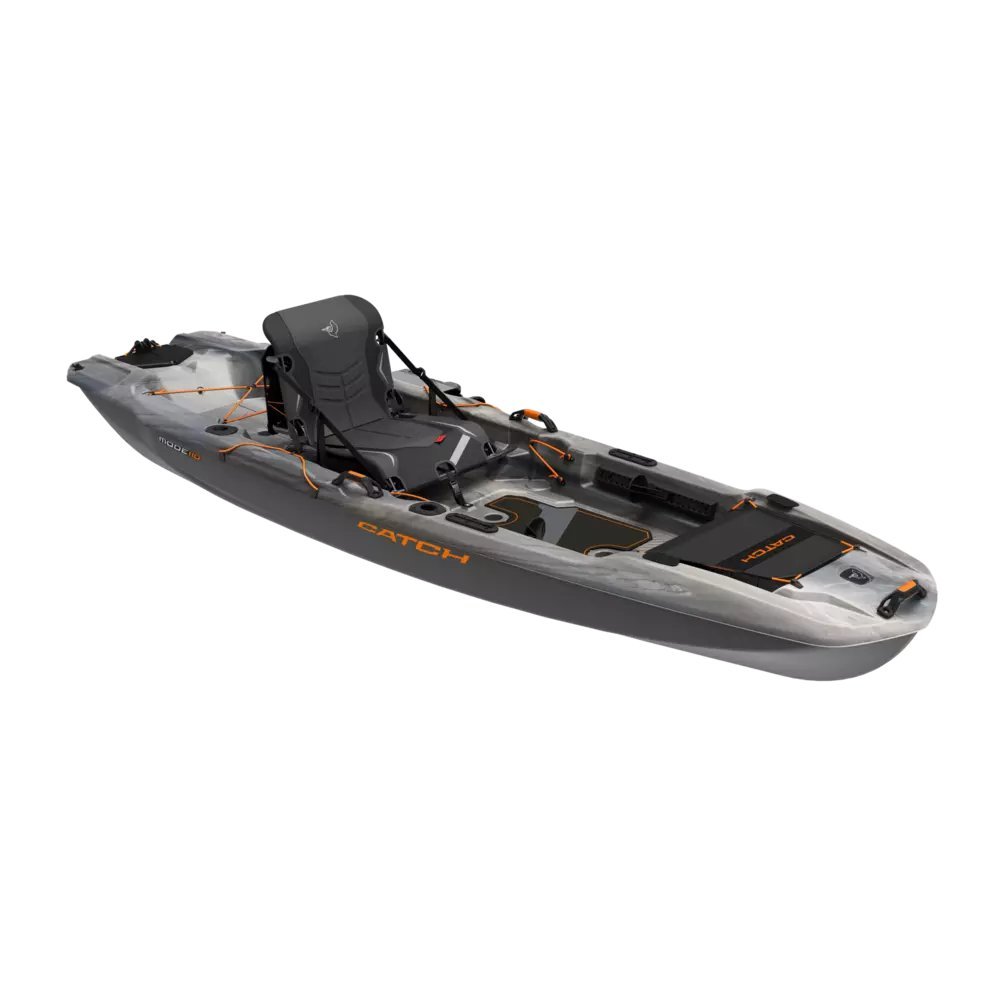


Pelican Catch Mode 110
Answers the three questions that matter for the average buyer: can I stand in it, can I mount my gear, and can I afford it. The tunnel hull gives a wide, flat standing deck, the elevated Ergoboost seat gets eyes above the waterline for sight fishing, and rigging tracks plus rod holders come standard.
- Tunnel hull with wide flat deck for stand-up casting stability
- Ergoboost elevated seat, 3 flush rod holders, 2x 4-inch rigging tracks, anti-slip deck pads with fish ruler
- 375 lb capacity; limited lifetime hull warranty
- Heavier than the 44 lb Sentinel; most people will want a kayak cart or a second person for loading
- No paddle included in the listing; budget for one separately
- Paddle-only: no pedal drive or motor mount for hands-free fishing
- Length / Width: 10'8" x 34.5"
- Capacity: 375 lb
- Hull: Tunnel hull, retractable skeg
Best for: The angler who wants one kayak for lakes, slow rivers and inshore saltwater without going pedal-drive.
2. Pelican Sentinel 100X Angler: Best Lightweight Fishing Kayak
"Lightweight fishing kayak" keeps rising in search for one reason: most anglers load their boat alone, and a 100 lb pedal barge turns every trip into a two-person operation. At 44 lb, the Sentinel 100X Angler is the lightest hard-shell fishing kayak in this guide, and genuinely car-toppable solo.
What the specs say: 9 ft 6 in, 30 in wide, 44 lb, 275 lb capacity, built from Pelican's Ram-X polyethylene. Two flush-mount rod holders, paddle and rod tie-downs, a center console with compartments, a front storage platform with mesh deck cover, and Pelican's ExoPak, a removable storage box that drops into the rear tank well. Multi-chine flat-bottom hull for stability; Pelican says it adds internal flotation to meet or beat ABYC standards. Limited lifetime hull warranty.
Who it's for: Anglers with a sedan and a roof rack, apartment dwellers without trailer storage, and anyone who fishes solo most of the time. This is the kayak you actually use because loading it isn't a workout.
Limitation to know: A 275 lb capacity ceiling, and a short 9'6" hull that is slower over distance: it is a ponds-and-small-lakes specialist, not an open-water boat.
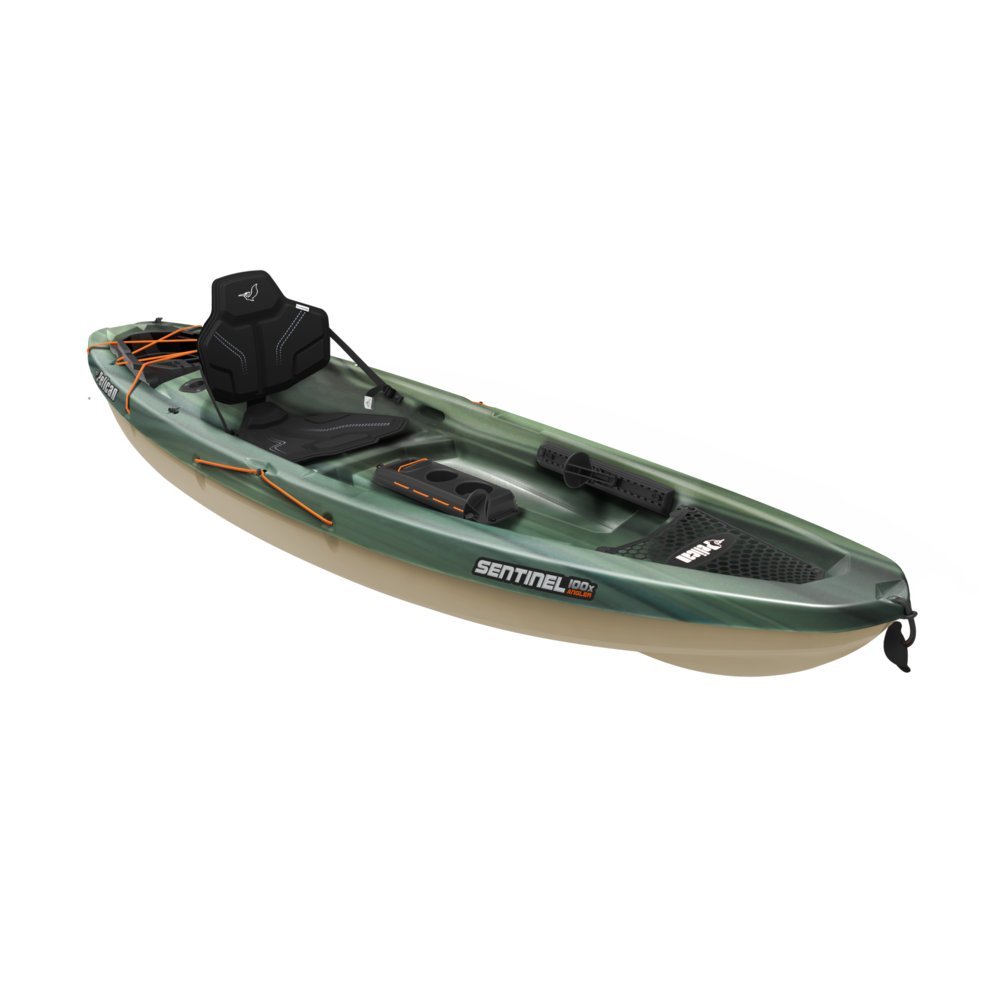
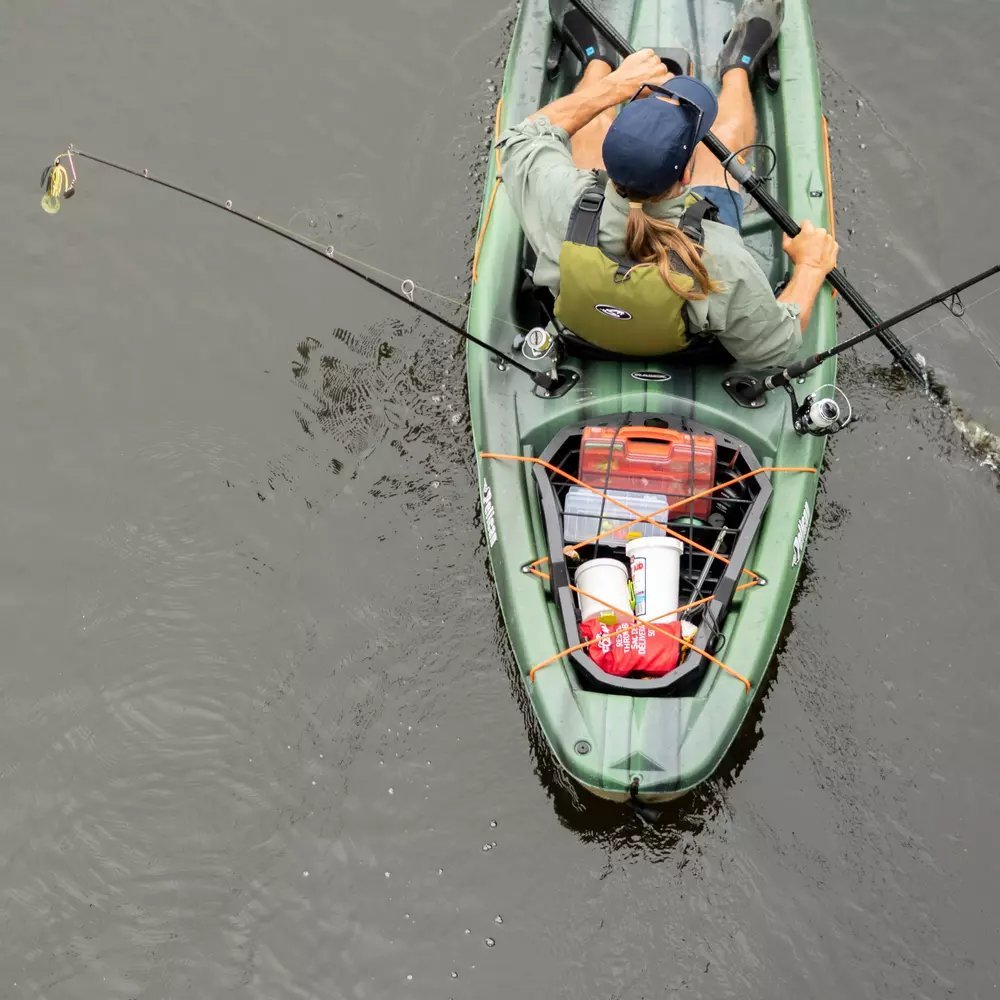

Pelican Sentinel 100X Angler
At 44 lb it's the lightest hard-shell fishing kayak in this guide, and genuinely car-toppable solo. Ram-X polyethylene, multi-chine flat-bottom hull, two flush rod holders, the removable ExoPak storage box, and internal flotation meeting ABYC standards.
- 44 lb, the lightest hard-shell fishing kayak here; solo car-top loading
- Ram-X hull, multi-chine flat bottom, internal flotation (ABYC)
- ExoPak removable storage, 2 flush rod holders, center console
- 275 lb capacity ceiling fills up fast with a bigger angler plus gear
- Short 9'6" hull is slower over distance; a ponds-and-small-lakes specialist, not an open-water boat
- Less deck space and gear capacity than the larger Catch Mode 110, so pack light
- Length / Width: 9'6" x 30"
- Colour: Fade Black Green / Light Khaki
- Weight / Capacity: 44 lb / 275 lb
- Hull: Ram-X, multi-chine flat
Best for: Solo anglers with a sedan and roof rack; apartment dwellers without trailer storage.
How to Choose the Right Fishing Kayak: A Buying Guide
Buy for your water, your body, and your car, in that order. Everything else is optimization.
1. Start with where you'll fish. Ponds and small lakes: a stable short sit-on-top works, and the 9'6" Sentinel is built for exactly this. Slow rivers: prioritize maneuverability and a skeg. Open water, bays and the ocean need length for tracking and stability in chop: the 13-foot class exists for this, and neither pick here is an open-water boat. Hull length is doing real work offshore, so do not take a short calm-water kayak into big water.
2. Be honest about capacity. Add your weight, your tackle, your cooler, your fish finder battery, then leave 20% headroom. A 275 lb limit is plenty for a 180 lb angler with light gear; it's a dealbreaker for a 240 lb angler with a loaded crate. Capacity is the spec beginners underweight most.
3. Decide: paddle, pedal, or motor. Paddle kayaks are cheaper, lighter, simpler, and fine for most anglers. Pedal drives free your hands for fishing and hold position in wind; they cost more and weigh more. Motorized kayaks add speed at the cost of registration requirements in many states (see the FAQ). Pick the propulsion you need, not the one that impresses forums.
4. Test the stand-up claim. "Stand-up stability" is marketing until you stand. Tunnel hulls and wide flat decks (the Catch Mode 110) genuinely support it; narrow budget hulls don't. If sight-casting standing up matters to you, don't buy a boat whose standing platform is a rumor.
5. Check the fish-finder plan. Accessory tracks (the Catch Mode's two 4-inch tracks) turn electronics installation from a weekend project into a ten-minute job. If you plan to add sonar, this matters more than hull color.
6. Measure your transport. Can you lift the Catch Mode 110 onto your roof rack alone? Buy the kayak your vehicle and your back can actually move. This single question disqualifies more dream boats than any review does, and it is why the 44 lb Sentinel exists.
Fishing Kayak Types Explained
Sit-on-top vs sit-in: Every pick in this guide is a sit-on-top, and that's deliberate. For fishing, sit-on-tops dominate because they're self-bailing, easier to get on and off, and more stable for casting. Sit-insides are drier and warmer for cold water but cramped for tackle management.
Paddle vs pedal vs motorized: Paddle = simplest, lightest, cheapest. Pedal = hands-free fishing, better position-holding, heavier and pricier. Motorized = fastest, covers the most water, but adds battery weight, cost, and in many states, registration and licensing requirements.
Inflatable vs hard-shell: Inflatables solve storage and transport completely; hard shells paddle better, last longer, and stand up to hooks and oyster shells.
Length logic: Longer tracks straighter and goes faster; shorter turns easier and transports easier. 9–10 ft for ponds and tight creeks; 12 ft as the versatile middle; 13+ ft for open water.
Reading a Kayak Spec Sheet: What the Numbers Actually Mean
Manufacturer spec sheets reward the buyer who knows how to read them. Length predicts tracking and speed: longer waterlines glide straighter and faster, which is why the 13'2" ocean boats exist. Width predicts primary stability: wider is steadier at rest, narrower is faster. Most fishing sit-on-tops land at 30–36 inches as the workable compromise. Listed weight is the number that decides whether you fish alone or need a buddy; always check whether it's the bare hull or the rigged weight (drives, seats and batteries add up fast). Max capacity is the ceiling, not the target: treat 80% of it as your practical limit. And warranty terms tell you what the manufacturer actually believes about its hull: lifetime hull warranties (Pelican offers one on these hulls) versus limited multi-year terms are a real signal, not fine print.
Head-to-Head: The Comparisons Buyers Actually Ask About
Pedal vs paddle: Pedal wins for hands-free fishing and holding position; paddle wins on price, weight, simplicity and shallow-water access (a drive that lifts out splits the difference). If you fish structure constantly, pedal. If you paddle skinny creeks, paddle.
Cheap vs premium: An entry-price boat gets you on the water; a premium boat gets you there with a drive, a standing deck, tracks and a transducer mount. The honest middle: most anglers use a fraction of premium features. Spend for the features you'll touch every trip (seat, stability, transport), not the ones that photograph well.
Sit-on-top vs sit-in for fishing: Sit-on-top, almost always. Self-bailing decks, easier re-entry after a tip, more deck space for gear. Sit-ins make sense only for cold-weather paddlers who value a dry cockpit above fishing ergonomics.
Inflatable vs hard-shell: Buy the inflatable if storage or transport is the binding constraint; buy the hard shell if performance is. An inflatable is a gateway, not a downgrade, but know which side of the trade you are on.
7 Mistakes Beginners Make Buying a Fishing Kayak
- Buying for the fish, not the car. A 13-foot ocean boat you can't load is a garage ornament. Transport first.
- Ignoring capacity math. Your weight plus gear plus cooler, with headroom. A 275 lb limit is not a suggestion.
- Assuming "stand-up stable" is universal. It's a hull-design claim; narrow budget boats don't have it.
- Skipping the paddle budget. Some listings don't include one. A bad paddle ruins a good kayak.
- Buying a pedal drive for skinny creeks. Drives need depth; check the minimum and the lift-out mechanism.
- Forgetting the life jacket. Budget for a USCG-approved paddling PFD (Type III / Level 70) with the kayak, not after it. This is the one non-negotiable accessory.
- Shopping price alone. The cheapest kayak that fits your water beats the cheapest kayak, period.
Fishing Kayak FAQs
What is the best fishing kayak for beginners? A stable sit-on-top paddle kayak: the Sentinel 100X Angler if light weight matters most, or the Catch Mode 110 if you want stand-up room. Both are forgiving hulls that let you learn balance and boat control without fighting the kayak.
Pedal vs paddle kayak: which is better for fishing? Pedal drives win for hands-free fishing and holding position over structure; paddle kayaks win on price, weight and simplicity. Beginners should start paddle unless they know they'll fish structure constantly.
Can you stand up in a fishing kayak? In boats designed for it, tunnel hulls and wide flat decks like the Catch Mode 110, yes. In narrow budget hulls, no, and trying is how rods go swimming. Check the standing platform, not the marketing.
What size kayak do I need for ocean fishing? Longer is better offshore: 12–13+ ft for tracking and wave handling, with a hull designed for open water (the "13-foot ocean fishing kayak" class). Pair it with a USCG-approved paddling life jacket, every trip.
How much weight capacity do I need? Your body weight plus all gear, with ~20% headroom. The 275 lb Sentinel suits lighter anglers with light loads; bigger anglers or loaded crates need the 375 lb Catch Mode 110.
Do I need to register a motorized fishing kayak? Often, yes. Many states require registration for any motorized watercraft, including electric-motor kayaks, and some waters restrict motors entirely. Rules vary by state and waterway; check your state's boating agency before buying.
Inflatable vs hard-shell fishing kayak? Inflatables win on storage and transport; hard shells win on paddling performance, durability and standing stability. Pick the inflatable if your living situation demands it, the hard shell otherwise.
Bad buying advice to ignore
Search results for "best fishing kayaks" include advice that sounds reasonable and fishes badly:
- "Just buy the cheapest kayak to start." The cheapest kayak that fits your water is fine; the cheapest kayak full stop is how beginners end up in a low-capacity inflatable on a windy reservoir. Match the boat to the water first, price second.
- "Any sit-on-top is stand-up stable." No. Standing stability is a hull-design property, not a category property: wide flat deck, tunnel hull. Narrow budget hulls will dump you.
- "Weight doesn't matter if you have a roof rack." Weight matters every single trip, twice (load and unload). A boat you dread loading is a boat you stop using. The weight difference between these two picks is the difference between a hobby and a chore.
- "You don't need a life jacket if you're a strong swimmer." False and dangerous. A USCG-approved paddling PFD is non-negotiable. Wind can push an empty kayak away faster than you can swim, and cold water incapacitates fast.
The Final Verdict
For most anglers, the Pelican Catch Mode 110 is the best fishing kayak: stand-up deck, real rod holders and accessory tracks, 375 lb capacity, at a price that does not require pedal-drive money. Solo loaders should look at the Pelican Sentinel 100X Angler (44 lb). Buy for your water, your body, and your car, and you will buy right the first time.
Final Recommendations
Best Overall: Pelican Catch Mode 110: the best all-round fishing kayak for most anglers
Best Lightweight: Pelican Sentinel 100X Angler: the lightest hard-shell pick, for solo loaders