
The short version: the Hisense L9Q TriChroma Laser TV is Hisense's brightest and most ambitious ultra short throw projector yet: Hisense rates it at 5,000 ANSI lumens with a 5,000:1 contrast ratio, a 110% BT.2020 triple-laser color gamut, Dolby Vision, and a 116W Devialet-tuned 6.2.2 sound system. It projects an 80 to 200 inch image from inches away. It is the right buy for a bright living room where you want a genuinely massive 4K image without a dedicated dark room. It is overkill, and overpriced, if you watch mostly in the dark; in that case a dimmer, cheaper triple-laser alternative like Hisense's own PX3-Pro leaves budget for a better screen and sound system.
The Hisense L9Q is the flagship of Hisense's L9 laser TV line, announced at CES 2025 in January 2025 as the successor to the L9H. It is sold as a standalone ultra short throw (UST) projector, and also bundled with one of Hisense's ambient light rejecting (ALR) screens in 100, 110, 120, 139, and 150 inch sizes. This review covers the standalone L9Q projector as sold in the US, the version carried on Amazon.
MoleMarket is research-based, not a test lab. We did not unbox, measure, or watch films on an L9Q. This review is built from Hisense's published specifications (the official L9Q spec sheet, Hisense USA's press release, and Hisense's own US store listing), professional reviews including Projector Reviews and Aivanet, and corroborating retailer spec pages. Every figure below is attributed to its publisher; nothing is invented, estimated, or presented as our own testing.
Hisense L9Q at a Glance
| Product | Best for | Key specs | Amazon |
|---|---|---|---|
| Hisense L9Q TriChroma Laser TV | Bright living rooms that need a 100 to 200 inch 4K picture without a dark room | 5,000 ANSI lumens · 4K UHD · 0.18 throw ratio · 116W Devialet sound | Check Price on Amazon |
Best Laser TV for Bright Rooms: Our In-Depth Review
Hisense L9Q TriChroma Laser TV (Standalone Projector)
Editors' Choice
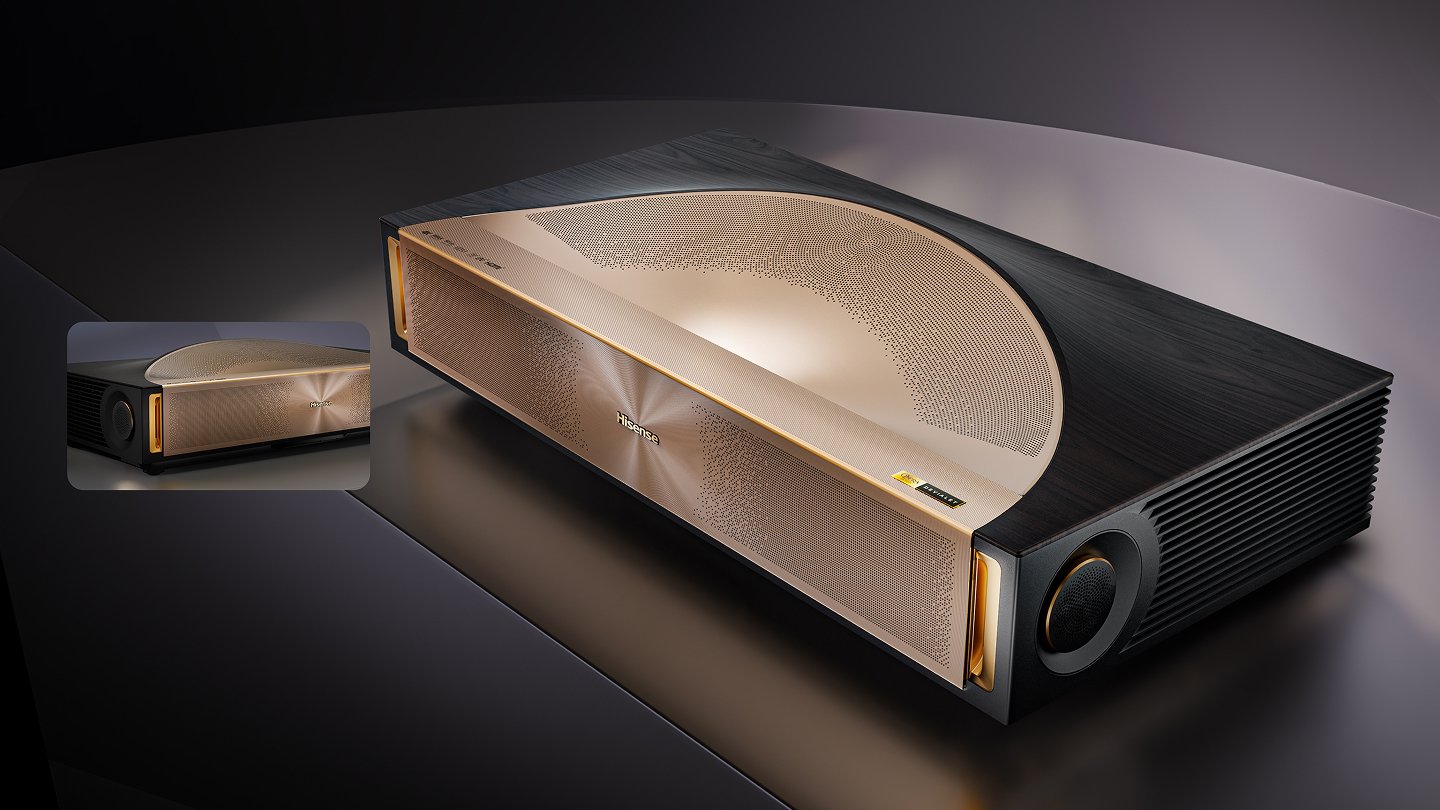


The Hisense L9Q in black with a champagne speaker grille and black walnut top panel: front three-quarter, front, and side views.
Hisense L9Q TriChroma Laser TV
- 5,000 ANSI lumens; 5,000:1 contrast (Hisense ratings)
- 4K UHD (3840 x 2160); RGB triple laser; 110% BT.2020
- 80 to 200 inch image from a 0.18 ultra short throw ratio
- 116W 6.2.2 sound tuned by Devialet; Dolby Vision; Google TV
Reasons to Buy
- Genuinely extreme brightness for a UST projector. Hisense rates the L9Q at 5,000 ANSI lumens, the brightest figure in the current consumer UST category. Professional reviewers describe the picture as bright and refined even in lit rooms, which is the exact scenario UST projectors usually struggle with.
- Triple-laser color with professional validation. The TriChroma RGB laser engine covers 110% of the BT.2020 color space, and Hisense publishes both Pantone and Pantone SkinTone validation. That is a real credential, not marketing fluff: Pantone-validated color is a standard, auditable claim.
- Built-in sound that reviewers single out. The 116W 6.2.2 channel system, tuned by Devialet with calibration by the Opera de Paris, supports Dolby Atmos and DTS:X. Reviewers consistently describe it as the best built-in projector sound they have encountered, which matters because UST projectors often replace the TV entirely.
- A real step up from the L9H. Hisense's own product materials position the L9Q as 67% brighter with a 28% shorter throw ratio (0.18) and an 80 to 200 inch range versus its predecessor. Buyers coming from an L9H get a materially newer product, not a rebadge.
- Complete modern connectivity. Two HDMI 2.1 ports with ALLM, two HDMI 2.0 ports with eARC, Wi-Fi 6E, Bluetooth 5.3, Google TV, and voice control through Google Assistant, Alexa, and Apple HomeKit are all published on the spec sheet.
Reasons to Avoid
- It is far more projector than a dark room needs. If you watch in a light-controlled home theater, 5,000 lumens is overkill. You would be paying for brightness you will never use, and Hisense's cheaper PX3-Pro (also triple laser) would free up budget for a better screen and external audio.
- A small image is nearly impractical. With a 0.18 throw ratio, even a 2.2 inch gap between projector and wall yields an 80 inch image, and a 100 inch image needs only a 5.4 inch gap. Buyers hoping for something modest, like a 75 inch picture, should buy a TV instead.
- The wall matters more than with conventional projectors. At such an extreme throw angle, any warping, texture, or imperfection in the wall shows up in the picture. Hisense sells matching ALR screens separately for a reason; a bare, imperfect wall undercuts what you paid for.
- The size and weight are TV-like in the worst way. At 28.4 pounds and roughly 24.6 by 12.5 by 6.5 inches, the L9Q is a substantial piece of furniture. It needs a low, stable media stand and it cannot be ceiling mounted.
- Price is in premium OLED territory. The standalone projector lists at $6,499.99 on Hisense's own US store (currently discounted there to $4,499.99 at the time of writing). For that money a large OLED or mini-LED TV is the alternative, and TVs need no screen and tolerate imperfect walls.
Who it's best for
The Hisense L9Q is best for the buyer who wants a truly enormous 4K image, 100 inches and up, in a room that is not a dedicated dark theater. If your living room has windows, if movie night competes with lamps, and if you have been eyeing a 98 inch TV but find the price or the logistics daunting, the L9Q is the product in the current UST market most honestly built for you. Hisense's 5,000 lumen rating is the number that matters here: brightness is the single biggest constraint on UST projectors in ambient light, and the L9Q simply starts further ahead than its rivals.
It also suits the buyer who wants one box to replace the TV entirely. The L9Q bundles Google TV, a TV tuner, voice assistants, and a 116W Devialet sound system, so the out-of-box experience is close to a television: plug it in, sign into streaming apps, and watch. Gamers are a secondary fit rather than the primary audience: Hisense publishes a 12 ms input lag figure in Game Mode (1080p at 120 Hz), plus a Game Bar and Turbo Mode, which is respectable for a projector, but dedicated gamers who play competitive titles will still prefer a monitor or a TV with 4K 120 Hz support. Sports fans are a strong fit, since brightness and a huge image are exactly what group viewing rewards. The person who should think carefully is the projector enthusiast with a light-controlled room and a calibrated setup: everything you love about a 2,000 to 3,000 lumen UST in the dark gets diluted when you pay the premium for 5,000 lumens you cannot use. And the person who wants a clean, minimalist living room should know that the L9Q, even with its iF Design Award styling, black walnut panel, and ambient lighting ring, still occupies a big stand directly in front of the screen, with a power cable and HDMI runs to manage. Read more context in our guide to choosing a home theater projector.
Why we recommend it
We recommend the L9Q on the strength of its documented, verifiable advantages over the rest of the UST category. Start with brightness: 5,000 ANSI lumens is not a marginal lead over typical UST projectors in the 2,000 to 3,500 lumen range; it is roughly double what most living-room USTs deliver. That margin is what lets the L9Q hold contrast and color saturation with the lights on, which is precisely the use case where ultra short throw projectors are usually weakest. Next, color: the TriChroma RGB triple-laser engine is a genuine technical distinction from single-laser and laser-plus-phosphor designs. Triple laser means no color wheel, no rainbow effect, and a wider native gamut; Hisense's published 110% BT.2020 coverage, backed by Pantone and Pantone SkinTone validation, puts this in the same color conversation as flagship TVs. The 5,000:1 contrast ratio is modest next to an OLED's infinite contrast, but it is honest for a projector, and professional reviews describe deep blacks for the category. HDR support is complete on paper: Dolby Vision, HDR10+, HDR10, and HLG, plus IMAX Enhanced certification, so you are not gambling on which format your content uses. The audio deserves its own paragraph because it is genuinely unusual. The L9Q carries what Hisense describes as the first 6.2.2 channel surround system in a laser TV: up to 116W, a 15-degree tilted sound bin inspired by Roman amphitheaters, Dolby Atmos, DTS:X, and tuning by Devialet with calibration from the Opera de Paris. Reviewers have described it as the best built-in sound of any projector they have heard, which means many buyers can skip a soundbar entirely. Add practical touches that the spec sheet confirms: auto screen fit with camera-based alignment, a 25,000-hour laser light source life, 350W power draw, a two-year limited warranty, and modern connectivity (HDMI 2.1 with ALLM, Wi-Fi 6E, Bluetooth 5.3, Chromecast, and AirPlay 2). This is the most complete flagship UST package Hisense has published, and the professional-review consensus agrees it looks and sounds the part.
Should you buy it?
You should buy the Hisense L9Q if you have a bright room, a wall or screen large enough for a 100 to 200 inch image, and a budget that stretches to flagship UST pricing. The standalone projector sells on Hisense's own US store for $4,499.99 (listed there at a $2,000 discount from $6,499.99, at the time of writing); Amazon's price for the same unit moves with promotions, so check the current figure before deciding. You get the brightest consumer UST on the market, triple-laser color that is professionally validated, the best built-in projector sound available, and a complete smart TV platform, all from a chassis that looks like furniture rather than office equipment.
You should skip it if your room is dark, your target image is under 100 inches, or your budget is closer to $3,000: in a dark room you are paying a large premium for brightness you will dim away, and Hisense's own PX3-Pro offers the same triple-laser formula at 3,000 lumens for far less, leaving money for the ALR screen and soundbar the L9Q's price leaves no room for. Also skip it if your wall is textured or warped and you will not buy a screen; the L9Q's image depends on a flat surface more than any conventional projector's does. And if you simply want the best 120 inch image money can buy with zero setup fuss, a large mini-LED TV is a legitimate rival at this price, with no screen, no throw-distance math, and no ambient-light caveats. For buyers who decide the L9Q fits, the decision is between the standalone projector (reviewed here) and Hisense's bundles with a matched ALR screen in 100 to 150 inch sizes, which remove the screen-matching guesswork and are priced as a package on Hisense's store.
Spec line: Ultra short throw DLP (0.47" DMD, pixel-shift 4K) · RGB triple laser, LPU Engine 2.0 · 5,000 ANSI lumens · 5,000:1 contrast · 110% BT.2020 · 80 to 200 in · 0.18:1 · 28.4 lb · Google TV · 116W 6.2.2 Devialet audio
How the L9Q compares to its closest alternatives
The L9Q is not reviewed in isolation in the real market, so here is where it sits against the alternatives reviewers most often name alongside it. None of these are fully reviewed in this article; they get text-level coverage because the full photo and link treatment applies only to the reviewed product.
- Hisense PX3-Pro: Hisense's step-down triple-laser UST, rated at 3,000 lumens with an 80 to 150 inch range and Dolby Vision. If you watch in a dark or dim room, professional reviewers have explicitly argued you are better off buying the PX3-Pro and spending the difference on a quality screen and a sound system. Same laser formula, same smart platform family, far lower entry price.
- Epson LS800: a 4,000-lumen 3LCD UST supporting up to 150 inches, running Android TV. The laser-plus-3LCD engine is a different technical approach: very bright, with Epson's historically strong color brightness, but it cannot match triple-laser native gamut. Worth a look if you want brightness but find the L9Q's price hard to justify and prefer Epson's service network.
- Xgimi Aura 2: a smaller, more design-forward UST at 2,300 lumens with a dual-light (laser plus LED) engine and Dolby Vision, covering 80 to 150 inches. It is the pick for buyers who value compactness and aesthetics over maximum brightness; in a bright room it cannot compete with the L9Q on punch.
For the broader projector landscape beyond UST, see our roundup of the best projectors for home theater.
How We Chose
MoleMarket does not run a test lab, so our product research is documentary: we assemble the manufacturer's published data first, then check it against professional reviews and owner reports, and only then write recommendations. For the L9Q we used Hisense's official L9Q spec sheet (published by Hisense USA; the 5,000 lumen, 5,000:1, 0.18 throw, 80 to 200 inch, 116W Devialet, and UPC 888143023823 figures all come from it), Hisense's CES 2025 launch press release (January 3, 2025), Hisense's own US store listing with its current pricing and bundle structure, the Hisense L9Q user manual, and professional reviews from Projector Reviews and Aivanet. Every factual figure in this article is attributed in the text; anything we could not verify from a published source was left out rather than estimated.
How to Choose a Laser TV (UST Projector)
Ultra short throw projectors, often sold as "laser TVs," sit inches from the wall and throw a huge image upward. The buying logic differs from conventional projectors, so here is how to choose.
Buy for your room's light, not for bragging rights. Brightness (lumens) matters most in ambient light. In a dedicated dark theater, 2,000 to 3,000 lumens is plenty and contrast matters more; in a living room with windows, 3,500 to 5,000 lumens is the honest requirement. The L9Q's 5,000 lumens exist for the bright-room buyer.
Budget for the screen. A UST projector without a screen is only half a product. Ambient light rejecting (ALR) screens designed for ultra short throw reject ceiling light and preserve contrast; they typically cost $1,000 to $2,500 for 100 to 120 inches. Hisense sells matched ALR screens in sizes from 100 to 150 inches, and bundles with the L9Q. A textured or warped wall will show every flaw at a 0.18 throw ratio, so if you will not buy a screen, reconsider.
Check the throw math before you buy furniture. At 0.18:1, a 100 inch image needs roughly a 5.4 inch gap from the wall, while a 150 inch image needs more depth and a bigger stand. Measure your media console and wall before ordering; the projector is 24.6 inches wide and 28.4 pounds.
Sound is part of the value calculation. Most UST projectors have mediocre built-in audio, which pushes buyers toward soundbars. The L9Q's 116W Devialet system is the exception that reviewers praise, so factor a soundbar's cost (and its cable clutter) into comparisons with cheaper projectors.
Smart platform and gaming. Google TV with Netflix, Disney+, and the rest built in means no streaming stick; HDMI 2.1 with ALLM and 12 ms game mode make the L9Q viable for casual gaming. Competitive gamers should still prioritize a TV or monitor.
Laser life and warranty. A 25,000-hour laser source means no lamp replacements over the projector's realistic lifetime. Confirm the warranty terms in writing; Hisense's spec sheet states a two-year limited warranty for the L9Q.
Frequently Asked Questions
Is the Hisense L9Q worth the money?
It is worth it for the buyer it was built for: someone who wants a 100 to 200 inch 4K image in a room with ambient light, where its 5,000 lumen rating and triple-laser color actually get used. Hisense's own US store lists the standalone projector at $4,499.99 (a $2,000 discount from $6,499.99) at the time of writing, so it is firmly a premium purchase. For a dark room, professional reviewers have argued the cheaper Hisense PX3-Pro plus a good screen and sound system is the smarter use of the money.
How bright is the Hisense L9Q?
Hisense rates the L9Q at 5,000 ANSI lumens with a 5,000:1 contrast ratio, the highest brightness figure published for any current consumer ultra short throw projector. Professional reviewers describe the picture as bright and refined in lit rooms, which is the scenario this brightness is designed for.
Does the L9Q need a screen, or can it project on a wall?
It can project on a wall, but Hisense's product line assumes a screen: the L9Q is sold in bundles with matched ALR screens in 100 to 150 inch sizes, and the projector supports 80 to 200 inches. At a 0.18 throw ratio, any wall warping or texture shows up in the image, so an ALR screen is strongly recommended for the picture quality the price implies.
Is the Hisense L9Q good for gaming?
Reasonably good for casual gaming: Hisense publishes a Game Mode with 12 ms input lag (at 1080p/120 Hz), plus a Game Bar and Turbo Mode for motion, and the projector carries two HDMI 2.1 ports with ALLM. Competitive players will still prefer a TV or monitor with higher refresh rates and lower lag, but for couch gaming on a 150 inch image it is well equipped.
What is the difference between the Hisense L9Q and the L9H?
The L9Q is the CES 2025 successor to the L9H. Hisense's own comparison materials position it as 67% brighter (5,000 vs the L9H's lower rating), with a shorter 0.18 throw ratio (28% shorter, per Hisense), an 80 to 200 inch projection range, and a wider 110% BT.2020 color gamut (about 3% wider). It also adds the LPU Digital Laser Engine 2.0 with AI picture processing and the 116W 6.2.2 Devialet sound system.