
Researched October 2026
The short version: an air purifier can capture mold spores floating in your room's air, but it cannot remove mold growing on a surface or fix the moisture feeding it. The Coway Airmega AP-1512HH Mighty (White) is the best all-round choice: strong independently verified CADR, honest medium-room coverage, and True HEPA filtration built for particle capture. For large rooms and basements, the PuroAir 400's HEPA 14 filtration covers far larger rooms. Serious or visible mold always needs professional remediation first; a purifier runs alongside that work, not instead of it.
The Direct Answer: Which Air Purifier Should You Buy for Mold?
Buy the Coway Airmega AP-1512HH Mighty (White) if you want the safest, most proven choice for a bedroom, home office, or living room where airborne mold spores are part of the concern. Its CADR ratings are independently verified (233 smoke / 246 dust / 240 pollen), it is honestly rated for rooms around 361 square feet, and its True HEPA plus deodorization filter stack targets exactly what matters here: fine airborne particles.
Buy the PuroAir 400 instead if the space is large: a basement, an open-plan living area, or a room well over 400 square feet. Its HEPA 14 filter and far larger airflow are built for volume, though its filters need replacing roughly every 90 days on PuroAir's own guidance, so the running cost is real.
And if the unit will live in a bedroom, the Levoit Core 300-P (White) is the quiet, no-frills pick with verified CADR and a sleep mode near 24 dB.
One sentence to carry through this whole guide: a purifier cleans the air; only fixing moisture and removing growth cleans the mold. The rest of this guide explains the filtration facts, the honest room-size math most marketing hides, and exactly where each of these three earns its place.
Quick Picks
Short on time? These are our top recommendations. Each button takes you to the exact product on Amazon.
| Product | Key Specs | Best Use Case | Standout Feature | Amazon Link |
|---|---|---|---|---|
| Coway Airmega AP-1512HH Mighty (White) Best Overall |
True HEPA, 233/246/240 CADR, 361 sq ft | Best overall | The default recommendation for years: honest numbers, proven filtration | Check Price |
| PuroAir 400 Best for Large Rooms and Basements |
HEPA 14, up to 2,000 sq ft, 90-day filters | Large rooms | The large-room pick for basements and big open spaces | Check Price |
| Levoit Core 300-P (White) Best Simple Bedroom Pick |
True HEPA, 222 sq ft, manual | Simple bedroom | The simple bedroom pick: True HEPA with no complexity | Check Price |
Detailed Reviews
Coway Airmega AP-1512HH Mighty (White), Best Overall
The AP-1512HH has been the default recommendation in independent air-purifier roundups for years, and the reason is boring in the best way: nothing about its core numbers is inflated. Coway's US store page states CADR of 233 (smoke), 246 (dust), and 240 (pollen) cfm, and rates the unit for 361 square feet at 4.8 air changes per hour, the honest, standard basis.
The filtration stack is a pre-filter (washable, catches the big stuff), a deodorization filter, and a True HEPA filter rated at 99.97% of 0.3-micron particles, plus a Vital Ion ionizer that is switchable and can be left off. That matters because mold spores are particles, and particle capture is the whole job here. The auto mode with its pollution sensor and color-coded LED is genuinely useful rather than decorative: set it and the unit manages its own fan speed. Eco mode stops the fan after 30 minutes of clean air in Auto mode, and the 1, 4, or 8-hour timer covers scheduled runs. At the low end it runs around 24.4 dB, quiet enough for a bedroom.
Limitations. There is no Wi-Fi or app control; everything happens on the unit. At top speed it is noticeably loud (up to 53.8 dB), which is the price of moving that much air. The deodorization filter needs replacing roughly every 6 months and the HEPA roughly yearly, so budget for two consumables, not one. And 361 square feet is the honest ceiling: this is not the unit for a big open basement.
Who should skip it: anyone needing to cover a large open space (see the PuroAir 400), and anyone who wants app control and smart-home integration.

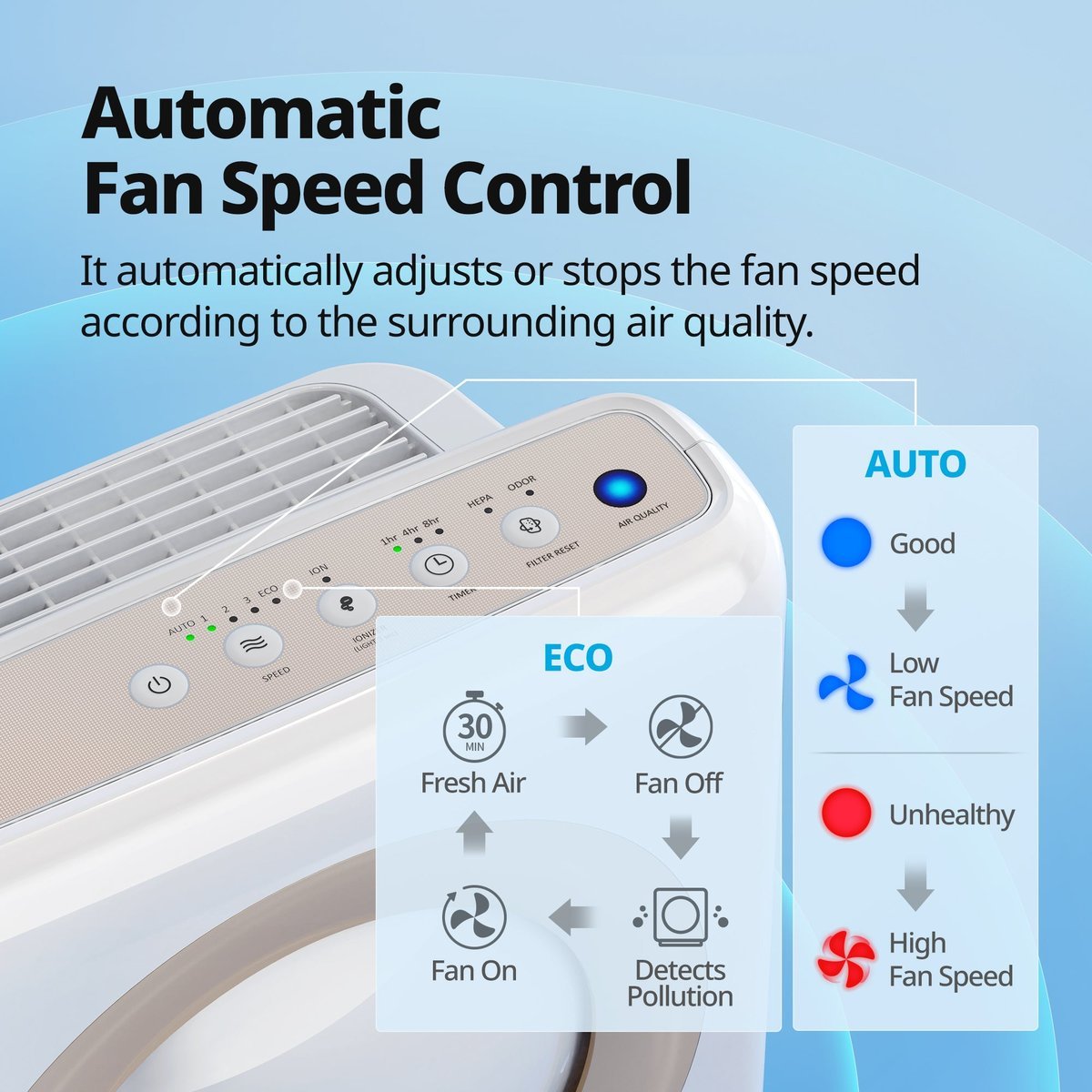

Coway Airmega AP-1512HH Mighty (White)
The default recommendation in independent air-purifier roundups for years, boring in the best way: nothing about its core numbers is inflated. CADR of 233 (smoke) / 246 (dust) / 240 (pollen) cfm, rated for 361 square feet at 4.8 air changes per hour. Pre-filter (washable), deodorization filter, and True HEPA at 99.97% of 0.3-micron particles, plus a switchable Vital Ion ionizer. The auto mode with pollution sensor is genuinely useful; Eco mode stops the fan after 30 minutes of clean air.
- CADR 233/246/240 cfm, honest numbers, 361 sq ft at 4.8 ACH
- True HEPA 99.97% of 0.3-micron particles plus washable pre-filter plus deodorization
- Auto mode with pollution sensor and color-coded LED, Eco mode, 1, 4, or 8-hour timer
- 24.4 dB at the low end, quiet enough for a bedroom
- No Wi-Fi or app control, everything happens on the unit
- Loud at top speed, up to 53.8 dB, the price of moving that much air
- Two consumables to budget: deodorization roughly every 6 months, HEPA roughly yearly
- 361 square feet is the honest ceiling, not for big open basements
- CADR: 233/246/240 cfm
- Coverage: 361 sq ft at 4.8 ACH
- Filter: True HEPA plus pre-filter plus deodorization plus Vital Ion
- Noise: 24.4 to 53.8 dB
- Size: 9.6 x 16.8 x 18.3 in, 12.5 lb
- Power: 77 W
Best for: Mold-concerned buyers wanting the proven all-rounder
PuroAir 400, Best for Large Rooms and Basements
Basements are the classic mold-concern room: below grade, often damp, and usually larger than a bedroom purifier can honestly serve. The PuroAir 400 is built for that job. Its HEPA 14 filter is a grade above standard True HEPA, and PuroAir states, citing independent ISO 17025 lab testing, that it captures up to 99.9% of airborne particles as small as 0.1 microns, including mold. The 3-layer system adds a pre-filter mesh and an activated-carbon layer for odors and gases, which matters because musty basement smell is a gas-phase problem HEPA alone cannot touch.
Coverage is the headline: PuroAir rates it for up to 2,000 square feet in one hour, based on its own ISO 17025 lab testing at typical residential ventilation rates. That is the largest coverage claim in this roundup, but it remains a lab-based figure; in a real basement with clutter and poor circulation, expect less. It includes a smart particle sensor with auto mode, a sleep mode that runs the quietest fan speed with dimmed lights, a 2, 4, or 8-hour timer, and CARB, ETL, ISO, and UL certifications. Lowest noise is 31 dB per PuroAir's own store page, and the warranty runs 2 years.
One honest conflict to flag: PuroAir's site recommends replacing filters about every 90 days, while the printed manual's generic guidance runs 6 to 8 months. This guide budgets on the 90-day cycle, the more conservative manufacturer-current figure, so four filter sets a year is the running cost to plan for.
Limitations. The big one is running cost: on the 90-day cycle, four filter sets a year is the most frequent cycle in this roundup. It is also the largest and heaviest unit here (14.7 lb, 21.5 inches tall). The CADR figures (138/181/163) come from third-party spec tables rather than PuroAir's own publications, so treat them as approximate. And the 2,000-square-foot figure is a one-hour lab number, not a promise for a cluttered real basement.
Who should skip it: anyone purifying a single bedroom (overkill, and the 90-day filter cycle is expensive overkill).


PuroAir 400
The large-room pick: built to cover big spaces and basements where the compact units give up. HEPA 14 filtration at 99.9% of particles down to 0.1 microns on an ISO 17025 lab basis, a 3-layer system with activated carbon for odors, and the largest coverage claim in this roundup at up to 2,000 square feet in one hour.
- HEPA 14, 99.9% of particles down to 0.1 microns, ISO 17025 lab basis
- Up to 2,000 square feet in one hour, the largest coverage here
- 3-layer system: pre-filter plus HEPA plus activated carbon for particles and odors
- Auto mode with smart particle sensor, sleep mode, 2, 4, or 8-hour timer, 31 dB lowest, 2-year warranty
- Most frequent filter cycle in the roundup on the budgeted 90-day cycle: four sets a year
- Largest and heaviest here: 14.7 lb, 21.5 inches tall
- CADR figures from third-party spec tables, treat as approximate
- 2,000 square feet is a one-hour lab figure; real rooms with clutter and poor circulation deliver less
- Coverage: Up to 2,000 sq ft in one hour
- Filter: HEPA 14 plus carbon, 90-day cycle budgeted
- Noise: 31 dB lowest (PuroAir store page)
- Size: 14.4 x 8.1 x 21.5 in, 14.7 lb
- Power: 80 W
- Warranty: 2-year
Best for: Large rooms and basements
Levoit Core 300-P (White), Best Simple Bedroom Pick
Some buyers do not want sensors, apps, or auto modes: they want a quiet box that cleans bedroom air and otherwise stays out of the way. The Core 300-P is the best version of that idea in this roundup. Its CADR is AHAM VERIFIDE at 143 (smoke) / 153 (dust) / 167 (pollen) cfm, and Levoit rates it for 222 square feet at 4.8 air changes per hour, a real bedroom number, not a marketing number. (Levoit also publishes an up to 1,074 sq ft figure; that is the one-air-change-per-hour number, and you should ignore it for sizing purposes.)
The 3-stage filter combines a pre-filter layer, a particle filter Levoit describes as HEPA-grade at 99.97% efficiency for 0.1 to 0.3 micron particulates, and an activated-carbon layer. Levoit sells interchangeable filter variants (Toxin Absorber, Smoke Remover, Pet Allergy) if your concern shifts. Sleep mode drops noise to about 24 dB with the display light off, genuinely bedroom-quiet, and the timer, filter reminder, and 56 W power draw are all sensibly simple. Two-year limited warranty.
Limitations. There is no air-quality sensor, no auto mode, and no app: fan speed is manual, always. The carbon layer is modest, so it is not the pick for strong musty odors. Filters need replacing roughly every 6 to 8 months. And 222 square feet is the ceiling: stretch it into a living room and it will be underpowered.
Who should skip it: anyone who wants automation, and anyone covering more than a bedroom.

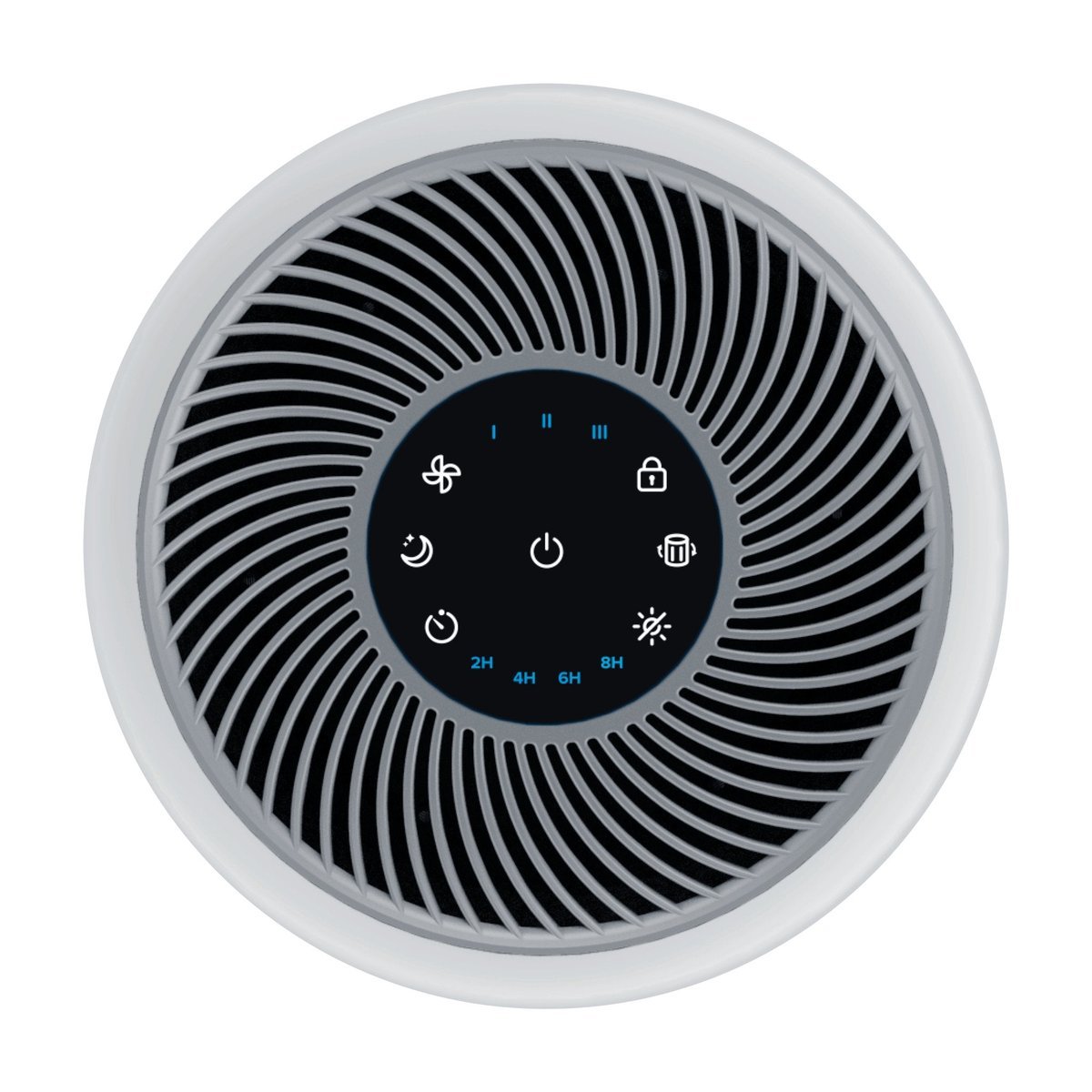
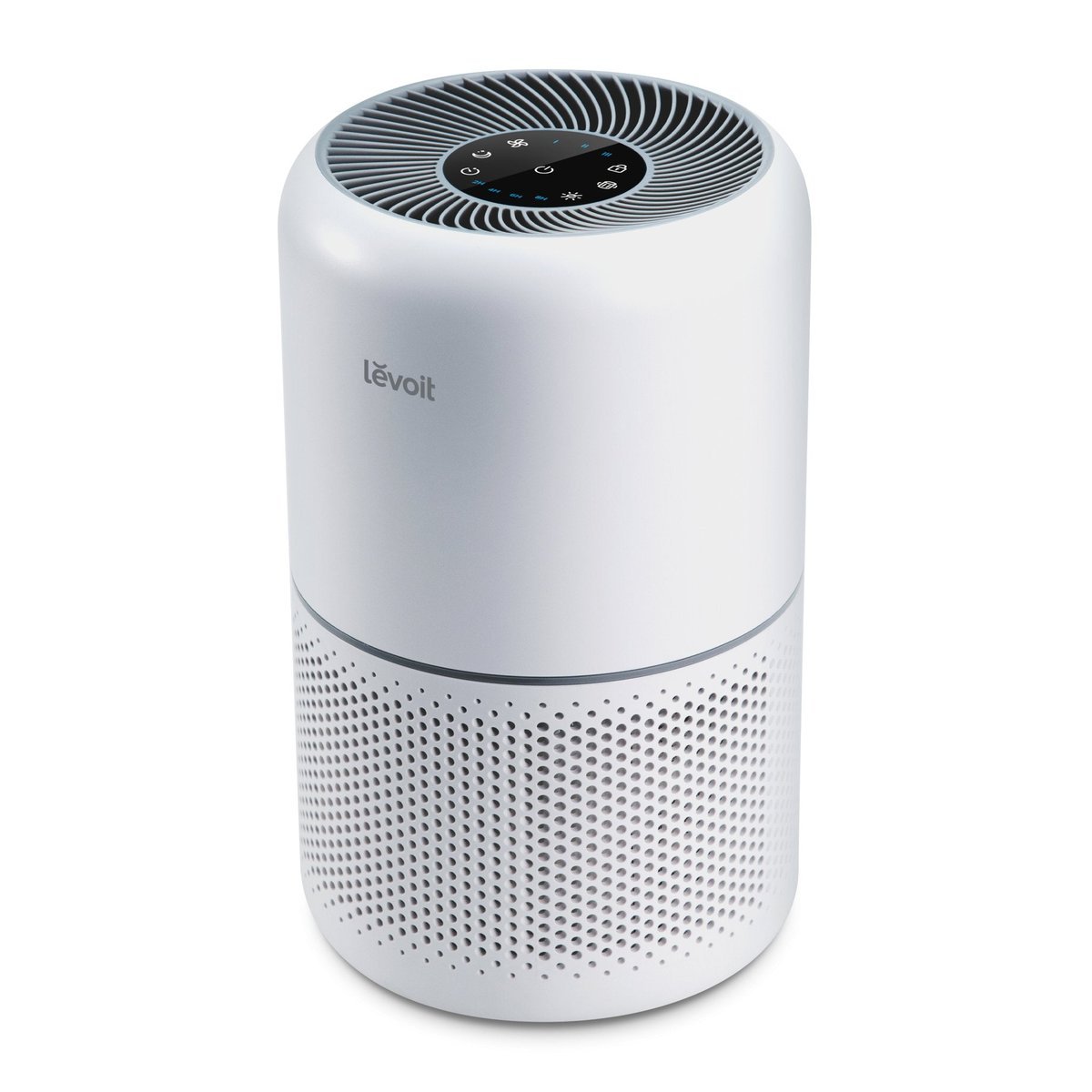
Levoit Core 300-P (White)
The simple bedroom pick: a straightforward True HEPA purifier with manual fan speed, no sensor, no auto mode, no app. Just clean air, quietly, in a bedroom-sized package, with AHAM VERIFIDE CADR and a 24 dB sleep mode.
- AHAM VERIFIDE CADR 143/153/167, honest 222 sq ft at 4.8 ACH
- 3-stage filtration: pre-filter, HEPA-grade 99.97% for 0.1 to 0.3 micron particulates, activated carbon
- Interchangeable specialty filters: Toxin Absorber, Smoke Remover, Pet Allergy
- Sleep mode 24 dB with display off, genuinely bedroom-quiet, plus timer and 2-year warranty
- No air-quality sensor, no auto mode, no app: fan speed is manual, always
- Modest carbon layer, not for strong musty odors
- Filters every 6 to 8 months
- 222 sq ft ceiling: underpowered in a living room
- CADR: 143/153/167 cfm, AHAM VERIFIDE
- Coverage: 222 sq ft at 4.8 ACH
- Filter: 3-stage HEPA-grade plus carbon, 6 to 8 months
- Noise: 24 dB sleep mode
- Size: 8.7 x 8.7 x 14.2 in, 7.9 lb
- Power: 56 W
Best for: Bedrooms needing simple, quiet purification
How We Selected These Purifiers
MoleMarket did not hands-on test these units. Each pick was selected through a research process: we pulled the models that recur across current independent US buying guides for mold-related air purification, then verified every specification quoted above against manufacturer product pages, user manuals, or reputable third-party spec data. Where manufacturer figures conflicted with independent measurements, most notably the room-coverage figures, we reported the honest basis and flagged the marketing figure rather than repeating it.
Recommendations were matched to buyer profiles, not ranked by popularity: best overall, large-room, and simple bedroom. Commission played no role in selection.
Health note: this guide makes no claims about health outcomes. Air purifiers address airborne particles; they do not treat, prevent, or cure any condition. If mold is affecting your health, consult a medical professional, and if mold is affecting your home, consult a remediation professional.
Buying Guide: How to Choose an Air Purifier for Mold
Start with the one rule that matters most
An air purifier captures mold spores floating in the air. It does not remove mold growing on a wall, a ceiling, inside drywall, or in an HVAC system, and it does nothing about the moisture feeding that growth. If you can see mold, smell persistent mustiness, or the affected area is larger than about 10 square feet, EPA mold guidance generally points toward professional remediation: a purifier is what you run alongside that work (and afterward, to keep airborne spore levels down), never instead of it. Any product or article promising that a purifier will "eliminate," "kill," or "cure" your mold problem is selling you something the technology cannot do.
HEPA is the whole game, but read the label
"HEPA" on the box is not enough; the grade matters:
- True HEPA is the standard to demand: it captures 99.97% of particles at 0.3 microns. Every pick in this guide meets True HEPA or better. Mold spores are typically several microns across, larger than the 0.3-micron test particle, which is exactly why True HEPA is well suited to capturing them.
- "HEPA-type," "HEPA-style," or "HEPA-like" are marketing terms with no standard behind them. They can mean meaningfully weaker filtration. If the product page does not say True HEPA (or HEPA 13/14), keep shopping.
- HEPA 14 (as in the PuroAir 400) is a higher grade than standard True HEPA. It is genuinely better filtration, but it is not a reason to oversize the unit or to pay for it in a small bedroom where True HEPA already captures the particles in question.
CADR and the room-size math nobody puts on the box
CADR (Clean Air Delivery Rate) is the one number that lets you compare purifiers honestly: cubic feet per minute of clean air delivered, measured independently for smoke, dust, and pollen. For mold-spore purposes, the dust and pollen figures are the most relevant.
The number almost nobody explains: air changes per hour (ACH). A purifier rated for "up to 1,000 sq ft" might deliver that coverage with the room's air passing through the filter once per hour, far too slow to keep spore levels down. The standard honest basis is about 4.8 to 5 air changes per hour. AHAM's own guidance works out to roughly this: a purifier suits rooms up to about CADR x 1.55 square feet. So a unit with 143 CADR (the Levoit) honestly serves about 222 square feet, exactly what Levoit's 4.8-ACH rating says, and a unit with 233 CADR (the Coway) honestly serves about 361 square feet. Whenever a coverage figure looks too good for the CADR, it is the 1-ACH marketing number. We called out every instance in the reviews above.
Practical rule: measure your room, multiply length by width, and buy a purifier whose 4.8 to 5 ACH rating covers it. When in doubt, size up one step rather than down.
Activated carbon handles what HEPA can't: odors
Musty smell is a gas-phase problem: volatile compounds in the air, not particles. HEPA does nothing for gases. If odor is part of your concern, make sure the unit has a real activated-carbon stage (all three picks do, though the Levoit's is modest and the Coway's deodorization filter is the more purpose-built of the group). Carbon saturates and needs replacing on schedule; a purifier with a dead carbon filter is just a particle filter with a smell problem.
UV-C and ionizers: the honest assessment
You will see UV-C lights marketed as "killing" mold spores and ionizers marketed as an extra purification stage. Be skeptical of both as mold solutions:
- UV-C can inactivate microorganisms given enough exposure time. Air moving through a purifier at hundreds of cubic feet per minute gives spores a fraction of a second past the bulb. Independent assessments consistently find the real-world germicidal contribution small. It is harmless as a bonus feature, but never buy a purifier for its UV-C.
- Ionizers charge particles so they clump and settle, but some ionizers produce ozone as a byproduct, and ozone is itself an indoor air pollutant. If a unit has an ionizer, check that it is switchable (the Coway's is) and that the unit is CARB certified. For mold-spore capture specifically, the HEPA filter is doing the work either way.
Filter costs are the real price
The sticker price is the down payment; filters are the mortgage. Before buying, note two things: the replacement interval and how many separate consumables there are. The PuroAir 400's 90-day cycle is the most expensive to run here; the Coway has two consumables on different schedules (deodorization about 6 months, HEPA about 1 year). Set a calendar reminder: a purifier running on a saturated filter is just a noisy fan.
Noise, placement, and run time
- Noise: for a bedroom, look for a low-speed figure near the mid-20s dB (Coway about 24.4, Levoit about 24). "Whisper-quiet" without a number is marketing.
- Placement: put the unit in the room where you spend the most time, with clear space around the intake, not wedged behind furniture. One purifier per problem room beats one oversized unit trying to serve a whole floor through doorways.
- Run time: purifiers work by continuous circulation. Steady low-speed or auto-mode running all day does far more than an occasional high-speed blast.
What about dehumidifiers?
The single most effective mold-fighting appliance is often not a purifier at all: it is a dehumidifier. Mold needs moisture; keep indoor relative humidity in the 30 to 50% range and you remove the condition mold needs to grow. A purifier and a dehumidifier are complements: the dehumidifier attacks the cause, the purifier handles the airborne spores. If your basement is damp, address the dampness first.
Air Purifier Types Explained
Compact cylindrical HEPA (Levoit Core 300-P). Small footprint, 360-degree or front intake, built for bedrooms and offices. Strengths: quiet low speeds, simple operation. Limits: honest coverage tops out in the low-200s square feet; carbon capacity is modest.
Mid-size HEPA boxes (Coway AP-1512HH). The classic form factor: larger filter area, higher CADR, honest coverage of 361 sq ft. Strengths: the best CADR-per-dollar in the category; proven filter platform. Limits: bigger, louder on high.
Large-room HEPA 14 units (PuroAir 400). Built for basements, open-plan living areas, and large rooms. Strengths: highest filtration grade, highest airflow, purpose-built for volume. Limits: the most expensive to run (frequent filter changes), physically large, and overkill for bedrooms.
Head-to-Head: The Comparisons That Actually Decide Purchases
Coway AP-1512HH vs. Levoit Core 300-P, the bedroom decision. Both serve bedrooms honestly, but they serve different buyers. The Coway moves substantially more air (233 vs. 143 smoke CADR), covers a larger room (361 vs. 222 sq ft), and manages itself with a sensor and auto mode. The Levoit is simpler, slightly quieter on paper at sleep mode, and easier to live with if you distrust automation. If the room is over about 220 square feet or you want set-and-forget, the Coway justifies its position. If the room is a standard bedroom and you want the simplest possible box, the Levoit is the calmer choice. Neither is "better" in the abstract: the room size decides.
PuroAir 400 vs. everything else, the large-room decision. There is no real contest here on coverage: nothing else in this roundup honestly serves a basement or open-plan space. The question is whether you need it. If the problem room is under about 360 square feet, the PuroAir is expensive overkill with a 90-day filter habit. If the problem room is a 600-plus square foot basement, the other two are underpowered and the PuroAir is the only honest answer. Match the machine to the room, not to the feature list.
Common Buying Mistakes
-
Trusting the big coverage number on the box. "Up to 1,000 sq ft" at one air change per hour is not a room recommendation. Always find the 4.8 to 5 ACH figure (or apply CADR x 1.55) before deciding a unit fits your room.
-
Expecting the purifier to fix the mold. This is the expensive mistake. A purifier captures airborne spores; it cannot remove growth on surfaces or dry out a damp wall. Fix moisture, remediate growth: the purifier handles the air.
-
Buying for the UV-C "mold-killing" claim. UV-C needs exposure time that fast-moving air does not provide. It is a bonus feature, not a mold strategy. Never pay a premium for it, and never choose a weaker HEPA unit because its UV-C marketing is louder.
-
Ignoring the filter math. A cheap unit with 90-day filters can cost more over three years than a pricier unit with yearly filters. Check the interval and the number of consumables before you buy.
-
Sizing for the wrong room. Measure the actual room. A 143-CADR unit does not serve a 400-square-foot living room no matter what the marketing page implies.
-
Expecting HEPA to remove musty odors. Odors are gases; HEPA captures particles. For smell, you need the activated-carbon stage, and it needs replacing on schedule.
-
Leaving an ionizer on without checking ozone. If your unit has an ionizer, make sure it is switchable and the unit is CARB certified or Zero Ozone verified. Ozone is not something you want to add to a room you are trying to make healthier.
Frequently Asked Questions
For most buyers and most rooms, the Coway Airmega AP-1512HH Mighty (White): verified CADR, honest about 361 sq ft coverage, and True HEPA filtration built for particle capture. For large rooms or basements, the PuroAir 400's HEPA 14 system is the better fit. The full comparison is in the reviews above, and remember that no purifier replaces fixing moisture and remediating visible mold.
They help with one specific part of the problem: capturing mold spores that are already airborne. A True HEPA filter captures 99.97% of 0.3-micron particles, and mold spores are larger than that, so the filtration physics is sound. What purifiers cannot do is remove mold growing on surfaces or fix the dampness feeding it.
No, not on its own, and be wary of any product claiming otherwise. An air purifier reduces airborne spores in the rooms it serves; it does not eliminate mold at its source. If mold is visible, smells persistent, or covers more than about 10 square feet, EPA guidance generally points toward professional remediation. A purifier is excellent supporting equipment during and after proper remediation.
No, and the distinction matters enormously for mold. An air purifier filters particles from the air; a dehumidifier removes moisture from the air. Since mold needs moisture to grow, a dehumidifier attacks the cause while a purifier handles the airborne spores: they complement each other.
Size it to the room using the honest 4.8 to 5 air-changes-per-hour figure: roughly, room square footage up to CADR x 1.55. A 200 sq ft bedroom needs about 130-plus CADR; a 350 sq ft living room needs about 225-plus CADR. Ignore "up to X sq ft" marketing figures unless they state the ACH basis.
Yes: insist on True HEPA (99.97% at 0.3 microns) or better, such as HEPA 14. Avoid "HEPA-type" or "HEPA-like" filters, which carry no standard and can be meaningfully weaker. Every pick in this guide meets True HEPA or better.
Partially, and only via the activated-carbon stage, not the HEPA filter. Carbon adsorbs the gaseous compounds behind musty odors, but it saturates and must be replaced on schedule. If the musty smell persists after remediation and carbon replacement, the moisture source is probably still active: investigate that rather than buying a bigger purifier.
Continuously, or at least on auto/low throughout the day in the affected room. Spore levels rebuild whenever air circulates from the source area, so steady low-speed filtration does far more than intermittent high-speed blasts. This is also why auto mode (Coway, PuroAir) is genuinely useful rather than a gimmick.
Final Verdict
The best air purifier for mold is the one sized honestly to your room, built around True HEPA filtration, and bought with clear eyes about what it can and cannot do. For most bedrooms, offices, and living rooms, that is the Coway Airmega AP-1512HH Mighty (White): verified performance, honest ratings, and a filter system designed for exactly this job. Large rooms and basements call for the PuroAir 400; quiet simplicity calls for the Levoit Core 300-P (White).
And the sentence worth repeating one last time: fix the moisture, remediate the growth, then let the purifier keep the air clean. No filter replaces that sequence.
Start with the Coway Airmega AP-1512HH Mighty (White) if you want the best balance of verified performance and honest medium-room coverage: it is the pick most buyers will still be happy with in a year. Step up in size to the PuroAir 400 for a basement or open-plan space, or step down in complexity to the Levoit Core 300-P (White) for a quiet bedroom.
Best Overall: Coway Airmega AP-1512HH Mighty (White), the proven all-rounder with honest CADR numbers
Best for Large Rooms and Basements: PuroAir 400, the large-room pick for basements
Best Simple Bedroom Pick: Levoit Core 300-P (White), the simple bedroom pick
Product photos are manufacturer-published images from the Coway US store, PuroAir, and Levoit official store pages, showing the exact variants reviewed. Coverage and CADR figures are the manufacturers' own ratings; where a manual and a store page disagree, this guide says so in the review.