
The Epson Home Cinema 880 sits in one of the busiest price tiers in home theater: a name-brand 1080p projector with serious brightness, built for movie nights, sports, and big-game viewing without the big-screen TV price. If you searched for it by name, you are probably past the "should I buy a projector" stage and into the "is this the right one" stage, or you saw a listing and want to sanity-check it against the older Home Cinema 4000, the step-up Home Cinema 2350, the Wi-Fi-equipped Home Cinema 1080, or the LED-powered BenQ HT2060.
This is a research-based review. We verified every specification below against Epson's own owner manual and published spec sheets, plus BenQ's published specs for the rival, and we compared all five models spec for spec. We did not run hands-on tests, so you will find no invented test scores here, just what the manufacturers publish and what the numbers actually mean for your room.
The 880 gets the full review treatment below, alongside its closest current sibling, the Home Cinema 1080. The other three models appear as comparison points throughout: the Home Cinema 4000 is discontinued and trades used, the Home Cinema 2350 is the 4K step-up, and the BenQ HT2060 is the LED alternative.
Bottom line up front: the Home Cinema 880 is a 3,300-lumen, native-1080p, 3-chip 3LCD projector (model V11H979020) with a 210 W UHE lamp rated up to 6,000 hours in normal mode and 12,000 hours in Eco mode. It is bright for its class, simple to set up, and cheap to keep running, but it has no built-in Wi-Fi, no 4K support, and a single HDMI port. Whether that is a deal-breaker or a non-issue depends entirely on your setup.
The Short Answer
Best value Epson 1080p: the Epson Home Cinema 880 is a native-1080p 3LCD projector with 3,300 lumens of color and white brightness, up to 16,000:1 contrast, and a 210 W lamp rated 6,000 hours (12,000 in Eco). It suits dark-to-dim rooms and gives maximum brightness per dollar. It is not 4K, has no built-in Wi-Fi or apps, and has one HDMI port, so bring a streaming stick.
Best with built-in Wi-Fi: the Epson Home Cinema 1080 is the same basic projector with 3,400 lumens, built-in Wi-Fi 5 with Miracast, and two HDMI ports. Pick it if wireless projection or a second wired source matters more than the 880's lower price.
The comparison models: the discontinued Home Cinema 4000 is the better dark-room projector if you find a clean used one; the Home Cinema 2350 adds 4K PRO-UHD and built-in Android TV at a higher tier; the BenQ HT2060 swaps the lamp for a long-life LED source and the lowest input lag here. All three are covered in prose below.
Quick Picks
Short on time? These are our top recommendations, each button takes you to the exact product on Amazon.
Comparison Table
| Product | Key Specs | Best Use Case | Standout Feature | Amazon Link |
|---|---|---|---|---|
| Epson Home Cinema 880 Best Value Epson 1080p |
1080p native; 3,300 lumens color and white; 210 W UHE lamp, 6,000 h / 12,000 h Eco; 1 x HDMI | buyers who want the brightest budget 1080p image for movies and sports in a dim-to-moderate room | Equal color and white brightness from 3-chip 3LCD | Check Price |
| Epson Home Cinema 1080 Best With Built-In Wi-Fi |
1080p native; 3,400 lumens color and white; 210 W UHE lamp, 6,000 h / 12,000 h Eco; 2 x HDMI; Wi-Fi 5 | buyers who want wireless projection and two wired sources without dongles or a switch | Built-in Wi-Fi 5 with Miracast mirroring | Check Price |
Brightness figures are kept exactly as Epson states them: color brightness is measured per IDMS 15.4 and white brightness per ISO 21118. The buying guide below explains why the standard matters as much as the number.
Detailed Reviews
1. Epson Home Cinema 880: Best Value Epson 1080p
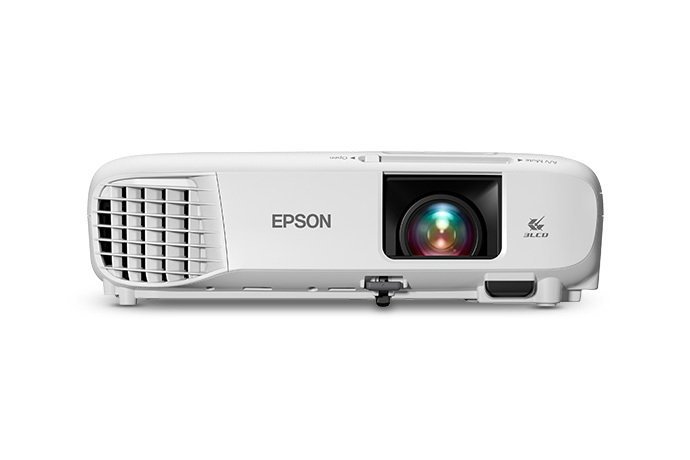
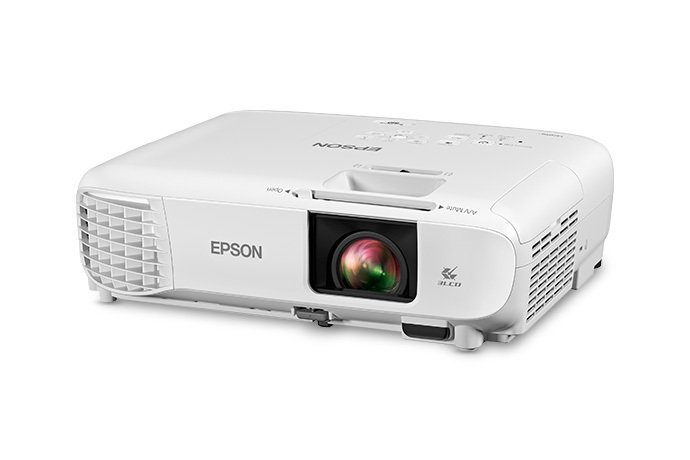
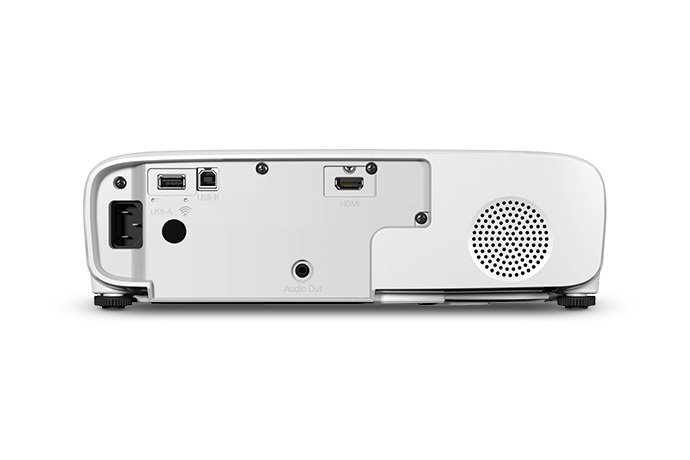
Epson Home Cinema 880
The Home Cinema 880 is Epson's entry-level home theater projector, model V11H979020: a standard-throw, lamp-based 1080p unit built around Epson's 3-chip 3LCD engine. It is the no-frills member of the Home Cinema line, offering maximum brightness and image size for the money with the minimum of smart features, and that focus is exactly why it leads this guide.
The verified specifications, all from Epson's owner manual and published spec sheet: native 1920 x 1080 resolution in 16:9; 3,300 lumens of color brightness (IDMS 15.4) and 3,300 lumens of white brightness (ISO 21118); up to 16,000:1 dynamic contrast; up to 1.07 billion colors; a 210 W UHE lamp rated up to 6,000 hours in normal mode and 12,000 hours in Eco mode; a throw ratio of 1.21 to 1.63 with manual 1.0 to 1.35x zoom and manual focus; automatic vertical keystone of plus or minus 30 degrees plus manual horizontal keystone of plus or minus 30 degrees; one HDMI port, USB-A for PC-free projection, USB-B for Plug 'n Play computer display, and a 3.5 mm stereo audio output; a built-in speaker; fan noise of 37 dB in normal mode and 28 dB in quiet mode; and a body measuring 11.9 x 3.4 x 9.8 inches at 5.9 lb. Epson rates the projected image range at 25 to 386 inches, and the projector supports front, rear, and ceiling mounting.
The headline strength is brightness that is honest as well as high. The 3,300-lumen rating is genuinely strong for a budget 1080p projector, and because the engine is 3-chip 3LCD, the color brightness matches the white brightness. Single-chip DLP rivals often quote a white brightness figure that their color output cannot match, so colorful sports and movie content on the 880 stays as bright as the spec sheet promises. At 5.9 lb it is light for a standard-throw unit, and setup is simple: the automatic vertical keystone (driven by the built-in picture skew sensor) plus manual horizontal correction covers most imperfect placements. The lamp is a standard 210 W UHE type with a long rated life, so running costs over the projector's life stay low.
The limitations are about features, not picture quality. There is no built-in Wi-Fi: wireless projection requires Epson's optional wireless LAN module, and there are no smart apps, so budget for a streaming stick. The single HDMI port fills up with that one stick, which means an AV receiver or an HDMI switch for multi-device setups. The 880 is strictly 1080p, so it cannot accept or display 4K content the way the 4K-enhanced models in this comparison can. Fan noise of 37 dB in normal mode is audible in quiet rooms, although Eco and quiet mode drop it to 28 dB at the cost of brightness. And like every lamp projector, brightness declines gradually as the lamp ages toward its rating.
- 3,300 lumens of color and white brightness, equal figures thanks to the 3-chip 3LCD engine
- Light 5.9 lb body with automatic vertical keystone, so setup takes minutes
- Long lamp ratings of 6,000 hours normal and 12,000 hours Eco keep running costs low
- User-replaceable standard UHE lamp and full 1080p image up to very large sizes
Reasons to avoid:
- Single HDMI port, so multi-device setups need a receiver or a switch
- No built-in Wi-Fi or smart apps; a streaming stick is effectively mandatory
- Strictly 1080p, with no ability to accept 4K content
- 37 dB normal-mode fan noise is audible in quiet rooms
- Model: V11H979020
- Resolution: native 1920 x 1080, 3-chip 3LCD
- Brightness: 3,300 lumens color (IDMS 15.4) / 3,300 lumens white (ISO 21118)
- Contrast: up to 16,000:1 dynamic
- Lamp: 210 W UHE, 6,000 h normal / 12,000 h Eco
- Throw ratio: 1.21 to 1.63, manual zoom 1.0 to 1.35x
- Inputs: 1 x HDMI, USB-A, USB-B, 3.5 mm audio out
- Weight: 5.9 lb
Best for: buyers who want the biggest, brightest 1080p image a name brand offers at a budget price, and who are happy adding a streaming stick for smart features.
2. Epson Home Cinema 1080: Best With Built-In Wi-Fi
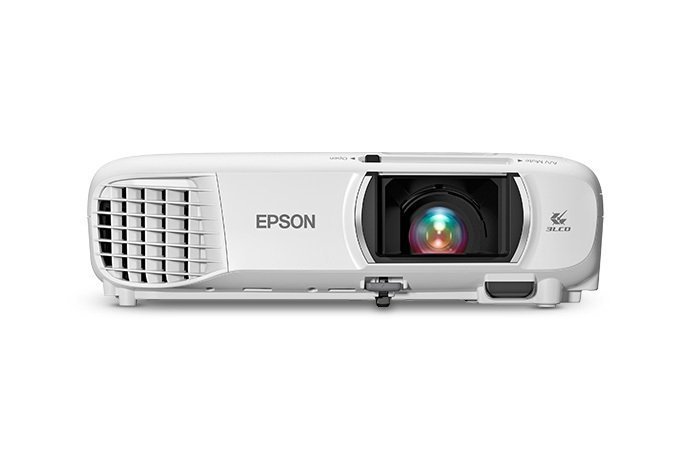
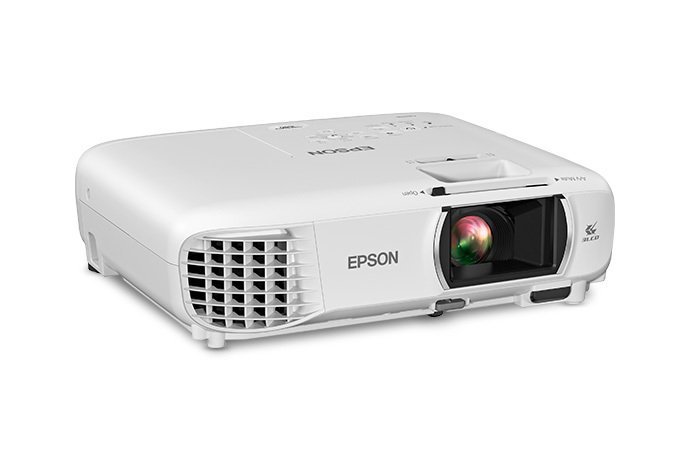
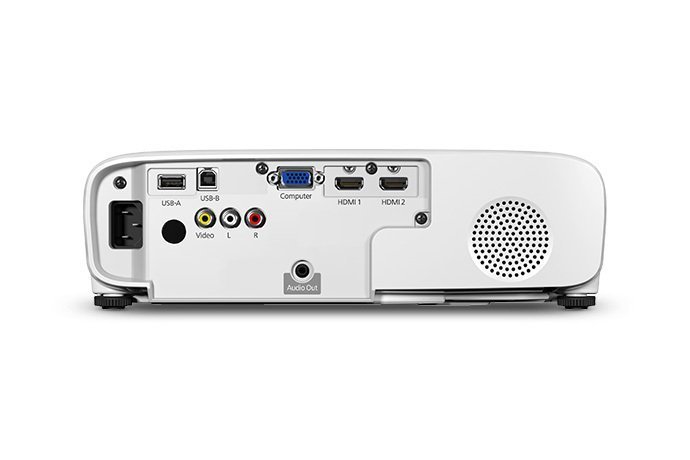
Epson Home Cinema 1080
The Home Cinema 1080, model V11H980020, is the 880's nearest relative: the same basic 3LCD 1080p lamp platform with built-in wireless and an extra HDMI port. If the 880 is "the projector," the 1080 is "the projector plus the dongles built in," and for many living rooms that difference is the whole decision.
The verified specifications: 3-chip 3LCD at native 1920 x 1080; 3,400 lumens of color brightness (IDMS 15.4) and 3,400 lumens of white brightness (ISO 21118); 16,000:1 dynamic contrast; the same 210 W UHE lamp platform as the 880, rated 6,000 hours in normal mode and 12,000 hours in Eco mode per Epson's owner manual; built-in Wi-Fi 5 (802.11ac) with Miracast screen mirroring; two HDMI ports, composite video, VGA, USB-A, USB-B for Plug 'n Play, and a 3.5 mm stereo output; a 2 W built-in speaker; 1.2x optical zoom with manual focus; automatic vertical keystone of plus or minus 30 degrees and manual horizontal keystone of plus or minus 30 degrees; a 30 to 300 inch projected image range; fan noise of 37 dB, or 28 dB in Eco; and a body measuring 12 x 3.75 x 10.9 inches at 6.17 lb. There is no built-in TV tuner.
The 1080 answers nearly every 880 complaint in one box. It adds 100 lumens, which is minor, and then adds the things that actually change daily use: wireless projection and Miracast mirroring without an accessory module, and a second HDMI port so a streaming stick and a game console can coexist without a switch. Because it shares the 880's lamp platform, the running costs are identical, and the picture is cut from the same cloth: equal color and white brightness from the 3LCD engine, the same contrast rating, and the same honest measurement standards behind the numbers.
The honest caveat is that the premium buys connectivity, not a better picture. The feature gap between the two models is wireless and ports; image quality is essentially the same projector. If you only ever connect one wired device and never mirror a phone or laptop, the 880 gives you the same image for less money. Two buying notes complete the picture. First, the 2 W speaker is a convenience for casual viewing, not a movie-night solution, so plan on the 3.5 mm output or an HDMI-fed soundbar as you would with the 880. Second, Epson's own store now lists the Home Cinema 1080 as discontinued, with the Home Cinema 1100 shown as its replacement, so remaining new stock is finite: buy it because the feature set fits, not as a long-term platform bet.
- 3,400 lumens of color and white brightness, the highest rating in this comparison
- Built-in Wi-Fi 5 with Miracast, so wireless projection needs no accessory module
- Two HDMI ports plus VGA and composite cover modern and legacy sources
- Same lamp platform as the 880, so running costs and lamp life are identical
Reasons to avoid:
- Picture quality is essentially the 880's; the premium buys connectivity only
- Epson now lists the model as discontinued, so new stock is finite
- No built-in streaming apps; the Wi-Fi serves projection and mirroring
- 2 W built-in speaker is a backup, not a movie-night solution
- Model: V11H980020
- Resolution: native 1920 x 1080, 3-chip 3LCD
- Brightness: 3,400 lumens color (IDMS 15.4) / 3,400 lumens white (ISO 21118)
- Contrast: 16,000:1 dynamic
- Lamp: 210 W UHE, 6,000 h normal / 12,000 h Eco
- Wireless: Wi-Fi 5 (802.11ac) with Miracast
- Inputs: 2 x HDMI, VGA, composite video, USB-A, USB-B, 3.5 mm audio out
- Weight: 6.17 lb
Best for: buyers who want the 880's picture plus wireless projection and a second HDMI port, and who will actually use both.
Buying Guide: How to Choose a Projector Like the Home Cinema 880
Brightness: read the standard, not just the number
The 880's 3,300-lumen figure is high for a budget projector, but the number alone is not the story. Epson publishes two brightness figures, measured to two different standards: color brightness per IDMS 15.4 and white brightness per ISO 21118, as stated in the footnotes of Epson's own owner manual. Many single-chip DLP competitors publish only a white-brightness figure, and their color output can be far lower. Because the 880 is 3-chip 3LCD, its color and white figures are equal, which is the practical takeaway: colorful sports and movie content stays bright, not just white test patterns. The practical rule: 3,000 or more lumens works in a dim-to-moderately-lit living room, while a fully dark room needs far less. Never compare a lumen number from one brand against another unless you know both were measured the same way.
Native resolution vs "4K": know which you are buying
The 880 is native 1080p (1920 x 1080): every pixel on the imaging chip maps 1:1 to a 1080p source, and it does not accept 4K content. The Home Cinema 4000 and 2350 are also native-1080p chips, but they use pixel-shifting (4K Enhancement and 4K PRO-UHD) to display up to 8.29 million pixels, and they accept native 4K input. The BenQ HT2060 accepts 4K input but displays 1080p. For most buyers at typical viewing distances, a good 1080p image beats a bad "4K" image, because resolution is only one ingredient.
Lamp vs LED: the running-cost question
Four of the five models in this comparison (the 880, 1080, 2350, and 4000) use replaceable UHE lamps rated between 4,500 and 12,000 hours depending on mode. At four hours a day, the 880's 6,000-hour normal rating is roughly four years, and Eco mode roughly doubles that. The BenQ HT2060's 4LED source is rated 20,000 to 30,000 hours, effectively the life of the projector. If you watch a lot and hate maintenance, LED wins; if you want maximum brightness per dollar and do not mind a lamp swap every few years, the lamp models win.
Throw ratio and placement: measure before you buy
Throw ratio (distance divided by image width) decides where the projector must sit. The 880's 1.21 to 1.63 range is a standard throw: for a 100-inch-wide image (about a 115-inch diagonal 16:9 screen), it needs roughly 10 to 13.5 feet of distance. The HT2060 (1.15 to 1.5) can sit a little closer; the 4000 (1.35 to 2.84) and 2350 (1.32 to 2.15) need more room but offer far more zoom flexibility. None of these are short-throw projectors: if the projector must sit two feet from the wall, you are shopping in the wrong category.
Keystone vs lens shift: the image-geometry ladder
Keystone correction digitally reshapes the image when the projector sits off-center. It is convenient, but it costs sharpness and pixels. Lens shift physically moves the lens optics with no image penalty. The ladder in this comparison: the HT2060 has the widest digital keystone (plus or minus 40 degrees on both axes), the 880 and 1080 have auto vertical plus or minus 30 degrees plus manual horizontal plus or minus 30 degrees, the 2350 adds plus or minus 60 percent vertical lens shift, and the 4000 has full powered lens shift (plus or minus 96 percent vertical, plus or minus 47 percent horizontal). Best practice is always the same: place the projector square to the screen first, and treat keystone as a correction tool, not a placement strategy.
Sound: plan on external audio
Every projector in this comparison has a built-in speaker (2 W in the 1080, 10 W bass-reflex in the 2350, dual 5 W in the HT2060), and every one of them is best thought of as a backup for casual viewing. For movie nights, budget for a soundbar or speakers: the 880 gives you a 3.5 mm stereo out, the 2350 adds HDMI ARC and Bluetooth audio, and the HT2060 has optical plus 3.5 mm.
Connectivity and smart features: count your HDMI ports
The 880's single HDMI port is its most limiting spec on paper: one streaming stick fills it completely. The 1080, HT2060, and 2350 all have two, and the 2350 dedicates one to its included Android TV dongle. Neither the 880 nor the HT2060 has built-in Wi-Fi or apps, so a streaming stick solves it, but factor it into the total cost. Only the 2350 is a true all-in-one streamer out of the box, and only the 1080 has wireless projection (Miracast) without accessories.
Input lag and gaming
If console or PC gaming matters, input lag decides. The HT2060 leads at 16.7 ms (1080p at 60 Hz) and 8.3 ms (1080p at 120 Hz); the 2350 is under 20 ms in its low-latency mode. Epson does not publish input-lag figures for the 880 or 1080. For casual gaming they are generally acceptable, but competitive gamers should favor the measured numbers.
Types of Projectors in This Comparison
Budget 1080p lamp projectors (the 880 and 1080): the value tier. Maximum brightness per dollar, replaceable lamps, no 4K. Buy this type if your room has some ambient light and your budget is the constraint.
4K-enhanced lamp projectors (the 4000 and 2350): native-1080p chips with pixel-shifting that accept 4K content and add HDR. Buy this type for a dedicated dark room where resolution and contrast matter more than raw brightness.
LED DLP projectors (the HT2060): a solid-state light source, no lamp replacements, typically better contrast and gaming specs, and lower peak brightness. Buy this type for heavy daily use and low maintenance.
Head-to-Head: The Comparisons That Matter
Epson Home Cinema 880 vs Home Cinema 4000
This is the comparison behind the secondary search term for this model, and it is really a new-versus-old question. The 4000 is the better home-theater projector in a dark room: 4K Enhancement, HDR10, 100 percent DCI-P3 color gamut, up to 140,000:1 contrast, and powered lens shift dwarf the 880's specs. But it is discontinued (a 2017 platform), dimmer at 2,200 lumens against the 880's 3,300, shorter-lived on lamps, and only available used. Verdict: buy the 4000 only if you find a clean used unit at a clear discount, have a light-controlled room, and value contrast over brightness. For everyone else (ambient light, warranty, current parts), the 880 is the sane buy.
Epson Home Cinema 880 vs Home Cinema 1080
The closest call in this guide, because the two share a lamp platform. The 1080 adds 100 lumens, built-in Wi-Fi 5 with Miracast, and a second HDMI port; the 880 is the same picture for less money. Verdict: if you will use wireless projection or connect two devices (say, a streaming stick and a console), the 1080's premium pays for itself. If you run one wired device and have no wireless needs, the 880 is the better value.
Epson Home Cinema 880 vs BenQ HT2060
Lamp 3LCD versus LED DLP. The 880 is brighter (3,300 vs 2,300 lumens) and lighter, with no rainbow effect. The HT2060 never needs a lamp, has far better contrast on paper, lower input lag, wider keystone range, and two HDMI 2.0b ports, but no Wi-Fi or smart features either. Verdict: heavy daily viewers and gamers should lean toward the HT2060; brightness-first buyers in rooms with ambient light should lean toward the 880.
Common Mistakes to Avoid
- Buying on lumens alone. A 3,300-lumen figure measured per IDMS and ISO standards is not comparable to a generic brand's "9,500 lumens" claim with no stated standard. Read the standard, not just the number.
- Confusing "accepts 4K" with "is 4K." The 880 is native 1080p and cannot process 4K input at all; the 4000 and 2350 accept 4K and pixel-shift it; the HT2060 accepts 4K and downscales it to 1080p. Different things, different prices.
- Ignoring throw ratio. Measure your room first. A standard-throw projector eight feet from the wall cannot fill a 120-inch screen no matter how good the reviews are.
- Paying new prices for the discontinued 4000. It left Epson's current line years ago, and its launch pricing is history. Used-market pricing is the only sane reference.
- Expecting Wi-Fi on the 880. Wireless needs Epson's optional LAN module, and there are no built-in apps. Budget a streaming stick, or step up to the 2350 or 1080.
- Planning a bright-room setup around contrast specs. Dynamic contrast figures (16,000:1, 140,000:1) describe dark-room performance. In a sunlit room, brightness and screen choice dominate.
- Mixing up the model numbers. The 880, 1080, and 4000 are different generations and tiers despite the similar names. The 1080 is the 880's wireless sibling; the 4000 is an older premium tier. Check the model number (V11H979020 is the 880) on the listing before you buy.
Frequently Asked Questions
No. It is native 1080p (1920 x 1080) and cannot accept or display 4K content. Epson's 4K-capable models in this comparison are the Home Cinema 4000 (4K Enhancement) and the Home Cinema 2350 (4K PRO-UHD), both of which use pixel-shifting from 1080p chips.
Not built in. Epson's owner manual states that wireless network support on the Home Cinema 880 requires the optional wireless LAN module. For built-in wireless, the Home Cinema 1080 has Wi-Fi 5 with Miracast, and the 2350 ships with an Android TV streaming dongle.
Epson rates the 210 W UHE lamp up to 6,000 hours in normal mode and 12,000 hours in Eco mode, with the usual caveat that lamp life varies with mode, environment, and usage. The lamp is user-replaceable (standard UHE type). At four hours of viewing a day, 6,000 hours is roughly four years.
The 4000 is the better pure home-theater projector (4K Enhancement, HDR10, far higher contrast, powered lens shift), but it is discontinued, dimmer at 2,200 lumens, and only available used. The 880 is brighter, current, and simpler. Dark dedicated room plus a good used deal: 4000. Anything else: 880. See the head-to-head section above.
Yes, the 880 has a built-in speaker, plus a 3.5 mm stereo audio output for external speakers or a soundbar. Like all projector speakers in this class, it is fine for casual viewing; plan external audio for movie nights.
Epson's spec sheet lists 25 to 386 inches diagonal; the Icecat spec database lists 25 to 368 inches. Either way, the practical limit is your room's throw distance and light control, not the spec maximum: a 3,300-lumen projector lights a 120 to 150 inch screen comfortably in a dim room.
Yes. Front, rear, and ceiling mounting are all supported per the spec sheet. A ceiling bracket is sold separately, and you will want to check the throw distance for your screen size before fixing the mount position.
It means the projector's color light output, measured per the IDMS 15.4 standard, is 3,300 lumens, and its white light output, measured per ISO 21118, is also 3,300 lumens. The equal figures matter: on 3-chip 3LCD projectors, colors stay as bright as whites, while some single-chip DLP models quote a white figure their color output cannot match.
Final Verdict
The Epson Home Cinema 880 is the right projector for a specific buyer: someone who wants the biggest, brightest 1080p image a name brand offers at a budget price, and who is comfortable adding a streaming stick for smart features. Its 3,300-lumen 3LCD engine, honest brightness standards, and long lamp life make it a genuinely good value for living rooms, sports viewing, and casual movie nights.
It is the wrong projector if you need 4K content support (look at the 2350 or a used 4000), built-in streaming (2350), wireless projection (1080), a second HDMI port (1080 or HT2060), or a fit-and-forget light source (the HT2060's 4LED). Among the two picks you can buy from this guide, the decision tree is simple: cheapest bright 1080p, the 880; the 880 plus wireless and two HDMI ports, the 1080.
Final Recommendations
Best Value Epson 1080p: Epson Home Cinema 880, 3,300 lumens color and white; native 1080p 3LCD; lamp rated 6,000 h normal.
Best With Built-In Wi-Fi: Epson Home Cinema 1080, 3,400 lumens; Wi-Fi 5 with Miracast; two HDMI ports.
Related Guides
- shopping the wider Epson range: our full Epson Home Cinema lineup guide.
- working to a tighter budget: our best budget projector picks.
- ready to step up in resolution: our best 4K projector guide.
- building the setup around games: our projector for gaming guide.