
This is a research-based review of a single product. We have not operated this fire pit. Specs are traced to the manufacturer's published material, and safety figures are verified manual figures where stated, or explicitly marked as general guidance. This is a safety-critical category: clearance, ventilation, and propane-handling claims are verified against manufacturer owner manuals where stated, or explicitly marked as general guidance. Never treat this article as a substitute for your unit's manual or local fire code.
Introduction
An LP (liquid propane) fire pit is the easy button for backyard fire: push-button ignition, no smoke, no sparks, no wood to split, and you can shut it off instantly when the evening is done. But "easy" does not mean "casual." Propane is a fuel gas, and the difference between a great patio centerpiece and a hazard is placement, clearances, and handling the tank correctly.
This is a single-product review, not a roundup. It covers one product in depth: the Flame King FKG6501D, a 19-inch portable propane fire bowl. Alongside the review, it covers the safety section most roundups skip: verified clearance figures from manufacturer manuals, tank runtime math, and propane storage rules. Every safety claim is either traced to an owner manual or labeled as general guidance.
Quick Picks
Short on time? This review covers one product in depth. The button takes you to the exact product on Amazon.
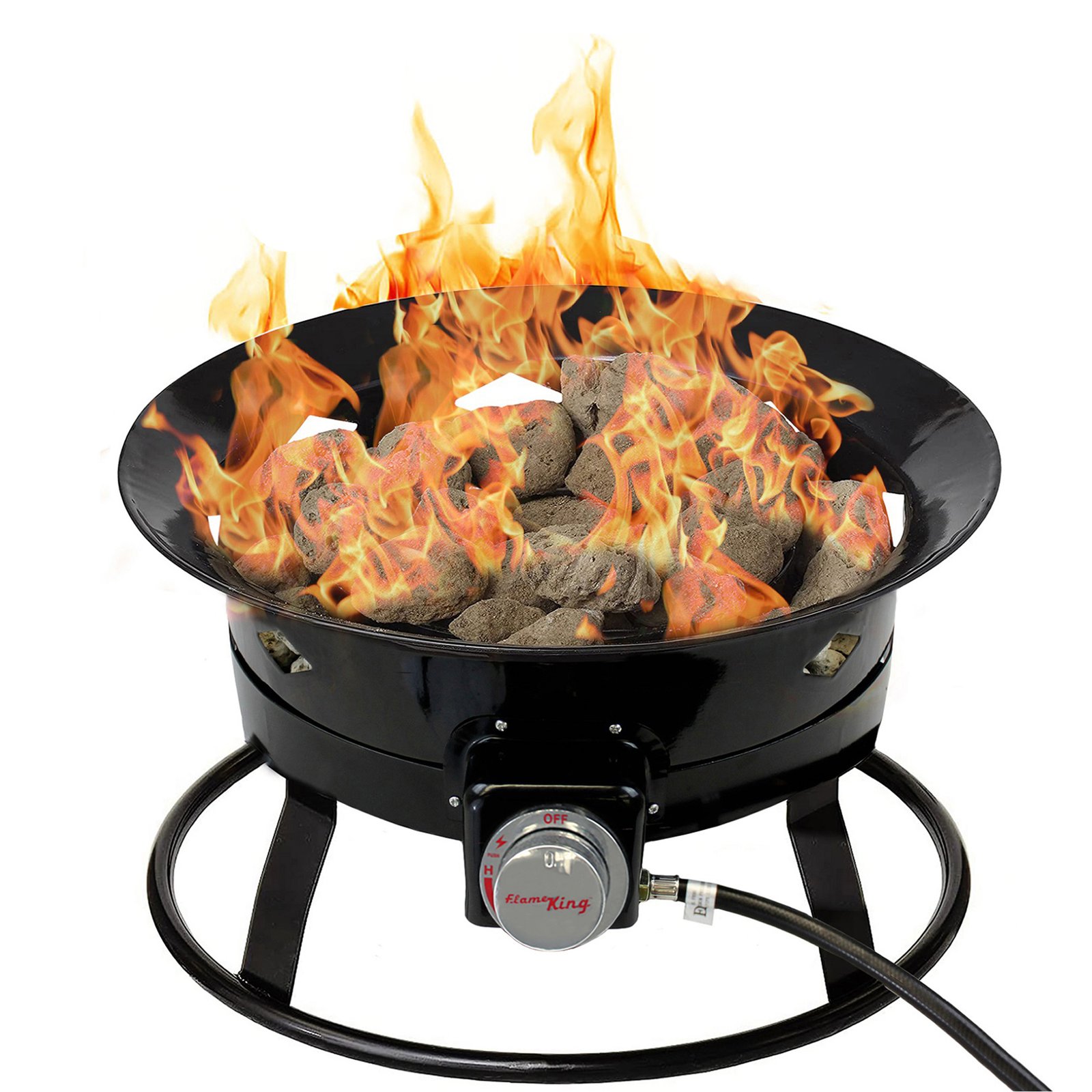
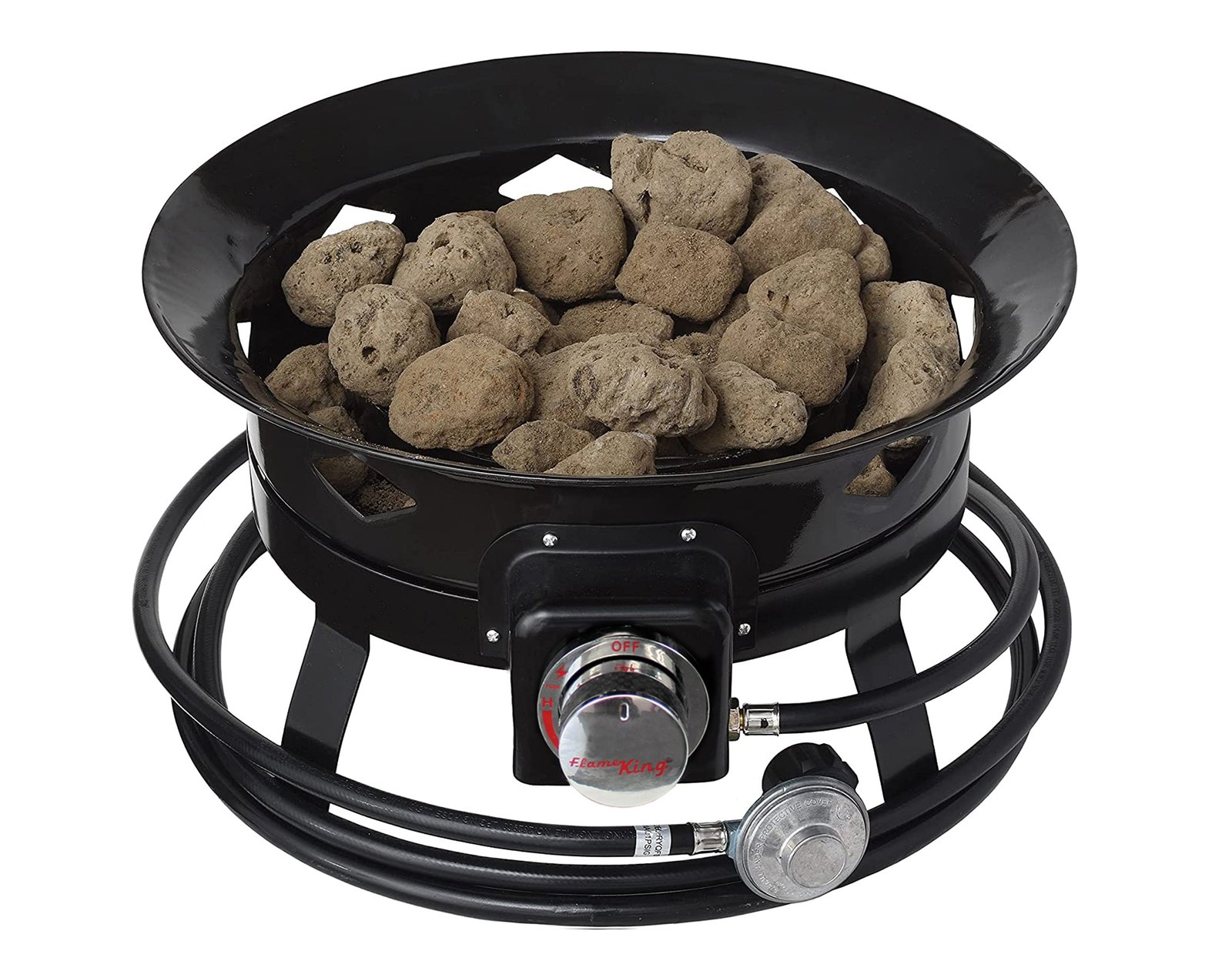

Flame King FKG6501D Portable Propane Fire Pit
The anti-table: a 19-inch portable propane fire bowl with piezo self-ignition and 58,000 BTU of output. It goes where tables cannot: campsites, tailgates, rentals, with simple piezo ignition and no battery to replace.
- 58,000 BTU of output for its size
- Simple piezo ignition with no battery to replace
- Goes where tables cannot: campsites, tailgates, rentals
- 10-ft hose with regulator included
- Cover and carry straps included
Reasons to Avoid:
- No table function: this is a bowl, not patio furniture, so there is no table surface and no hidden tank storage.
- The external tank sits beside the unit rather than hidden inside.
- Higher wind exposure than tables with glass guards: an open bowl flame is more affected by wind.
- Radiant, local heat: warmth is felt facing the flame rather than across a large patio, so seating should face the bowl.
Important limitation: No table function; external tank sits beside it; higher wind exposure than tables with glass guards.
- Model: FKG6501D
- Size: 19" x 19" x 10.5"
- Weight: 22.85 lb per the manufacturer PDP (the manual lists 18 lb)
- BTU: 58,000 BTU/HR
- Ignition: Piezo self-igniting
- Hose: 10-ft with regulator
- Included: Cover and carry straps
- Form: Portable propane fire bowl
- Color: Black
Variant note: FKG6501D only. Do not substitute FKG6502D, the 24-inch model.
Best for: Campers, tailgaters, renters, anyone who wants fire without furniture.
| Product | Key Specs | Best Use Case | Standout Feature | Amazon Link |
|---|---|---|---|---|
| Flame King FKG6501D Portable Propane Fire Pit Portable Propane Fire Pit |
FKG6501D: 19" x 19" x 10.5"; 22.85 lb per the manufacturer PDP; 58,000 BTU/HR; piezo self-igniting; 10-ft hose with regulator; cover and carry straps included; portable propane fire bowl; black. Must not substitute FKG6502D (24-inch model). | Campsites, tailgates, rentals, and patios where portability matters; protect the piezo igniter in transit. | 58,000 BTU in a portable 19-inch bowl, with piezo ignition and no battery to replace. | Check Price |
How We Chose This Review
This review covers one product because it is the one product in this research set that meets the verification bar: its exact variant is confirmed by two independent sources that print its ASIN, and three genuine manufacturer photos of the exact variant are in hand and verified. The review is research-based, not hands-on: we have not operated this fire pit, and no testing, scores, or performance claims beyond the manufacturer's published specs appear here. Where the manufacturer's PDP and its manual disagree (weight: 22.85 lb on the PDP, 18 lb in the manual), both figures are stated with their sources rather than picking one silently.
How to Choose a Portable Propane Fire Pit
Start with where the fire will live. A portable bowl suits campsites, tailgates, rentals, and small patios; a fixed table suits a permanent patio with room for furniture. Then check the practical points: output against your space (more BTU burns more propane, so match output to the area, not to ambition); ignition type (piezo needs no battery but wears over years; push-button spark is simple; battery igniters add one more battery to maintain); hose and regulator (use the regulator supplied with the unit); what is included (cover, carry straps, and hose matter for a portable unit); and clearances (read the "Minimum Clearance to Combustibles" section of your unit's manual before you place it, and check local codes, HOA rules, and lease terms before you buy).
The complete LP fire pit buying guide
BTU and heat: what the numbers actually mean
BTU (British thermal units per hour) is the maximum heat input, not a comfort guarantee. As a rule of thumb, match output to your space: a small patio needs less output, a larger or wind-exposed space needs more. More BTU also means more propane burned (see runtime math below). Bigger is not better: an oversized burner on a small patio is uncomfortable and wasteful. Match BTU to your space, not your ambition.
Tank runtime: the only math you need
A standard 20 lb propane tank holds about 4.6 gallons of propane; at about 91,500 BTU per gallon, that is roughly 420,000 BTU of fuel. Divide by your burner's BTU rating. For this review's product, the derivation is:
- 20 lb tank: about 4.6 gallons x about 91,500 BTU per gallon = about 420,900 BTU, rounded to about 420,000 BTU
- 58,000 BTU: about 420,000 / 58,000 = about 7.24 hours, or about 7.2 hours at full blast
These are estimates: you will rarely run full blast, so real-world evenings stretch further. But the math kills a common fantasy: a high-output burner will not run "all weekend" on one tank. Budget for refills (or a second tank) if you entertain often.
Safety: clearances, placement, and ventilation. Read this twice
This is the section that matters most. Propane fire pits are outdoor-only appliances: every manufacturer manual we checked states this identically: never in a building, garage, or any enclosed area, including under overhead combustible surfaces like pergolas, awnings, and patio roofs.
Verified clearance figures (manufacturer owner manuals, checked 2026-10-17): minimum 80 inches of clearance above the unit, 36 inches to the sides from combustibles, installed on a non-combustible surface only, with the base vent opening kept obstacle-free at all times. A separate fire-table manufacturer's manual specifies 60 inches from the burner center to any combustible sidewall and 72 inches from any overhang.
What this means for you: clearances vary by brand and model, the figures above are verified examples, not universal law. Your unit's manual is the authority; read the "Minimum Clearance to Combustibles" section before you place it. General rules that hold across manuals: non-combustible flooring only (stone, concrete, brick, not wood decking unless the manual explicitly allows it); never under anything that can burn above it; keep the area clear of combustibles, gasoline, and flammable vapors; never leave it unattended while lit; turn the gas off at the cylinder when not in use.
Carbon monoxide: propane combustion produces CO. Outdoors in ventilated space, it disperses; in any enclosed or semi-enclosed space, it can accumulate to dangerous levels. This is the physical reason behind the outdoor-only rule, not a technicality.
Propane handling and storage
- Leak check: after connecting a tank, check connections with soapy water (bubbles = leak). Several manufacturers include a reminder card for this, do it every time you swap tanks.
- Storage: cylinders must be stored outdoors in a well-ventilated area, out of reach of children, never in a building, garage, or enclosed area. Indoor storage of the appliance itself is only permissible with the cylinder disconnected and removed, and disconnected cylinders need their valve plugs installed.
- Transport: keep cylinders upright and secured; never transport a connected appliance.
- Regulators: use the regulator supplied with the unit, manuals specify it must be the same model supplied.
- When not in use: gas off at the supply cylinder. Every time.
Certifications: what to look for
Look for a CSA or ETL/UL certification mark on the product and in the listing, it means the appliance was tested to the relevant North American gas-appliance standard. Where this article states a certification, it is per the retailer/manufacturer listing and flagged for verification, marks should be confirmed on the actual product. No certification mark on a gas appliance is a reason to keep shopping.
Local codes, HOAs, and rental rules
Your manual is not the only authority. Many municipalities restrict open-flame appliances on balconies and near property lines; some require permits for fixed gas installations; HOAs and landlords routinely ban them on decks and balconies outright. A few minutes with your city's fire code page (search "[your city] fire pit regulations") and your HOA/lease terms can save you from buying a fire pit you are not allowed to light. This is general guidance, local rules vary widely, and the fire marshal's answer beats any article's.
Portable bowl vs. fire pit table
Fire pit tables are patio furniture with a burner: table space, hidden tank storage, permanent placement. Portable fire bowls (the Flame King reviewed here) trade furniture for freedom: light, stowable, campsite-ready, with the tank sitting alongside. What we do not cover here: natural-gas fire pits (different installation, fixed gas line, often permits) and wood-burning pits (different category, different rules). This article is LP-only by design. The choice is lifestyle, not specs: if you camp or rent, the portable bowl wins outright; if you own the patio and want daily-use furniture, a table wins on daily-use metrics.
Materials and weather resistance
Powder-coated steel and aluminum frames handle weather; wicker/HDPE exteriors add UV resistance; tempered glass tops look premium but add weight. Whatever the materials, use the weather cover when the unit is not in use, moisture in the burner pan causes ignition problems, and covers are cheap insurance. Stainless burners resist corrosion best in coastal air. The Flame King includes a cover, which covers this need out of the box.
Ignition types
Push-button spark (most tables): simple, reliable, no battery. Battery igniter: one more battery to maintain. Piezo self-igniting (Flame King): no battery at all, but piezo crystals wear over years. Match-lit (some burner kits): cheapest, least convenient. For a patio table you will light hundreds of times, push-button is the sweet spot; for a portable bowl, piezo keeps the kit simple.
Wind, weather, and the accessories worth buying
Wind is the enemy of every open-flame fire pit: it lays the flame sideways, cuts heat output, and can blow out the burner on gusty days. A tempered glass wind guard: a ring of glass panels around the burner, is the single best accessory for an LP fire pit: it stabilizes the flame, improves heat efficiency, and blocks the wind from scattering lightweight fire glass. Measure your burner pan before ordering; guards are sized to the fire feature, not the table.
Beyond that: a weather cover (included with the Flame King, a separate purchase for most units) keeps rain out of the burner pan, standing water causes ignition failures and rust. A tank cover or hideaway matters if your table does not conceal the tank. And keep a long-reach lighter as backup; even the best igniters fail eventually, and relighting instructions are in your manual.
Seasonal maintenance and winterizing
End-of-season care takes twenty minutes: turn the gas off at the cylinder and disconnect it; store the cylinder outdoors, upright, disconnected, with the valve plug installed, never in the garage or shed. Brush debris out of the burner pan and check that burner ports are clear (a soft brush, never a pin that enlarges the ports). Cover the unit. Inspect the hose and regulator annually for cracking, abrasion, or stiffness, replace per the manufacturer's guidance, not when it fails. Before first use each season, do the soapy-water leak check on every connection and confirm the ignition works before guests arrive.
Common buying mistakes (and how to avoid them)
- Placing it under a pergola or patio roof. The most common dangerous mistake. Manuals prohibit overhead combustibles, heat and flame do not negotiate.
- Putting it on a wood or composite deck without checking. Non-combustible surface is the manual default. Deck + gas appliance needs explicit manufacturer approval.
- Ignoring clearances. 36" sides / 80" top (verified manual figures) is not decorative guidance. Measure before you buy.
- Storing the tank indoors. Cylinders live outdoors, disconnected, valve-plugged. Every manual says this.
- Leaving it burning unattended. Wind shifts, kids and pets move, embers are not the issue with gas, gas flow is. Never walk away from a lit burner.
- Skipping the soapy-water leak check. Thirty seconds per tank swap. Do it.
- Buying BTU for a patio you do not have. An oversized burner in a tiny courtyard is a furnace, not ambiance.
- Assuming "smokeless" means "safe indoors." Propane fire pits are marketed as clean-burning, they are, and they are still outdoor-only. CO is invisible.
Dangerous advice we saw in the SERPs (and the correction)
- "It is fine under a covered patio as long as there is airflow." Correction: manufacturer manuals explicitly prohibit use under overhead combustible surfaces, period. "Airflow" does not change the clearance requirement. Check your unit's manual.
- "You can store the propane tank in the garage over winter." Correction: cylinders must be stored outdoors in ventilated areas, disconnected, with valve plugs. Garages accumulate leaked propane at floor level, propane is heavier than air.
- "Just leave it on low while everyone goes inside." Correction: never leave a gas appliance unattended while in operation. Turn the gas off at the cylinder.
- "Any deck is fine, it is not a real fire." Correction: it is a real gas flame. Non-combustible surface per the manual, or explicit manufacturer approval for your deck type.
Frequently asked questions
About 7.2 hours at full blast, by this derivation: a 20 lb tank holds about 4.6 gallons of propane, at about 91,500 BTU per gallon that is about 420,000 BTU of fuel, and 420,000 divided by 58,000 BTU per hour is about 7.24 hours. Real-world use at lower flame settings stretches this considerably, most owners get multiple evenings per tank.
Only if your unit's manual explicitly allows it. The default across manufacturer manuals is installation on non-combustible surfaces only (stone, concrete, brick). Do not improvise with a gas appliance. Check the manual.
No. Manufacturer manuals prohibit use under overhead combustible surfaces. Verified manual figures require 80 inches of overhead clearance, a standard patio cover violates this. This is the most important "no" in the article.
Propane needs no fixed line, you place the unit, connect a tank, and go, which is why it is the renter- and patio-friendly choice. Natural gas is cheaper to run long-term but requires a professionally installed gas line (and often permits). This article covers LP only.
Within their radius, yes, a high-output burner is comparable to a patio heater's output class. They are radiant heaters: you feel warmth on exposed skin facing the flame, but they will not warm the air of a large patio like an indoor furnace. Wind cuts effectiveness significantly.
Yes, all propane combustion produces some CO, which is exactly why every manual mandates outdoor, well-ventilated use only. In open air it disperses harmlessly; in enclosed spaces it can accumulate to dangerous levels. Never use one indoors, in a garage, or under a low cover.
Either, per your unit's design: lava rocks give a natural look and diffuse heat; fire glass gives a modern look and does not degrade. Use only media rated for fire-pit use, keep the burner ports clear, and never use river rocks or gravel, trapped moisture can make them explode when heated.
Per the manufacturer PDP: the 19-inch bowl, a 10-ft hose with regulator, a cover, and carry straps. The tank itself is separate, as with most portable LP units.
No. The FKG6501D is the 19-inch model reviewed here. The FKG6502D is a different, 24-inch model and must not be substituted.
Final Recommendation
Flame King FKG6501D Portable Propane Fire Pit: the portable LP fire pit in this review: 58,000 BTU in a 19-inch bowl, piezo ignition with no battery to replace, cover and carry straps included, and a 10-ft hose with regulator. Buy it when the fire needs to travel: campsites, tailgates, rentals, and small patios.
Related guides
- the fuel decision in depth (planned)
- placement, clearances, and seasonal maintenance (planned)
- when a fire pit is not the right heater (planned)
- permanent installations and permits (planned)