
If you searched "pure air purifier," you have probably noticed something odd: half the results are products with "Pure" in the name and the other half are articles ranking the quietest air purifier as if they were the same thing. They are not, and that confusion is exactly why this guide starts with the name itself. "Pure" shows up in three different ways in the air purifier aisle. Blueair calls its most popular line Blue Pure. Pure Enrichment calls its line PureZone. Sensibo sells a smart unit called Pure. These are three different companies, and the word "pure" on the box tells you nothing on its own about how well a machine actually cleans your air.
This guide covers Blueair's Blue Pure line: the two quiet models below, compared on room size, filtration and noise, plus how to pick a quiet one for a bedroom. Every specification below comes from manufacturer-published documentation or a named third-party source; where a number could not be verified from the manufacturer, the card says so rather than inventing it.
The Short Answer
For bedrooms, the Blueair Blue Pure 511i Max is the quiet pick. It drops to a published 19 dB in night mode, is rated for 237 square feet at 4.8 air changes per hour, and has a PM2.5 sensor that adjusts fan speed automatically during the day. Because that rating covers a typical bedroom, it has headroom to run on a low, quiet setting all night.
For mid-size rooms, the Blueair Blue Pure 311i Max is the right-sized pick. It covers around 439 square feet, drops to a published 23 dB on low, and shares the 511i Max smart feature set: auto mode, app control and night mode. The key rule for quiet: buy a purifier rated slightly above your room size so it can run on low, where every fan is quiet.
Quick Picks
Short on time? These are our top recommendations. Each button takes you to the exact product on Amazon.

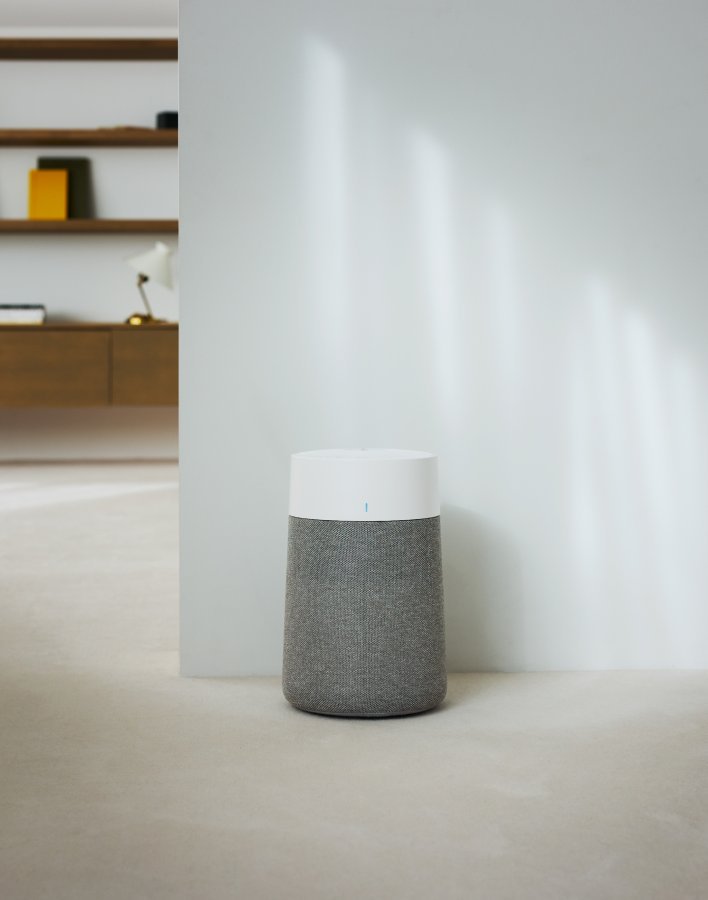

Blueair Blue Pure 511i Max
The 511i Max is the night-shift specialist. Its headline number is 19 dB on night mode, genuinely whisper territory, and it has a PM2.5 sensor that adjusts fan speed automatically during the day.
- 19 dB night mode, genuinely whisper territory, while a PM2.5 sensor auto-adjusts during the day
- Rated for 237 sq ft at 4.8 air changes per hour, so a bedroom-size load runs on a low, quiet setting
- Wi-Fi + app control, voice commands, RealTrack filter-life prediction
- 360° air intake; can sit against a wall without choking airflow; 4.2 lb and 17 W max
- Modest CADR for larger rooms: Blueair publishes a smoke CADR of 153 CFM, which rates the unit for 237 sq ft at 4.8 air changes per hour, so larger rooms will see lower air changes per hour.
- Daytime noise reaches about 48 dB on higher speeds: the 19 dB figure is night mode only, so daytime running is clearly audible.
- Smart features only pay off if you use them: the app, voice control and RealTrack filter-life prediction add nothing if you just want a simple set-and-forget purifier.
- Room size: 237 sq ft at 4.8 air changes per hour (manufacturer PDP)
- CADR: Pollen 174 CFM; Dust 159 CFM; Smoke 153 CFM (manufacturer PDP, updated to new DOE standards)
- Filtration: HEPASilent; 99.97% down to 0.1 micron
- Noise: 19 dB (night mode); up to about 48 dB
- Power: Max 17 W
- Weight: 4.2 lb (manufacturer PDP)
- Smart features: PM2.5 auto sensor, auto + night modes, RealTrack filter life, Wi-Fi + app, voice commands, 360° intake
Best for: Bedrooms and anyone who wants the purifier to think for itself
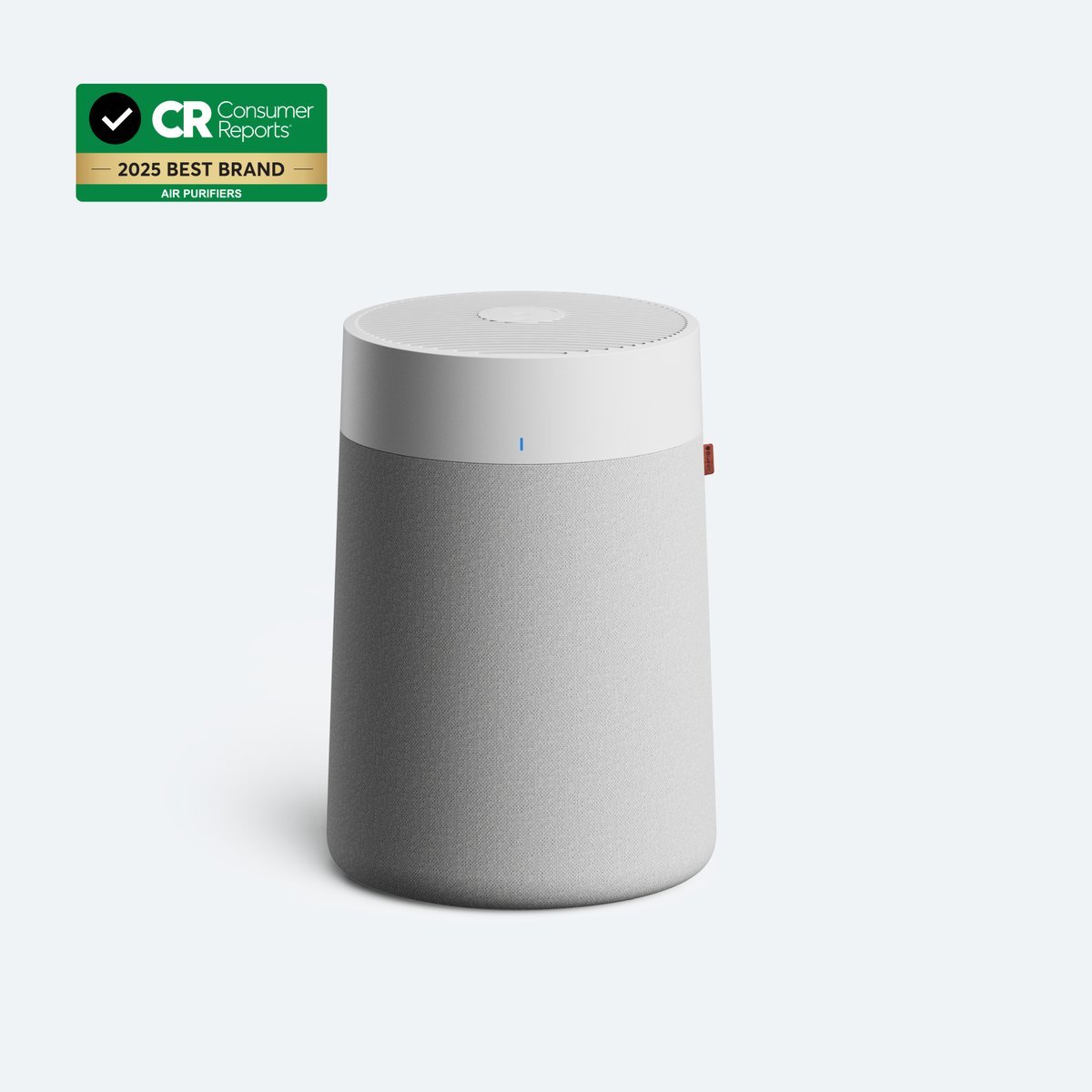
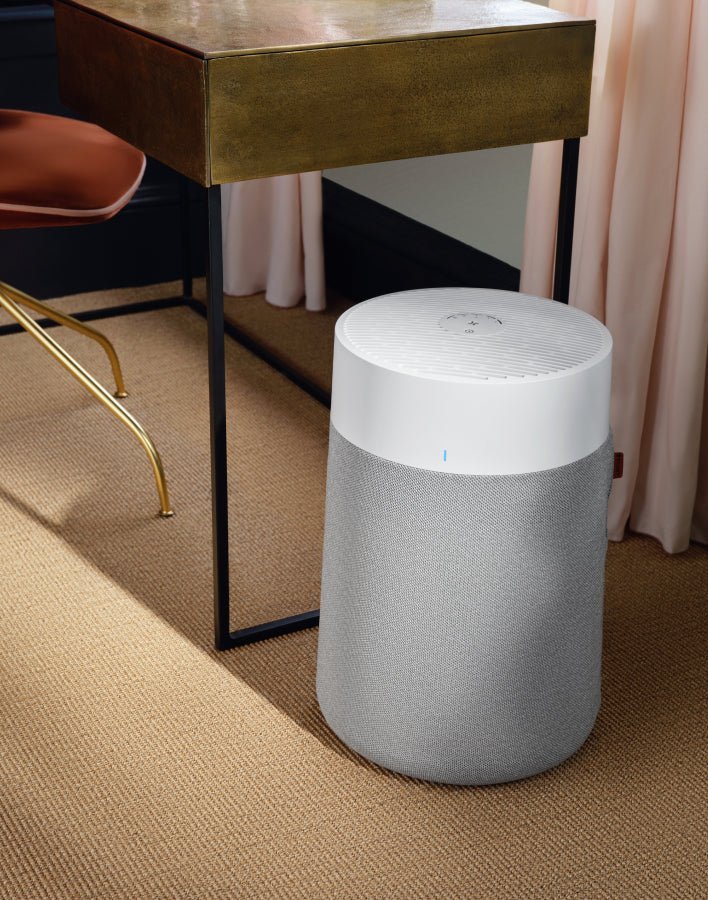
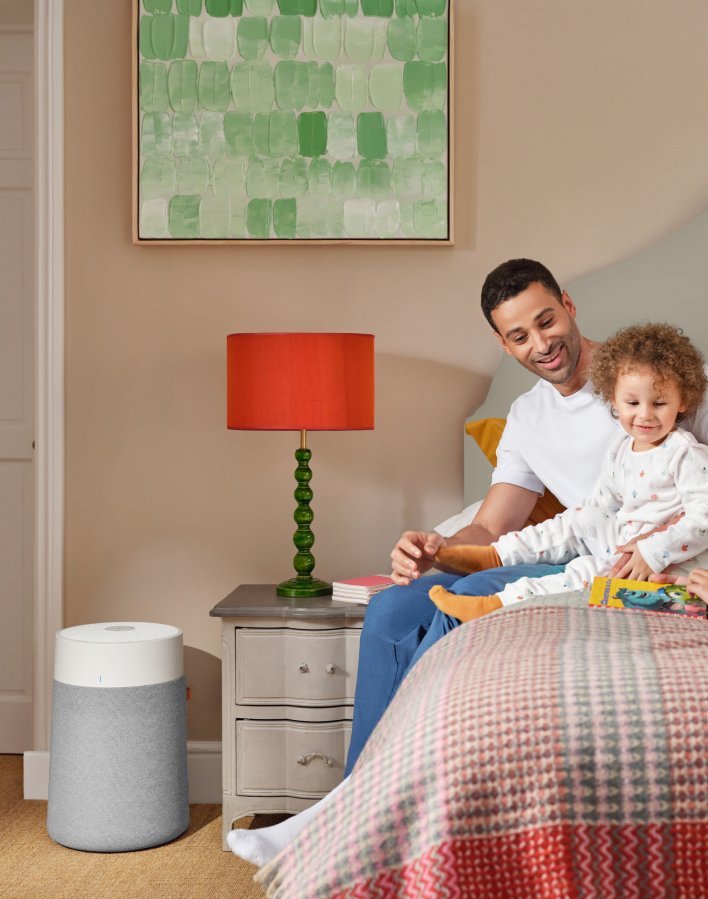
Blueair Blue Pure 311i Max
The 311i Max is the mid-size pick for a typical bedroom or home office: 283 CFM smoke CADR, 439 square feet at standard 4.8-air-changes math, and a lowest published noise level of 23 dB.
- 23 dB on low, close to the 511i Max 19 dB night mode (and decibels are logarithmic, so small differences matter)
- Same smart feature set as the 511i Max (auto mode, app control, night mode), sized for smaller rooms
- Goldilocks pick for 300 to 450 sq ft bedrooms and home offices
- CADR and coverage figures come from a third-party aggregator rather than Blueair directly, so treat them as provisional and confirm against Blueair's spec sheet before buying.
- Coverage tops out around 439 square feet: rooms larger than a mid-size bedroom or office need a bigger unit.
- Auto mode can ramp the fan up at night when the sensor detects something: use night mode to lock the fan low if you are a light sleeper.
- Room size: 439 sq ft at about 4.8 air changes/hour (third-party aggregator)
- CADR: 283 CFM smoke (third-party aggregator; provisional)
- Filtration: HEPASilent + carbon
- Noise: 23 dB (lowest published)
- Smart features: Auto mode, app control, night mode (same set as 511i Max)
Best for: Bedrooms and offices where the 511i Max is larger than you need
| Product | Key Specs | Best Use Case | Standout Feature | Amazon Link |
|---|---|---|---|---|
| Blueair Blue Pure 511i Max Best for bedrooms |
237 sq ft at 4.8 ACH; 19 dB night mode; PM2.5 auto sensor; app + voice | Quiet bedroom and small-room purification with auto sensing | 19 dB night mode; PM2.5 auto sensor; app + voice control | Check Price |
| Blueair Blue Pure 311i Max Best for mid-size rooms |
439 sq ft (4.8 ACH); 283 CFM smoke CADR; 23 dB low; app + auto | Mid-size bedroom and office purification | Mid-size sweet spot: 283 CFM CADR, 23 dB, smart features | Check Price |
Buying Guide: How to Choose a Pure Air Purifier
Forget the word "Pure" for a moment. Choosing an air purifier comes down to five decisions, and getting them in the right order saves you from the two most common regrets: buying too small, and buying louder than you expected.
1. Match the CADR to your room, not the room-size claim
Room-size claims are marketing; CADR (Clean Air Delivery Rate) is measurement. CADR tells you how many cubic feet of clean air the unit delivers per minute, rated separately for smoke, dust, and pollen. Of our picks, the 311i Max has a third-party-reported smoke CADR of 283 CFM, while Blueair publishes a smoke CADR of 153 CFM for the 511i Max (pollen 174 CFM, dust 159 CFM, updated to new DOE standards).
A practical rule from bedroom-purifier specialists: your purifier's smoke CADR should be at least two-thirds of your room's square footage. A 180-square-foot bedroom needs a smoke CADR of at least 120. The 311i Max (283 CFM) clears that bar for rooms up to about 425 square feet, consistent with its 439 sq ft claim. With a published smoke CADR, you can check the room-size claim yourself: the 511i Max at 153 CFM smoke CADR rates 237 sq ft at 4.8 air changes per hour, so a room much larger than that needs lower air changes or a bigger unit.
2. Buy slightly oversized if you want quiet
Here is the single most useful trick in this guide: an oversized purifier running on low is quieter than a correctly sized one running on high. Fan noise rises with speed, so a unit rated for 900 square feet will clean a 300-square-foot bedroom on its lowest, whisper-quiet setting while delivering the same air changes as a small unit straining at full speed. If quiet matters, deliberately buy one size up and run it on low or night mode.
3. Read the noise number that matches your real use
Manufacturers publish a noise range, and only the bottom of it matters for bedrooms. The numbers that count:
- Under 30 dB: whisper-quiet, fine for most sleepers (library-quiet).
- 30 to 40 dB: quiet background hum, most people sleep through it.
- Above 40 dB: you will hear it, fine for daytime, not for light sleepers.
Also pay attention to the kind of noise. A steady fan whoosh is white noise that many people find soothing or even sleep-aiding; rattling, humming motors, or vibration are mechanical noise and far more disruptive. And beware smart auto modes that suddenly ramp the fan up at 3 a.m. when the sensor detects something. A dedicated night/sleep mode that locks the fan low matters as much as the decibel number.
4. Filtration: True HEPA is the baseline, carbon handles smells
For particles, dust, pollen, pet dander, mold spores, True HEPA (99.97% of particles at 0.3 microns) is the non-negotiable standard. Be suspicious of "HEPA-type" or "HEPA-style," which are not the same certification. Blueair's HEPASilent is a real alternative (electrostatic plus mechanical, rated by the manufacturer to 0.1 micron), but note it is a manufacturer claim, not an AHAM test.
For odors, cooking smells, and VOCs, you need activated carbon. HEPA alone does nothing for gases. Both Blueair picks include a carbon layer. Extra stages (UV-C, ionizers) are optional: they add cost and, in the case of ionizers, a small ozone question (see FAQ), without changing the particle-filtration math.
5. Running costs: filters and electricity
The purchase price is only the down payment. Main filters on these units typically last about six months (Blueair's RealTrack models predict life from actual use rather than a calendar). Replacement-filter prices vary widely by brand, so check the cost of a year's worth of filters before you buy. It is the number that determines the real cost of ownership. Electricity is the good news: the 511i Max draws at most 17 watts.
Head-to-Head: The Comparison That Actually Matters
Blue Pure 511i Max vs. 311i Max
The 511i Max is the quieter machine (19 dB night mode, PM2.5 auto sensor, smoke CADR 153 CFM, rated 237 sq ft at 4.8 air changes per hour). Blueair also states 569 sq ft in 30 minutes and 1,138 sq ft in 1 hour for the 511i Max; those are time-basis figures, not 4.8 air-changes coverage. The 311i Max is the mid-size pick (23 dB low, around 439 sq ft, third-party-reported 283 CFM smoke CADR). Buy the 511i Max for a bedroom where silence and automation win. Do not buy it for rooms above 450 square feet expecting quiet 4.8 air-changes performance: at that size it cannot reach 4.8 air changes per hour, even at full speed. Buy the 311i Max for a 300 to 450 square foot bedroom or office where you want the same smart feature set with more coverage.
7 Mistakes to Avoid When Buying a Pure Air Purifier
- Assuming "Pure" means HEPA. It is a naming coincidence across three companies. Check the filtration spec, True HEPA or a named equivalent, on every model.
- Buying exactly to your room size. A purifier rated at your exact square footage must run on medium or high to keep up, and medium is where the noise lives. Size up for quiet.
- Trusting the high-speed noise number. You will live with the low speed. Compare models on their lowest published dB, and treat "not published" as a warning.
- Ignoring the filter-replacement cost. Six-month filter cycles are standard; a cheap purifier with expensive proprietary filters is the most expensive purifier.
- Placing it in a corner. Purifiers need airflow. A few feet from the bed, away from walls and furniture, cleans dramatically better than a unit tucked behind a nightstand.
- Turning it off at night. Particles keep settling and resuspending around the clock; a purifier only helps while it is running. This is why the night-mode noise number matters so much.
- Buying an ionizer-only "purifier" for a bedroom. Ionizers without a real filter charge particles so they stick to walls and bedding, and the EPA warns that ozone is a lung irritant, a bigger concern in a closed bedroom where you breathe the air for hours.
Bad Advice You Will Find Searching This Keyword
Because "pure air purifier" is an ambiguous keyword, the search results around it contain three traps worth naming:
Trap 1: "Pure" equals "pure air." Several thin affiliate pages treat any product with "pure" in the name as automatically the purest option, ranking them by keyword match rather than filtration. The word on the box is branding. CADR, True HEPA certification, and published noise figures are evidence. Buy the evidence.
Trap 2: Ozone-generator "purifiers" marketed as "pure air" machines. Some products ranking near this keyword generate ozone deliberately and market it as "purifying." The EPA's position is clear: ozone is a lung irritant, and these devices can produce it at levels that are a health concern indoors. A real air purifier filters air; it does not add chemicals to it.
Trap 3: Coverage claims with no air-change math. "Covers 2,000 sq ft" means nothing without stating how many air changes per hour that assumes. One air change per hour in a huge room is nearly useless. Compare models on CADR and on room size at a stated 4 to 5 air changes per hour, the way AHAM's methodology does.
Frequently Asked Questions
No. It is a keyword fragment that matches product names: Blueair's Blue Pure line, Pure Enrichment's PureZone line, and the Sensibo Pure. There is no filtration technology called "pure air purification." Judge each model on CADR, filtration type, and noise, not the name.
Among the models in this guide, the Blueair Blue Pure 511i Max publishes the lowest night-mode noise at 19 dB, followed by the 311i Max at 23 dB. As a general rule, look for a sleep-mode rating under 30 dB, a display that shuts off, and a unit rated above your room size so it can run on low all night.
True HEPA purifiers remove the airborne particles that trigger many allergies: pollen, dust-mite allergen, pet dander, mold spores. They do not cure allergies or treat asthma; they reduce the particle load in the air you breathe. For odor and chemical sensitivity, make sure the unit also has an activated-carbon layer, since HEPA does not capture gases.
Roughly every six months for the main filter on the models in this guide, though it depends on air quality and run time. The Blueair "i" models estimate remaining life from actual sensor and run-time data. Washable pre-filters (Blueair's fabric sleeve) should be cleaned every few weeks to extend main-filter life.
Yes. Air purifiers only clean while running, and particles continuously settle and resuspend. Continuous operation on a low, quiet setting is the standard recommendation, including overnight. This is another reason to size up: a larger unit on low cleans as well as a small unit on high, at a fraction of the noise.
The EPA warns that ozone, which some ionizers produce as a byproduct, is a lung irritant, and the concern is greater in a closed bedroom where you breathe the same air for hours. For bedrooms, the safer choice is a purely mechanical purifier: True HEPA for particles plus activated carbon for odors, with no ozone emission. Both picks in this guide follow that mechanical path.
Final Recommendations
Best for bedrooms: Blueair Blue Pure 511i Max, 19 dB night mode plus auto-sensing, the night-shift specialist
Best for mid-size rooms: Blueair Blue Pure 311i Max, the mid-size sweet spot, 23 dB low with the full smart feature set
Related Guides
- Best air purifier for dust: our guide to purifiers for dusty rooms.
Product photos are manufacturer-published images from Blueair's official product pages. Where a figure comes from a third-party source rather than the manufacturer, the card says so.