
A turntable without the right speakers is a beautiful object that barely makes a sound. The signal coming off a vinyl record is far too weak and unevenly balanced for ordinary speaker inputs, so the speakers you pair with a record player decide not just how your records sound, but whether they play at all. The good news: you don't need a receiver, a rack of separates, or an engineering degree. A pair of powered speakers, with the amplifier built in, plus a phono stage somewhere in the chain, is a complete vinyl system.
This guide covers powered speakers made to work with turntables: which ones accept a raw turntable signal directly, which ones need your turntable to have its own built-in preamp, and how to match a pair to your room, your turntable, and how you listen.
A note on scope: this guide recommends two pairs, both with built-in phono preamps. Cheaper turntable speakers exist, but this guide only links products that could be verified, so no unverified model appears here, whatever its price.
The Direct Answer
Get the Kanto YU4 if you want the safest, simplest choice. Its built-in phono preamp accepts a turntable's raw signal directly, with no separate preamp box and no receiver, and it adds Bluetooth, optical inputs, a remote, and a subwoofer output for later. If one pair must also handle TV and streaming at a premium level, the Klipsch The Fives is the complete all-in-one answer, with HDMI-ARC, a 192kHz USB DAC, and the loudest, most dynamic sound here. Note that both picks sit above the budget tier: this guide lists no budget pick because no budget model could be verified to the standard this guide requires.
Quick Picks
Short on time? These are our top recommendations, and each button takes you to the exact product on Amazon.
| Product | Key Specs | Best Use Case | Standout Feature | Amazon Link |
|---|---|---|---|---|
| Kanto YU4 Best Overall |
Phono stage built in · 140W · sub out | Best overall | The tidy all-in-one: amp + switchable phono stage in one cabinet | Check Price |
| Klipsch The Fives Best Premium All-in-One |
Phono + HDMI-ARC · 160W · 192kHz DAC | Best premium | One pair replaces soundbar, DAC, and phono stage | Check Price |
Detailed Reviews: The 2 Best Turntable Speakers
1. Kanto YU4: Best Overall
The Kanto YU4 earns the top spot because it removes the two decisions that trip up first-time vinyl buyers. The amplifier and a switchable phono stage live in the same cabinet, so a turntable with no built-in preamp plugs straight into the RCA input, while a turntable that already has a preamp just needs the rear switch flipped to line. Nothing else at this size and price does both jobs in one box as tidily, which is why it shows up as the top recommendation across nearly every current turntable-speaker roundup.
The hardware is built around a 4-inch Kevlar woofer and a 1-inch silk dome tweeter, driven by a 140-watt-peak (70-watt RMS) Class D amplifier. Listed frequency response runs 60 Hz to 20 kHz, so deep sub-bass is limited, but a dedicated subwoofer output lets you add low end later, and an 80 Hz filter arrangement keeps the main drivers focused when you do. Connectivity is generous: the switchable phono/line RCA input (with a proper ground terminal for the turntable's grounding wire), two optical inputs, a 3.5 mm AUX jack, Bluetooth 4.0 with aptX, and even a USB charging port on the back. The included remote handles volume, input, bass, treble, and balance from the listening position.
At 8.7 inches tall per cabinet, the YU4 fits on desks, bookshelves, and media consoles where bigger speakers won't. The honest limitation is output: it's a small-room and nearfield speaker. It fills bedrooms, offices, and apartments comfortably, but it won't pressurize a large open-plan living room the way its bigger sibling, the YU6, can.
Best for: first-time vinyl setups, apartments, desks, and anyone whose turntable lacks a built-in preamp. Watch out for: limited deep bass without a subwoofer; Kanto refreshed the YU line in 2026 (YU4 G2), so confirm which generation the listing shows before buying.

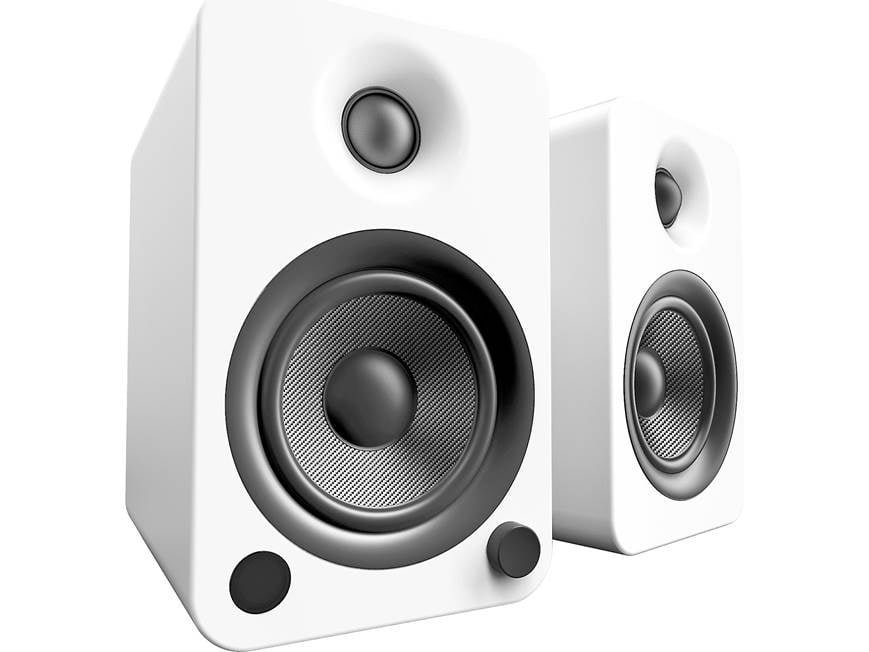

Kanto YU4
The top spot: the amplifier and a switchable phono stage live in the same cabinet, so a turntable with no built-in preamp plugs straight into the RCA input. 4-inch Kevlar woofer, 1-inch silk dome tweeter, 140W peak (70W RMS) Class D, switchable phono/line RCA with ground terminal, two optical inputs, 3.5mm AUX, Bluetooth 4.0 with aptX, subwoofer output, and an included remote.
- Built-in switchable phono stage, so no preamp needed
- 140W peak Class D, 4-inch Kevlar woofer, 1-inch silk dome tweeter
- Subwoofer output; optical ×2, AUX, Bluetooth aptX; included remote
- Limited deep bass without a subwoofer
- Small-room and nearfield speaker: it will not pressurize a large open-plan living room the way the bigger YU6 can
- Kanto refreshed the YU line in 2026 (YU4 G2): confirm which generation the listing shows before buying
- Driver: 4-inch Kevlar, 1-inch silk dome
- Power: 140W peak / 70W RMS
- Phono: Switchable phono/line
Best for: First-time vinyl setups, apartments, desks, and turntables lacking a built-in preamp
2. Klipsch The Fives: Best Premium All-in-One
If your speakers need to do more than play records, handling TV audio, streaming, and computer audio too, The Fives are the most complete single purchase in this guide. They're powered monitors with a built-in phono preamp (a switchable phono/line RCA input with a ground screw), and they layer on HDMI-ARC with CEC, Bluetooth 5 with aptX HD, USB-B, optical, and a 3.5 mm input, plus a subwoofer output. One pair genuinely replaces a soundbar, a desktop DAC, and a phono stage.
The driver complement is serious: a 4.5-inch high-excursion fiber-composite woofer and a 1-inch titanium LTS vented tweeter mated to Klipsch's 90° × 90° Tractrix horn, fed by 160 watts of total system power (320 watts peak). Listed response is 50 Hz to 25 kHz with dynamic bass extension down to 46 Hz, and maximum output is rated at 109 dB, comfortably the loudest, most dynamic pair here. The 192 kHz/24-bit USB DAC makes them a strong desktop audio hub too, and HDMI-ARC lets your TV remote control volume.
The trade-offs are price and personality. The horn-loaded tweeter is energetic and forward, exciting for rock and movies, but it can sound sharp if the speakers fire straight at you in a bright room; slight toe-in and soft furnishings help. There's also no Wi-Fi streaming, so network audio fans will miss AirPlay or Chromecast.
Best for: listeners who want one premium pair for vinyl, TV, and streaming, and rooms that need real output. Watch out for: forward treble that rewards careful placement; Dynamic Bass EQ ships enabled and is worth auditioning on and off.

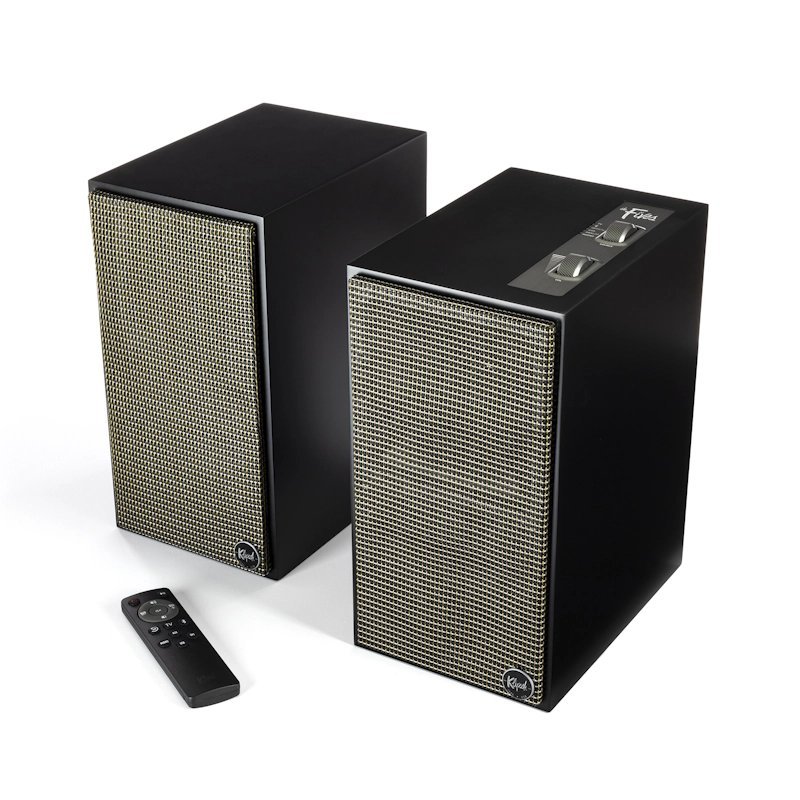

Klipsch The Fives
The most complete single purchase: powered monitors with built-in phono preamp (switchable phono/line RCA with ground screw), HDMI-ARC with CEC, Bluetooth 5 with aptX HD, USB-B, optical, 3.5mm, and subwoofer output. 4.5-inch high-excursion woofer, 1-inch titanium LTS tweeter on Klipsch's Tractrix horn, 160W system power (320W peak), 50Hz–25kHz, 192kHz/24-bit USB DAC.
- Built-in phono preamp + HDMI-ARC, replacing a soundbar, DAC, and phono stage
- 160W system power; 4.5-inch woofer, 1-inch titanium tweeter, Tractrix horn
- 192kHz/24-bit USB DAC; subwoofer output; Bluetooth 5 aptX HD
- Forward, energetic treble rewards careful placement and can sound sharp in a bright room
- No Wi-Fi streaming: no AirPlay or Chromecast
- Pricier than the Kanto YU4
- Dynamic Bass EQ ships enabled: audition it on and off before settling
- Power: 160W system (320W peak)
- Driver: 4.5-inch woofer, 1-inch titanium tweeter
- Inputs: Phono, HDMI-ARC, BT 5, USB, optical
Best for: Listeners who want one premium pair for vinyl, TV, and streaming
Buying Guide: How to Choose Turntable Speakers
The phono preamp question decides everything
A turntable's cartridge produces a "phono-level" signal: very quiet and deliberately uneven, with bass reduced and treble boosted during record cutting. A phono preamp (also called a phono stage) amplifies that whisper to "line level" and applies the RIAA equalization curve that restores the correct tonal balance. Without a phono preamp somewhere in the chain, records sound faint, thin, and tinny. This is the single most common setup mistake in vinyl.
You need exactly one phono stage, and it can live in any of three places:
- In your turntable. Many entry-level turntables (most Audio-Technica, Sony, and Fluance decks, for example) have a built-in preamp with a PHONO/LINE switch underneath or on the back. Set it to LINE when connecting to ordinary powered speakers.
- In your speakers. The Kanto YU4 and Klipsch The Fives in this guide have a switchable phono/line RCA input with a ground terminal. Set the switch to PHONO, connect the turntable's ground wire to the terminal, and you're done.
- As a separate box. A small external phono preamp (roughly the size of a deck of cards) sits between the turntable and any line-level powered speakers. This is also the upgrade path: a good external stage can outperform built-in ones.
The rule: count your phono stages. Zero means silence (or near-silence). Two means double-amplified, distorted sound. If your turntable's preamp is ON, the speaker's input must be set to LINE, and vice versa.
Powered vs. passive: which route?
Both picks in this guide are powered (active) speakers: the amplifier is built into one cabinet, so a turntable connects with a single cable and there's no receiver to buy, place, or learn. For most buyers, this is the right answer, with fewer boxes, fewer cables, and amplifiers matched to the drivers by the manufacturer.
Passive speakers (no built-in amp) are the alternative, and they're the right choice if you're building a traditional hi-fi system with a stereo receiver or integrated amplifier that has its own phono input. Passive plus a good amp can outperform powered speakers dollar-for-dollar at higher budgets, but the total system costs more and takes more space. If you're starting from scratch, powered is simpler and cheaper.
Match the speaker to your room
Speaker size and power should track room size. The compact 4-inch Kanto YU4 suits bedrooms, offices, and apartments up to roughly 200 square feet. For living rooms and open spaces, the Klipsch The Fives brings more output and deeper bass reach. And remember that bass depth follows physics: small cabinets can't move much air, so if deep bass matters in a small room, budget for a subwoofer. Both picks here include subwoofer outputs.
Think beyond vinyl
Your speakers will probably play more than records. Bluetooth (on both picks) covers phone streaming; optical inputs (on both picks) connect TVs and consoles; HDMI-ARC (The Fives only) turns the pair into a genuine soundbar replacement; USB (The Fives) handles computer audio. Buy for the system you'll actually use, not just the turntable.
Turntables With Built-In Speakers: A Different Product
Some shoppers searching for "turntable speakers" actually want a turntable with speakers built in: the all-in-one suitcase-style record players (Crosley, Victrola, Jensen, and similar) that play out of the box with no extra equipment. These exist, they're inexpensive, and they're the simplest possible way to hear a record.
Be clear-eyed about the trade-off: speakers squeezed into a turntable plinth are small, underpowered, and share a cabinet with a vibrating motor. They are the weakest link in every all-in-one system, and the short, lightweight tonearms on the cheapest models track records heavily. An all-in-one is fine for casual listening or as a gift, but anyone who cares about sound quality will outgrow one quickly. A modest turntable plus any pair of powered speakers in this guide sounds dramatically better and costs less than a premium all-in-one.
Do You Need a Separate Amplifier for a Turntable?
Short answer: only if your speakers are passive. Here's how the three setups compare:
- Powered speakers + turntable with built-in preamp (e.g., powered speakers + Audio-Technica AT-LP60X): the simplest system. One cable from turntable to speakers. No amplifier needed.
- Powered speakers with built-in phono preamp + any turntable (e.g., Kanto YU4 + a preamp-less deck): also one cable, and it works with turntables that have no preamp of their own. No amplifier needed.
- Passive speakers + amplifier/receiver + turntable: the traditional hi-fi route. The amplifier (or a receiver with a PHONO input) provides both the phono stage and the power. More flexible and upgradeable, but more expensive and more complex.
A standalone turntable amplifier search usually means one of two things: a phono preamp (to fix a quiet/thin signal into powered speakers) or a full integrated amplifier (to drive passive speakers). Identify which one your system is missing before buying.
How to Connect a Turntable to Powered Speakers
- Check for a built-in preamp on your turntable. Look for a PHONO/LINE switch on the back or underside. If it's there, set it to LINE (unless your speakers have their own phono input; see step 2).
- If there's no switch, check your speakers. Speakers with a PHONO/LINE switch (Kanto YU4, Klipsch The Fives) accept the raw turntable signal. Set the switch to PHONO.
- If neither has a phono stage, add an external phono preamp: turntable → preamp input, preamp output → speakers' RCA input.
- Connect the ground wire. Turntables have a thin ground wire (usually with a spade or U-shaped terminal). Attach it to the ground terminal on the speaker or preamp. Skip this and you'll likely hear a low hum.
- Use the right cable. A standard stereo RCA cable is all you need for wired connections. The red and white plugs go to the matching jacks.
- Set volumes sensibly. Start with the speakers at low volume, drop the needle, then bring the level up. If the sound is distorted even at low volume, you probably have two phono stages active. Switch one to LINE.
Mistakes to Avoid
- Plugging a turntable into line-level speakers with no phono stage. The result is barely audible, tinny sound, the most reported "my speakers are broken" problem in vinyl, and it's a setup error, not a defect.
- Running two phono preamps at once. Turntable preamp ON plus speaker input on PHONO equals loud, distorted, bass-heavy sound. One phono stage only.
- Forgetting the ground wire. That thin extra wire isn't optional; without it, expect hum.
- Buying on watts alone. A 42-watt pair with efficient drivers can play louder and cleaner than a cheap 100-watt pair. Room size and driver size matter more than the wattage number.
- Ignoring placement. Speakers crammed into a bookshelf corner or sitting directly on the same surface as the turntable will sound boomy and can feed vibration back into the stylus. Give them space, and ideally put the turntable on a separate, stable surface.
- Expecting deep bass from compact speakers. Physics is non-negotiable: 4-inch woofers don't produce sub-bass. If you want it, plan for a subwoofer output. Both picks here have one.
Bad Advice to Ignore When Shopping for Turntable Speakers
While checking what currently ranks for this topic, we found advice worth warning you about:
- All-in-one turntables listed as "speakers." At least one ranking page lists suitcase turntables (Crosley- and Jensen-style units) under "best speakers for record players." Those are turntables with tiny built-in speakers. Buying one expecting a speaker pair leaves you with a second turntable and no real speakers. Speakers and turntables are different products; this guide covers speakers.
- "Most powered speakers are designed specifically for vinyl." One ranking site claims this outright. It isn't true: most powered speakers are line-level devices with no phono stage, which is precisely why the preamp question matters. Treat any source that glosses over the phono preamp as unreliable.
- "Just plug any powered speaker into your turntable." Several thin pages imply universal plug-and-play. Without a phono preamp in the turntable, the speakers, or a separate box, that connection produces the classic thin, quiet, tinny result. Always verify where your phono stage lives before you buy.
Frequently Asked Questions
Not directly. The turntable's signal must pass through a phono preamp before reaching the speakers, via a preamp built into the turntable, a phono input on the speakers (like the Kanto YU4 or Klipsch The Fives), or a separate preamp box. Any powered speakers with an RCA or AUX input work once that requirement is met.
Almost always a missing phono preamp. A raw turntable signal is far weaker than the line-level signal speakers expect, and it hasn't been RIAA-equalized, so it also sounds thin. Check whether your turntable or speakers have a PHONO/LINE switch and make sure exactly one phono stage is active.
Yes. "Powered" means the amplifier is built into the speaker cabinet, so each pair needs mains power, usually one power cable for the active speaker, with the second speaker connected by speaker wire.
Only in specific cases. Some turntables have built-in Bluetooth transmitters that can pair with Bluetooth speakers, and Bluetooth-equipped powered speakers (like both picks here) accept wireless audio from any Bluetooth source. But a standard wired turntable cannot talk to a Bluetooth-only speaker without a Bluetooth transmitter adapter, and wired RCA always sounds better for vinyl.
The brands behind this guide's two picks are Kanto and Klipsch. What matters more than the badge is the feature set: a phono input if your turntable needs one, enough power for your room, and the extra inputs (Bluetooth, optical, subwoofer out) you'll actually use.
Not necessarily, but small bookshelf speakers can't produce deep bass. It's a physical limit of small drivers, not a defect. If you listen to bass-heavy music or want home-theater-style low end, choose speakers with a subwoofer output (both picks here have one) so you can add a sub later.
Only for casual listening. All-in-one turntables are convenient and cheap, but their tiny built-in speakers are the weakest part of the system, and the cheapest models can track records heavily. A basic turntable plus dedicated powered speakers sounds substantially better for similar money.
We only link a product once we have verified the exact model. Several other turntable speakers were considered for this guide, but we could not verify them to that standard, so they are left out rather than linked unverified. The two pairs in this guide cover the two most useful shapes: a compact all-rounder and a premium all-in-one, and both accept a turntable signal directly through a built-in phono preamp.
Final Verdict
For most vinyl listeners, the Kanto YU4 is the right buy: its built-in phono preamp works with any turntable, the feature set covers Bluetooth, optical, and future subwoofer expansion, and the compact cabinets fit real rooms. If one pair must handle vinyl, TV, and streaming at a premium level, the Klipsch The Fives is the complete answer. Both picks sit above the budget tier, so treat this guide as a verified shortlist rather than a budget roundup.
Whatever you choose, get the phono preamp question right first. It's a five-minute check that decides whether your records sing or whisper.
Final Recommendations
Best Overall: Kanto YU4, the best overall turntable speaker
Best Premium All-in-One: Klipsch The Fives, the premium all-in-one