
Let's clear this up first: you're looking for a splitting axe. "Spitting axe" is one of the most common misspellings in the tool world, and search engines see it constantly, but the tool that splits firewood is spelled s-p-l-i-t-t-i-n-g. Now that we're on the same page: a splitting axe is a specialized tool with a heavy, wedge-shaped head designed to force wood fibers apart along the grain, and picking the right one is the difference between satisfying one-strike splits and an afternoon of stuck blades and sore shoulders.
What actually makes a splitting axe different from a regular axe? Geometry. A felling or chopping axe has a thin, sharp bit designed to sever wood fibers across the grain. A splitting axe has a thick, wedge-shaped head designed to force fibers apart along the grain. It works like a wedge you swing, not a knife. That single design difference is why the right tool turns splitting into satisfying one-strike work while the wrong tool turns it into an afternoon of stuck blades.
A note on how this guide was built. Our research covered six well-regarded splitting axes and mauls, but we only recommend a product when we can verify its exact Amazon listing from two independent non-Amazon sources and confirm three real manufacturer photos of the exact variant. Only one tool passed that bar, and it is the single pick below. The other five are covered honestly in the Also Considered section, without purchase links, because we could not verify their listings to that standard. This is a single-product review, not a roundup, and it says so plainly rather than padding the list with unverified tools. This guide is research-based: it compares manufacturer specifications and published findings from independent reviewers, and it makes no hands-on testing claims.
If you're in a hurry, here's the short version.
The Short Answer
Best overall splitting axe: the Fiskars X27 Super Splitting Axe (36"), the reference point the whole category is measured against. Its 4.3 lb forged-steel head, wedge-shaped bevel-convex blade and 36-inch FiberComp handle deliver genuine one-strike splits on medium to large rounds, and it carries a lifetime warranty.
No second pick is recommended in this review. The strongest runner-up, the Fiskars IsoCore 8 lb Splitting Maul, is covered as an unlinked mention in Also Considered: its Amazon listing could not be verified from two independent non-Amazon sources, so under our standard it earns no purchase button.
Quick Picks
Short on time? This is our one verified recommendation, and its button takes you to the exact product on Amazon.
The Pick at a Glance
| Product | Key Specs | Best Use Case | Standout Feature | Amazon Link |
|---|---|---|---|---|
| Fiskars X27 Super Splitting Axe 36" Best Overall |
36 in; 4.3 lb head; 6.28 lb total; FiberComp handle | taller users splitting medium to large rounds as their main firewood chore | Bevel-convex wedge blade with insert-molded head that cannot loosen | Check Price |
All specifications are manufacturer-listed figures for the exact variants linked, cross-checked against the sources named in each review.
Detailed Review
Fiskars X27 Super Splitting Axe 36": Best Overall

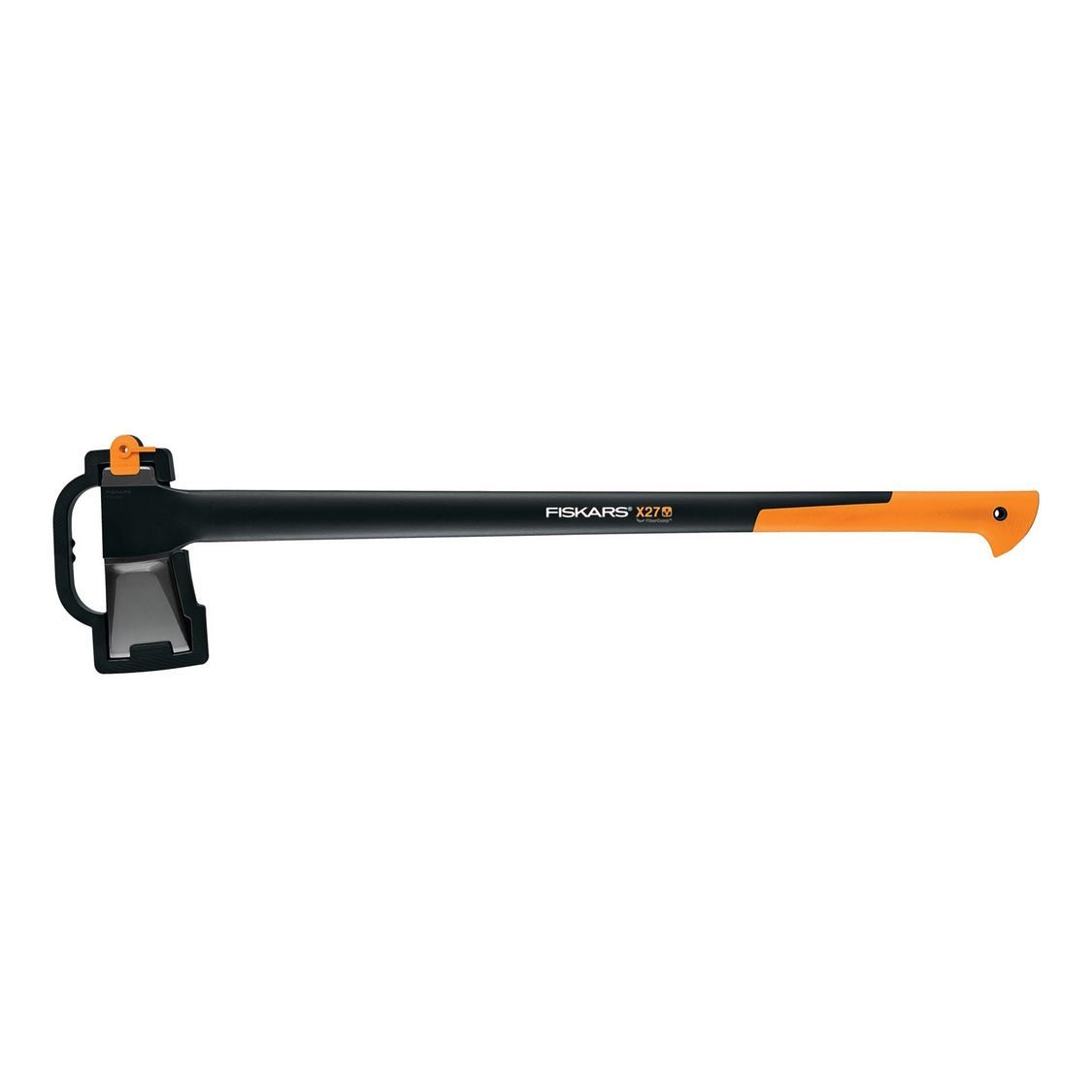

Fiskars X27 Super Splitting Axe 36"
The X27 is not just a good splitting axe, it is the reference point the entire category is measured against. Men's Journal's 2026 outdoor tool awards named it their best splitting axe, and it is the near-universal recommendation across 2026 roundups for a simple reason: the combination of a 4.3 lb forged-steel head with bevel-convex wedge geometry and a 36-inch FiberComp handle produces genuine one-strike splits on medium to extra-large rounds, at a total weight of just 6.28 lb.
- Maximum splitting power in its class: the long handle builds head speed, so the axe does the work instead of your arms
- Insert-molded PermaHead design: the head is molded into the handle and cannot loosen the way traditional wedged heads eventually do
- Low-friction blade coating helps the head pop back out of the wood instead of sticking, and the proprietary grinding keeps the edge sharp longer
- Backed by a full lifetime warranty, and the 36-inch length keeps the blade well away from your feet on a bad swing
Reasons to avoid:
- Long and unwieldy for shorter users: if you are under about 5 ft 8 in, a 28-inch axe will likely serve you better
- Harder to aim precisely on small pieces, and complete overkill for kindling
- The 36-inch handle needs real storage space and is awkward to transport in a small vehicle
- Model: 378841-1002
- Length: 36 in
- Head weight: 4.3 lb
- Total weight: 6.28 lb
- Handle: FiberComp composite, shock-absorbing
- Blade: hardened forged steel with low-friction coating
- Warranty: full lifetime warranty
Best for: taller users and anyone splitting medium to large rounds as their main firewood chore.
The details are what make the X27 work. The head is insert-molded to the handle, Fiskars' PermaHead design, so it can't loosen the way traditional wedged heads eventually do, and overstrike damage that would snap a wooden handle just scuffs the composite. The blade's bevel-convex profile is the splitting-specific part: rather than a thin edge that slices, the cheeks widen quickly behind the edge and physically push the two halves of the round apart as the head drives in. That is why owners consistently report one-strike splits on straight-grained rounds that would swallow a chopping axe whole. The low-friction coating then helps the head release instead of wedging itself fast.
Weight distribution is the other half of the story. At 6.28 lb total, the X27 is remarkably light for its power, because the long FiberComp handle contributes leverage rather than mass. Fiskars describes the balance as perfected to increase swing speed, and swing speed matters as much as head weight: a 4.3 lb head swung fast delivers more splitting energy than a heavier head swung tired. The trade-off is control. Thirty-six inches is a lot of axe, and on small rounds or short pieces it is harder to place the blade exactly where you want it. If you are of average height or shorter, or your rounds are mostly modest, a 28-inch axe with the same head design is the more accurate tool, even if it occasionally needs a second swing on the biggest rounds.
Best for: taller users and anyone splitting medium to large rounds as their main firewood chore.
Watch out for: the length. It is the X27's superpower and its one real weakness. Buy it for the wood and the user it fits, not because it tops every list.
Also Considered: Five Good Tools We Do Not Link
Our research also covered five other respected tools. Each is a legitimate product, but we could not verify its exact Amazon listing from two independent non-Amazon sources, so under our verification standard they appear here as unlinked mentions only, with no purchase buttons. If their listings become verifiable, they can be promoted into the picks in a future update.
Fiskars IsoCore 8 lb Splitting Maul 36". The strongest runner-up and the maul-format counterpart to the X27: an 8 lb forged head with Fiskars' IsoCore Shock Control System, built for knotty, twisted and green rounds that trap axe blades. It is unlinked here because its Amazon listing failed our verification standard: the only non-Amazon pages printing its ASIN were Amazon affiliate plugin shortcodes on third-party roundups, which are Amazon-derived markup rather than independent prints, and no retailer, catalogue or price-history page printing the ASIN in its own product data could be found despite a targeted hunt. If that evidence appears, it can be promoted into a pick in a future update.
Fiskars X25 Splitting Axe 28". The X27's shorter sibling: the same roughly 4 lb head and wedge geometry on a 28-inch FiberComp handle. Swings are more accurate, storage and transport are easier, and for average-height users splitting standard rounds it is arguably the smarter default than the X27. The trade-off is pure physics: less leverage and less head speed, so the very largest rounds may take an extra swing.
Gränsfors Bruk Large Splitting Axe. The traditional pole of the category: a 3.5 lb hand-forged head, stamped with the smith's initials, on a 27.5-inch American hickory handle. Superb on straight-grained wood, fully maintainable and re-handleable, and priced like the heirloom it is. Hickory needs occasional care, and it will not match the X27's brute wedge power on the gnarliest rounds.
Husqvarna S2800. A 5 lb head on a 28-inch composite handle: more splitting authority than the 4 lb Fiskars axes in a controllable length, which suits shorter, stronger users. It is also the heaviest axe-format tool in our research set, and you will feel that after an hour of splitting.
Estwing Fireside Friend 14". A one-piece forged-steel splitting tool that is really a wedge with a handle, built for one job: turning split firewood into kindling at the fireside. Nothing to loosen or break, and the compact size makes it controllable one-handed on a chopping block. It is a companion to a full-size axe, never a replacement for one.
How We Chose
Every product in this guide started from manufacturer specifications, then was cross-checked against published 2026 roundups and specialist axe guides. A pick then had to pass two hard checks before it earned a purchase button. First, its exact variant, model and configuration as reviewed, had to have its Amazon ASIN printed by two independent non-Amazon sources; Amazon's own pages never count as evidence. Second, we needed three real manufacturer photos of that exact variant, each viewed at full size. Five of the six researched tools failed the first check and were moved to Also Considered rather than linked on weaker evidence. No hands-on testing was performed for this guide, and any performance finding attributed to another reviewer is labelled as theirs.
Buying Guide: How to Choose a Splitting Axe
Length: match the handle to your height
Handle length is the most important sizing decision. A 36-inch tool like the X27 suits taller users, roughly 5 ft 10 in and up, and large rounds; it gives maximum leverage and, counterintuitively, is the safest length for beginners, because a bad swing buries the head in the dirt well away from your feet. A 28-inch axe is the all-rounder for average-height users: easier to aim, store and transport. Short tools around 14 inches are for kindling only, never primary splitting. A shorter axe also puts your legs in the danger zone on a bad swing, because the arc can carry the head into your shins after it passes through the wood.
Head weight: about 4 lb is the sweet spot
For splitting axes, a head of around 4 lb is the proven balance of power and swing speed. Heavier heads, 5 to 8 lb and into maul territory, split tougher wood but fatigue you faster; lighter heads are for kindling and carving. Do not assume heavier is better: swing speed contributes as much energy as head weight, and a 4 lb head swung fast out-splits a 6 lb head swung tired.
Axe vs maul: know which job you're doing
A splitting axe has sharp wedge geometry and a 3.5 to 5 lb head; for seasoned, straight-grained firewood it is the faster, less tiring option. A splitting maul is a blunter, heavier wedge of 6 to 8 lb or more; it exists for knotty, twisted, green or oversized rounds that trap axe blades. Most homeowners need a splitting axe first and add a maul only if their wood demands it.
Handle material: composite vs hickory
Composite handles like Fiskars' FiberComp are lighter, need zero maintenance, and on insert-molded designs the head cannot loosen. Hickory offers traditional feel and feedback, can be repaired and re-handled, but needs care: dry storage, occasional oiling, and a head check before each session, since traditional wedged heads can work loose over time.
Match the tool to the wood
Seasoned hardwoods such as oak, maple and ash, dried 6 to 12 months, split cleanly with any good axe; this is the X27's home turf. Green, unseasoned wood is tougher and heavier; let it season first if you can, or reach for a heavier maul-format tool. Knotty, twisted and crotch wood defeats axes regularly and is maul territory. Softwoods like pine and fir split easily but burn fast. Elm is famously stringy, and even mauls struggle with it. If 90 percent of your wood is straight-grained and seasoned, one splitting axe handles everything.
Splitting Technique and Safety Basics
Good technique matters more than an expensive axe. Split on a sturdy chopping block, a large round 12 to 18 inches tall, never on the ground: the block sets the wood at a comfortable height and stops the blade safely. Stand with feet shoulder-width apart and well clear of the block, and let the axe do the work; raise it and let gravity plus momentum drive it down rather than muscling it. On large rounds, split slabs off the outside edges first instead of attacking the center, and split along existing checks in the end grain, working around knots rather than through them. If a head sticks, do not wrestle it: lift the axe with the log attached and bring the whole thing down on the block together. An old tire strapped to the top of the block, with rounds set inside it, holds split pieces upright and easily doubles your pace.
The safety rules are non-negotiable. Wear eye protection and sturdy boots, never sandals. Clear the area: no people or pets within two axe-lengths. Never hold the wood you are swinging at; that is the leading cause of hand injuries with short axes, and a piece that needs holding is too small for the axe. Check the head before every session, split sober, rested and in daylight, and sheath the blade whenever the tool leaves your hands.
Frequently Asked Questions
A splitting axe, with a head of about 3.5 to 5 lb, has a relatively sharp wedge for forcing apart seasoned, straight-grained wood quickly. A splitting maul, at 6 to 8 lb or more, is a blunter, heavier wedge that splits by mass: slower, but able to power through knotty, twisted or green wood that traps axe blades. Own the axe first; add the maul if your wood demands it.
Match handle length to your height: 36 inches for taller users and large rounds, 28 inches as the all-rounder for average height, and short tools only for kindling. A head weight around 4 lb is the proven sweet spot for axes; go heavier, into maul territory, only for difficult wood.
By the consensus of 2026 roundups, including Men's Journal's best splitting axe award, yes. The 4.3 lb head, 36-inch shock-absorbing handle, stick-resistant coating and lifetime warranty make it the default recommendation. The main reasons to choose otherwise are height, since shorter users often prefer a 28-inch axe, or a preference for traditional forged tools with wooden handles.
A splitting axe should be sharp but not razor-honed like a carving axe. The wedge geometry does the splitting, not a razor edge, and an overly thin edge chips on knots and hard wood. The convex bevel profile used on the X27 is the right shape: sharp enough to bite, thick enough to wedge.
Keep the edge touched up with a file or puck sharpener, wipe the head dry after use or oil it lightly, and store the tool sheathed in a dry place. Composite handles need nothing; hickory handles benefit from occasional boiled linseed oil and dry storage. Check traditional heads for looseness before each session.
You can, badly. Chopping axes have thin bits meant to cut across grain, so in splitting work they stick constantly and can glance dangerously. A splitting axe's thick wedge geometry is purpose-built to force grain apart. Using the wrong geometry is the most common reason beginners think they are bad at splitting when they simply have the wrong tool.
Split first, then season: splitting exposes interior grain and dramatically speeds drying. Most hardwoods need 6 to 12 months of stacked, covered, ventilated storage after splitting to reach the sub-20 percent moisture content that burns cleanly. Splitting green wood is harder work, so many splitters work through their pile in spring for the following winter's fires.
Final Verdict
For most firewood splitters, the Fiskars X27 remains the answer in 2026: maximum splitting power, a lifetime warranty, and a one-strike reputation earned across virtually every serious roundup. If your pile includes the ugly rounds, the knotty, twisted and green pieces that trap axe blades, a heavier maul-format tool is the specialist for that job, but buy the axe first and add the maul only if your wood demands it. And remember the spelling: it's a splitting axe. Whatever you typed into the search bar, now you know which tools to buy, how to size them, and how to swing them safely.
Final Recommendations
Best Overall: Fiskars X27 Super Splitting Axe 36": 4.3 lb head, FiberComp handle, lifetime warranty.
Related Guides
- choosing between hand tools and machinery: splitting axes and mauls versus powered log splitters, and when the powered tool earns its cost.
- chopping versus splitting explained: why felling axes and splitting axes are different tools, and which jobs each one owns.
- a beginner's first axe: how to pick a first axe for firewood, camp and yard work without overspending.