
A circular saw is the one power tool that crosses every boundary of the trade: framers hang walls with them, remodelers break down plywood with them, and DIYers build their first deck with them. Which is why buying one deserves better than a five-minute scan of star ratings. The differences that matter (worm drive versus sidewinder torque, electric brakes, guard quality, and how a saw's weight feels on your fourth hour of cutting) don't show up in a spec table, but they decide whether the saw you buy becomes a lifelong tool or an expensive shelf ornament.
Every pick below is a real product with manufacturer-documented specifications selected because independent roundups from woodworking and tool publications keep putting the same handful of models at the top. We have not hands-on tested these saws. The verdicts below are research-based, built from manufacturer spec pages, owner manuals, and published tool-site reviews.
The Short Answer
Best overall circular saw: the SKILSAW SPT77WML-01: the classic 15-amp worm drive (7-1/4" blade, 11.5 lb, magnesium construction, bevel to 53°) that framers have measured everything else against for decades. If you want one saw that never bogs down in wet framing lumber and lasts through a career, start here.
Best corded sidewinder: the DEWALT DWE575SB: 15 amps, 5,200 RPM, only 8.8 lb with an electric brake and 57° bevel capacity. The saw that makes worm-drive torque unnecessary for most people, at a weight your arm will thank you for.
Best cordless circular saw: the Milwaukee M18 FUEL 2732-20: 18V brushless, 5,800 RPM, magnesium shoe and guards, electric brake, and manufacturer-claimed corded-15-amp performance. The pick for the cordless jobsite, with the weight (~9 lb bare, ~12.6 lb with the 12Ah battery) to prove it's a real full-size saw.
Best value: the SKIL 5280-01: 15 amps, 5,300 RPM, 8.7 lb, with a single-beam laser guide and dust blower. Genuine full-size cutting capacity (2-3/8" at 90°) without the pro-tool price.
Lightest circular saw: the DEWALT DCS565: 20V MAX, 6-1/2" blade, brushless, just 6.3 lb as a bare tool with a 50° bevel. The one-handed-feeling saw for sheet goods, trim, and overhead work.
Quick Picks
Short on time? These are our top recommendations. Each button takes you to the exact product on Amazon.
Comparison Table
| Product | Key Specs | Best Use Case | Standout Feature | Amazon Link |
|---|---|---|---|---|
| SKILSAW SPT77WML-01 Best Overall Circular Saw |
15A corded; 7-1/4"; 11.5 lb | Framing pros, heavy lumber | 15A worm drive, 7-1/4", 11.5 lb, 53° bevel | Check Price |
| DEWALT DWE575SB Best Corded Sidewinder |
15A corded; 7-1/4"; 8.8 lb | All-round corded pick | 15A, 5,200 RPM, 8.8 lb, electric brake, 57° bevel | Check Price |
| Milwaukee M18 FUEL 2732-20 Best Cordless Circular Saw |
18V cordless; 7-1/4"; ~9 lb bare | Cordless jobsites | 18V brushless, 5,800 RPM, magnesium shoe, electric brake | Check Price |
| SKIL 5280-01 Best Value |
15A corded; 7-1/4"; 8.7 lb | Budget DIYers | 15A, 5,300 RPM, 8.7 lb, laser guide, 51° bevel | Check Price |
| DEWALT DCS565 Lightest Circular Saw (Best Compact) |
20V MAX cordless; 6-1/2"; 6.3 lb bare | Lightweight/trim work | 20V MAX, 6-1/2", 4,950 RPM, 6.3 lb bare tool, 50° bevel | Check Price |
Weights are manufacturer or manual-documented figures; cordless weights are bare-tool figures (battery adds weight). RPM figures are no-load.
Detailed Reviews
SKILSAW SPT77WML-01: Best Overall Circular Saw
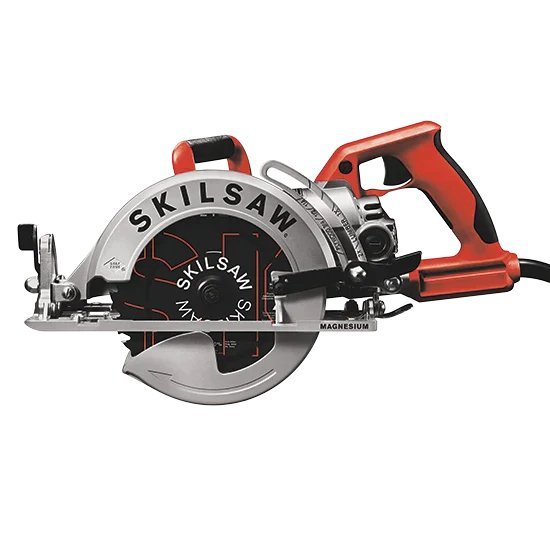
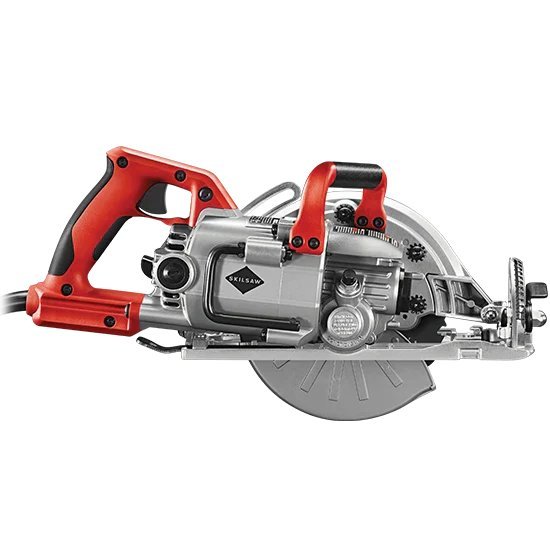
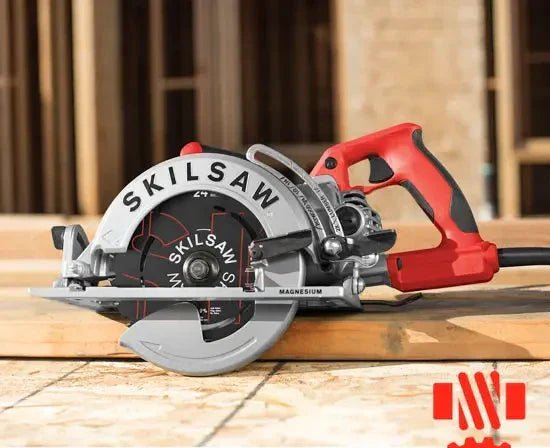
SKILSAW SPT77WML-01
The reference point. If there is one circular saw the trade agrees on, it's the SKILSAW worm drive: a 15-amp Dual-Field motor driving a 7-1/4" blade through a worm-gear drivetrain that delivers the kind of torque that pulls through wet, doubled-up framing lumber without a complaint. The SPT77WML-01 is the magnesium update of that legend: the footplate and gear housing are magnesium, which is how
- The specs read like a framing checklist: 2-3/8" depth of cut at 90° (enough for 2x lumber), 1-15/16" at 45°, bevel capacity to 53° with common stops, and a Cut-Ready depth system for fast, repeatable depth settings.
- It ships with a 24-tooth carbide blade and a multifunctional wrench.
- The Dual-Field motor design (dual copper coils) is aimed at cooler operation under sustained load, which is exactly what long rip sessions demand.
Important limitation: It's the heaviest saw in this guide at 11.5 lb, and worm drives sit the blade on the left, so right-handed users either love the sightline or never get used to it. No electric brake on this model, so the blade coasts after you release the trigger; set the saw down only after the blade stops.
- Motor: 15 amps, 120V (1,800W), Dual-Field design
- Blade: 7-1/4", 5/8" arbor (24-tooth carbide blade included)
- Weight: 11.5 lb
Best for: Framers, contractors, and anyone cutting heavy or wet lumber daily. If your saw earns its keep on a jobsite, the worm drive is still the answer.
Verdict: The reference point. If there is one circular saw the trade agrees on, it's the SKILSAW worm drive: a 15-amp Dual-Field motor driving a 7-1/4" blade through a worm-gear drivetrain that delivers the kind of torque that pulls through wet, doubled-up framing lumber without a complaint. The SPT77WML-01 is the magnesium update of that legend: the footplate and gear housing are magnesium, which is how a worm drive (a layout notorious for weight) comes in at 11.5 lb.
The specs read like a framing checklist: 2-3/8" depth of cut at 90° (enough for 2x lumber), 1-15/16" at 45°, bevel capacity to 53° with common stops, and a Cut-Ready depth system for fast, repeatable depth settings. It ships with a 24-tooth carbide blade and a multifunctional wrench. The Dual-Field motor design (dual copper coils) is aimed at cooler operation under sustained load, which is exactly what long rip sessions demand.
Key specifications (per the product manual and spec data): - Motor: 15 amps, 120V (1,800W), Dual-Field design - Blade: 7-1/4", 5/8" arbor (24-tooth carbide blade included) - Weight: 11.5 lb - Depth of cut: 2-3/8" at 90°, 1-15/16" at 45° - Bevel: up to 53° - Construction: magnesium footplate and gear housing - In the box: saw, 24-tooth carbide blade, multifunctional wrench
Who it's for: Framers, contractors, and anyone cutting heavy or wet lumber daily. If your saw earns its keep on a jobsite, the worm drive is still the answer.
Limitations, honestly: It's the heaviest saw in this guide at 11.5 lb, and worm drives sit the blade on the left, so right-handed users either love the sightline or never get used to it. No electric brake on this model, so the blade coasts after you release the trigger; set the saw down only after the blade stops.
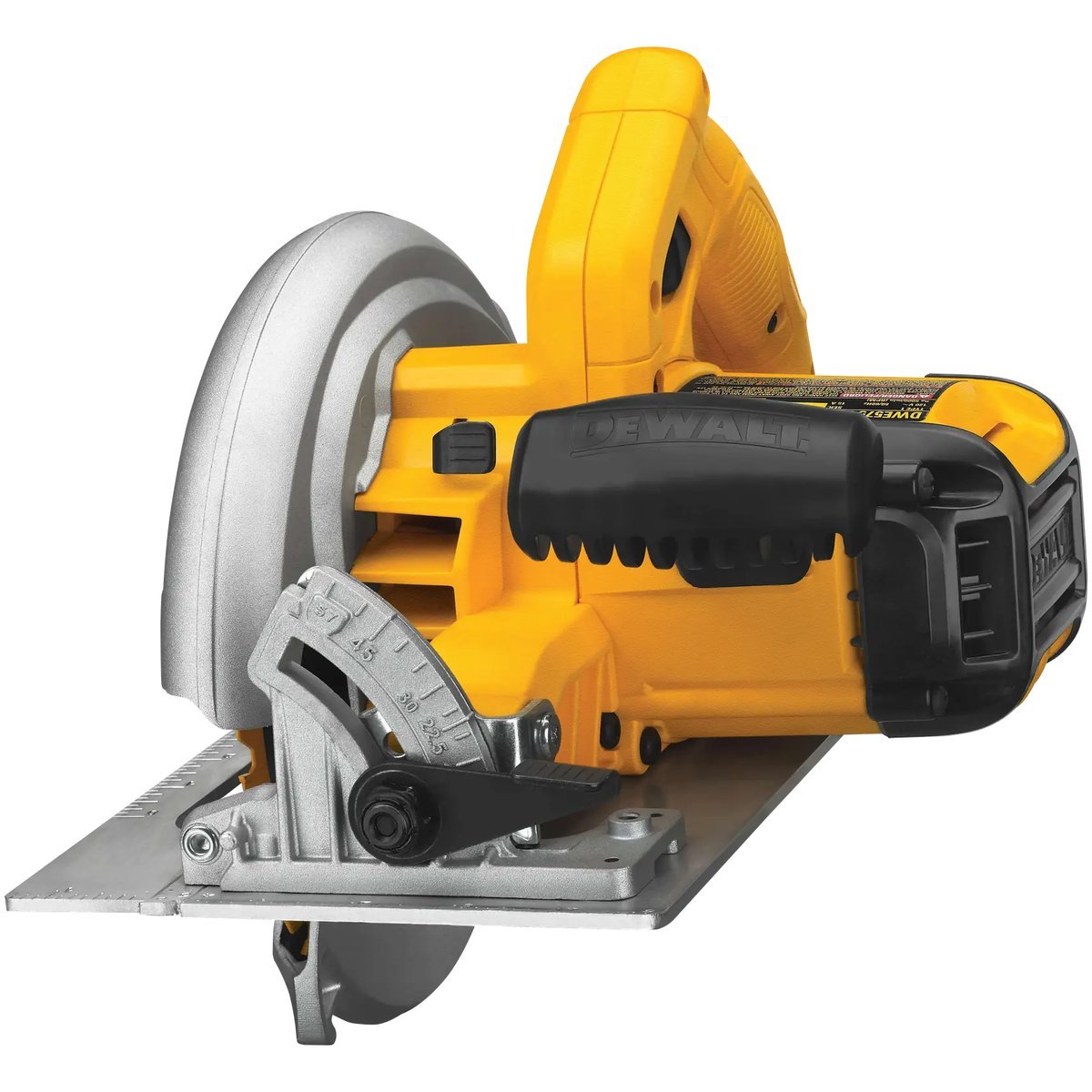
DEWALT DWE575SB: Best Corded Sidewinder
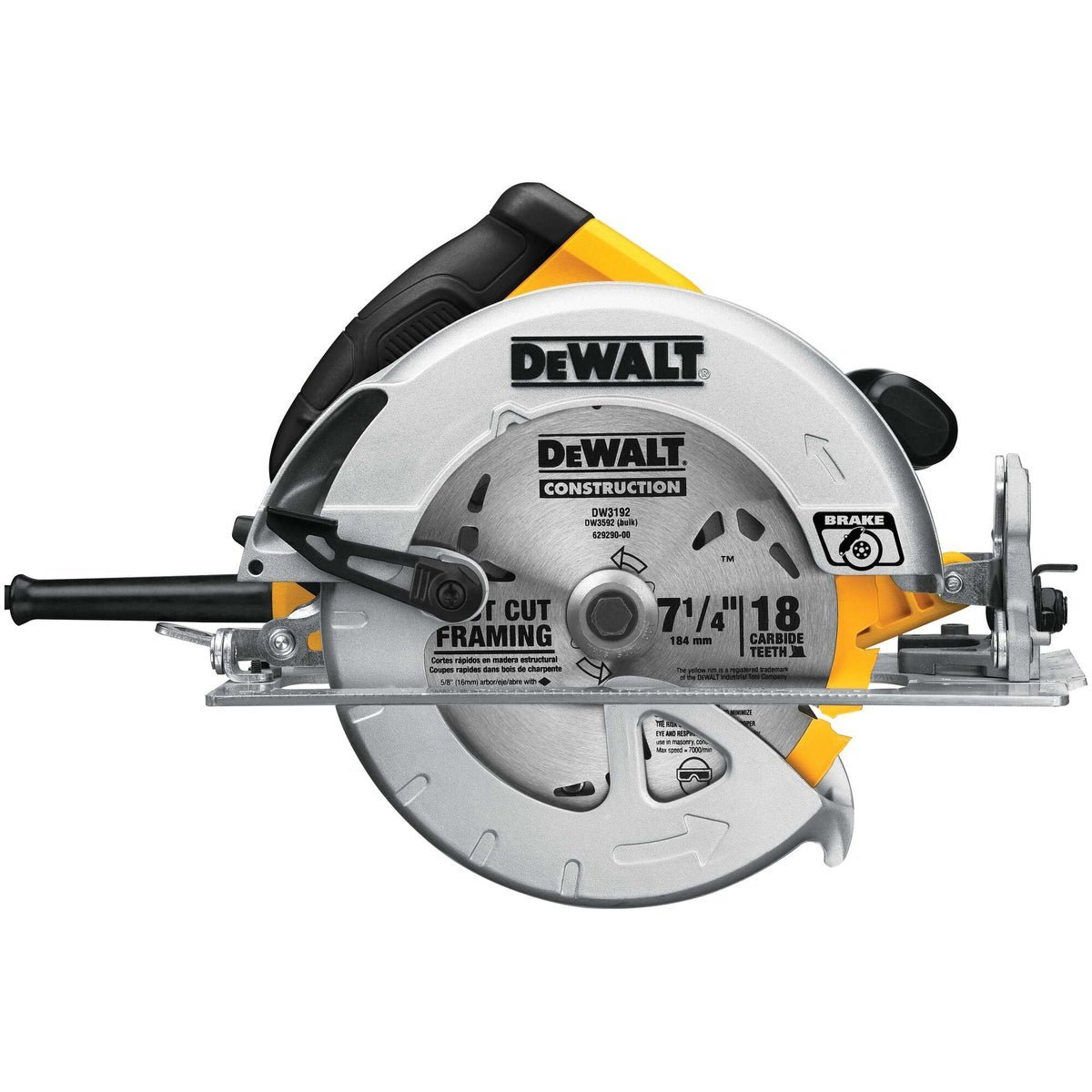
DEWALT DWE575SB
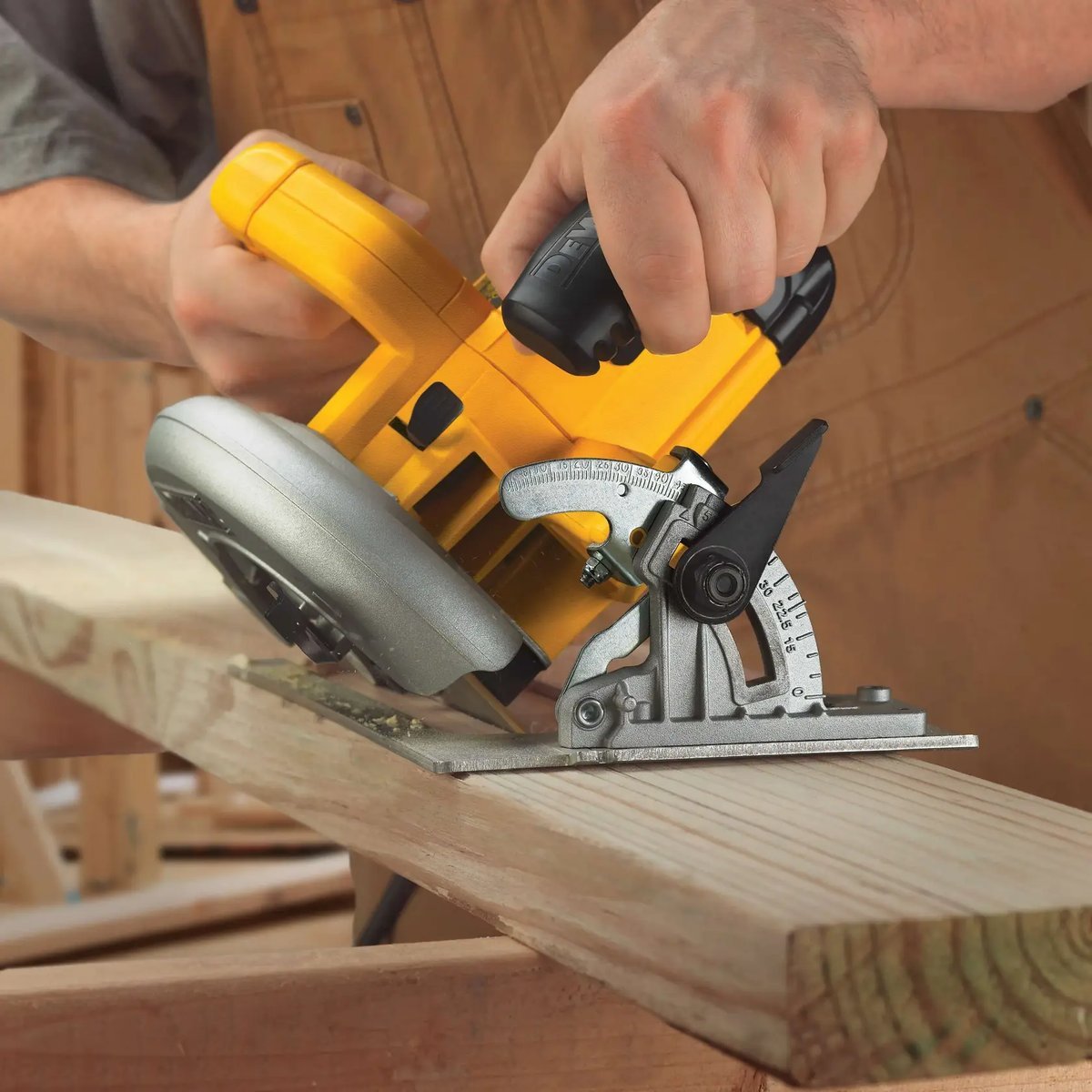
The argument-ender for the sidewinder-versus-worm-drive debate, at least for everyone who isn't framing for a living. The DWE575SB is a 15-amp, 7-1/4" corded sidewinder that weighs just 8.8 lb, nearly three pounds lighter than the SKILSAW, while offering a deeper 57° bevel capacity (with positive stops at 22.5° and 45°), a 5,200 RPM no-load speed, and an electric brake that stops the blade the m
- The details show jobsite thinking: a ball-bearing lower guard for smooth retraction even in dust, a high-grade stamped aluminum shoe, an integrated dust blower that clears the cut line, and a patented cord-protection sys
- Depth of cut is 2.55" at 90° and 1.9" at 45°: genuinely full-size capacity in the lightest package of any full-size corded saw here.
- DEWALT backs it with a 3-year limited warranty plus a 1-year free service contract.
Important limitation: The stock blade is the usual weak point (several reviewers suggest an upgrade for finish work), and the cord is always the cord, so if your work moves around the site, the Milwaukee below may serve you better. No LED light or dust port, unlike some competitors.
- Motor: 15 amps, corded, 5,200 RPM no-load
- Blade: 7-1/4" (carbide-tipped blade included)
- Weight: 8.8 lb
Best for: The best default choice for most buyers: DIYers who want pro capability, remodelers, and framers who'd rather carry 8.8 lb all day than 11.5.
Verdict: The argument-ender for the sidewinder-versus-worm-drive debate, at least for everyone who isn't framing for a living. The DWE575SB is a 15-amp, 7-1/4" corded sidewinder that weighs just 8.8 lb, nearly three pounds lighter than the SKILSAW, while offering a deeper 57° bevel capacity (with positive stops at 22.5° and 45°), a 5,200 RPM no-load speed, and an electric brake that stops the blade the moment you release the trigger.
The details show jobsite thinking: a ball-bearing lower guard for smooth retraction even in dust, a high-grade stamped aluminum shoe, an integrated dust blower that clears the cut line, and a patented cord-protection system that DEWALT rates at 3× durability against cord pull-out. Depth of cut is 2.55" at 90° and 1.9" at 45°: genuinely full-size capacity in the lightest package of any full-size corded saw here. DEWALT backs it with a 3-year limited warranty plus a 1-year free service contract.
Key specifications (per DEWALT spec data via retailer/review sources): - Motor: 15 amps, corded, 5,200 RPM no-load - Blade: 7-1/4" (carbide-tipped blade included) - Weight: 8.8 lb - Depth of cut: 2.55" at 90°, 1.9" at 45° - Bevel: up to 57°, positive stops at 22.5° and 45° - Safety: electric brake; ball-bearing lower guard - Extras: integrated dust blower, on-board blade-wrench storage, contractor bag, 10-ft cord
Who it's for: The best default choice for most buyers: DIYers who want pro capability, remodelers, and framers who'd rather carry 8.8 lb all day than 11.5.
Limitations, honestly: The stock blade is the usual weak point (several reviewers suggest an upgrade for finish work), and the cord is always the cord, so if your work moves around the site, the Milwaukee below may serve you better. No LED light or dust port, unlike some competitors.
Milwaukee M18 FUEL 2732-20: Best Cordless Circular Saw


Milwaukee M18 FUEL 2732-20
The cordless saw that ended the "cordless can't hang with corded" era. Milwaukee's POWERSTATE brushless motor runs at 5,800 RPM, and Milwaukee's own positioning claims performance on par with a 15-amp corded saw, with the obvious caveat that runtime is battery-dependent (Milwaukee claims up to 750 cuts per charge on the 12.0Ah High Output battery, a lab-style figure; treat it as a ceiling, not a
- Everything about this saw is built for the jobsite: magnesium shoe and guards, an integrated rafter hook, an LED work light, an electric brake, an integrated dust port with a vacuum adapter, and REDLINK PLUS electronic o
- Cut capacity is 2-9/16" at 90° and 1-7/8" at 45°, with a 50° bevel.
- It runs on the M18 platform, so if you already own Milwaukee batteries, the 2732-20 bare tool slots straight into your kit.
Important limitation: Note the weight math: bare it's ~9 lb, but with the big 12.0Ah battery it's over 12 lb, heavier than any corded saw here. And it's sold as a bare tool (2732-20); batteries and charger are separate purchases. If you're not on the M18 platform, the full kit cost climbs fast.
- Platform: M18 (18V), POWERSTATE brushless motor, REDLINK PLUS intelligence
- Blade: 7-1/4" (24-tooth blade included in kits)
- No-load speed: 5,800 RPM
Best for: Anyone whose work moves: framers on sites without power yet, roofers, deck builders, and the already-M18-committed. The best cordless circular saw pick if corded power at a corded weight is acceptable.
Verdict: The cordless saw that ended the "cordless can't hang with corded" era. Milwaukee's POWERSTATE brushless motor runs at 5,800 RPM, and Milwaukee's own positioning claims performance on par with a 15-amp corded saw, with the obvious caveat that runtime is battery-dependent (Milwaukee claims up to 750 cuts per charge on the 12.0Ah High Output battery, a lab-style figure; treat it as a ceiling, not a promise).
Everything about this saw is built for the jobsite: magnesium shoe and guards, an integrated rafter hook, an LED work light, an electric brake, an integrated dust port with a vacuum adapter, and REDLINK PLUS electronic overload protection. Cut capacity is 2-9/16" at 90° and 1-7/8" at 45°, with a 50° bevel. It runs on the M18 platform, so if you already own Milwaukee batteries, the 2732-20 bare tool slots straight into your kit.
Key specifications (per Milwaukee/retailer spec data): - Platform: M18 (18V), POWERSTATE brushless motor, REDLINK PLUS intelligence - Blade: 7-1/4" (24-tooth blade included in kits) - No-load speed: 5,800 RPM - Weight: ~9 lb as a bare tool; ~12.6 lb with the 12.0Ah battery (per published spec data) - Depth of cut: 2-9/16" at 90°, 1-7/8" at 45° - Bevel: 50° - Features: magnesium shoe and guards, electric brake, LED light, rafter hook, dust port with vac adapter - Warranty: 5 years
Who it's for: Anyone whose work moves: framers on sites without power yet, roofers, deck builders, and the already-M18-committed. The best cordless circular saw pick if corded power at a corded weight is acceptable.
Limitations, honestly: Note the weight math: bare it's ~9 lb, but with the big 12.0Ah battery it's over 12 lb, heavier than any corded saw here. And it's sold as a bare tool (2732-20); batteries and charger are separate purchases. If you're not on the M18 platform, the full kit cost climbs fast.
SKIL 5280-01: Best Value

SKIL 5280-01
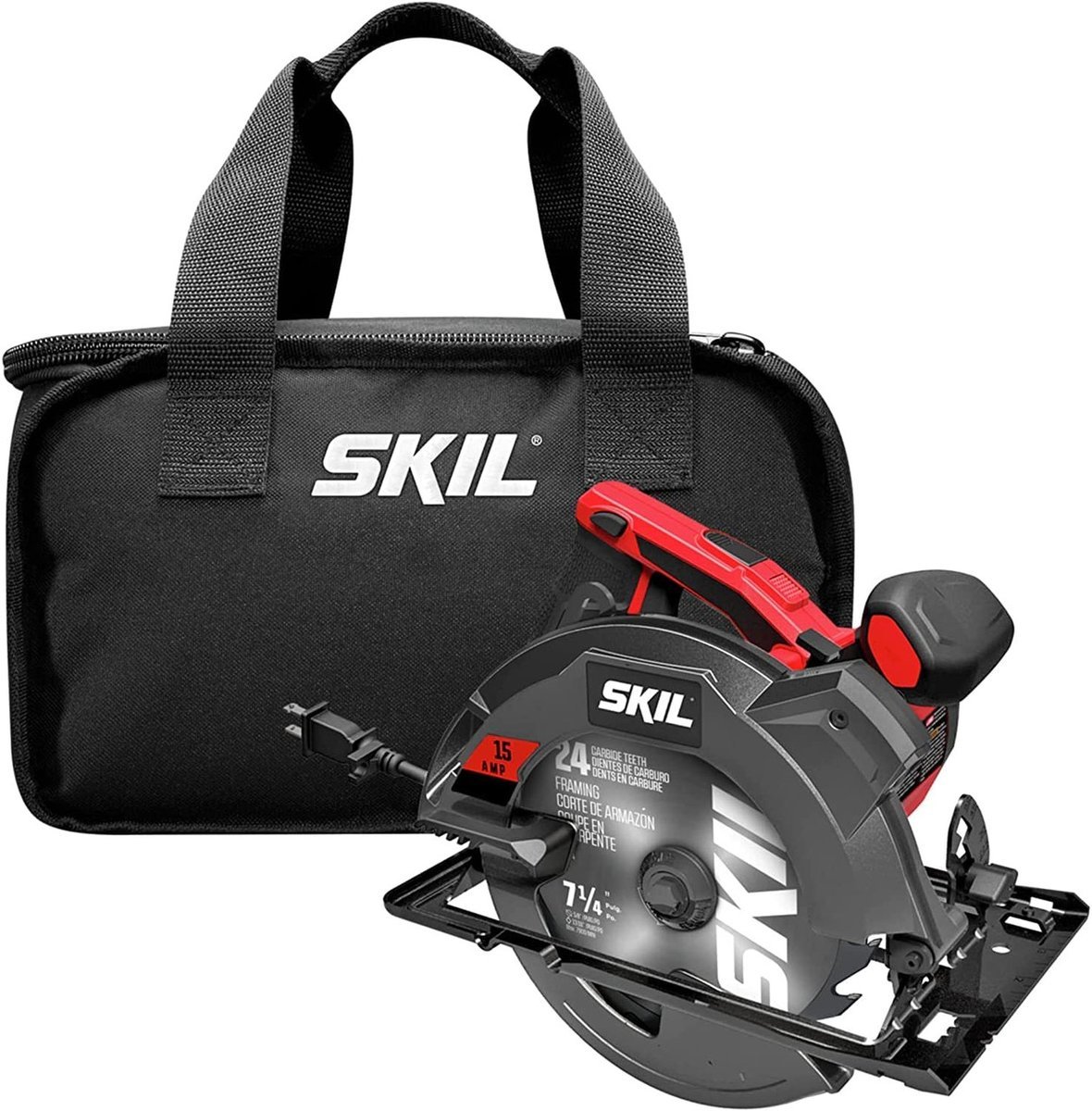
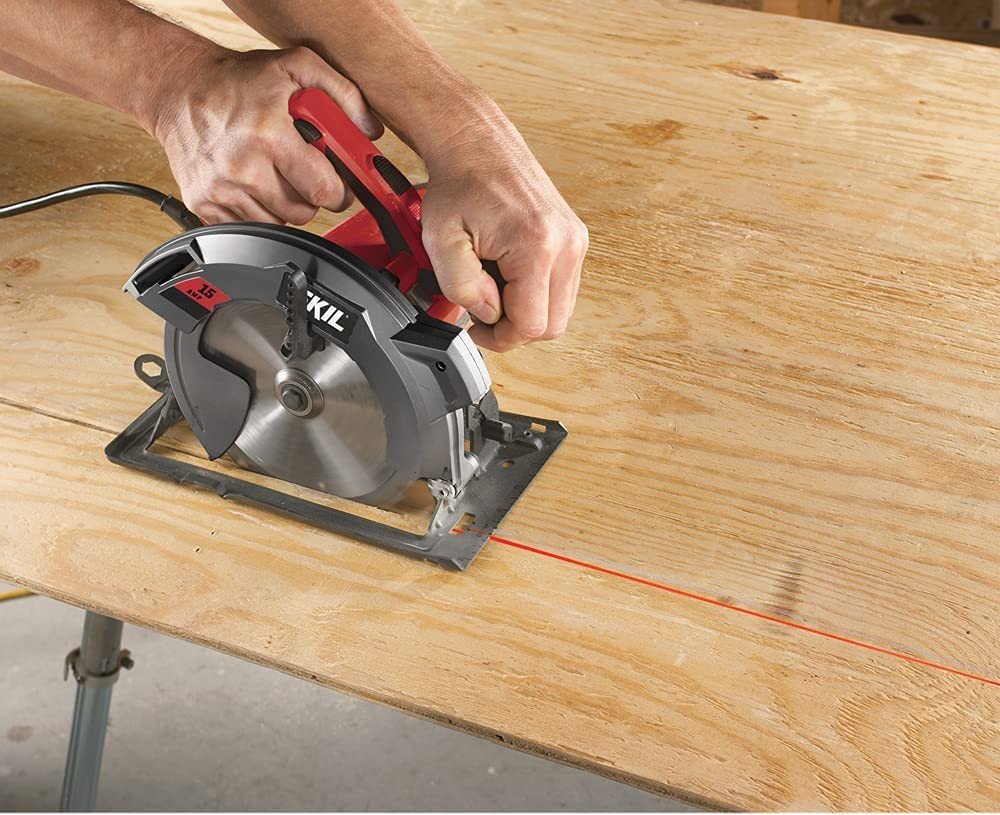
The "best corded circular saw" pick for anyone who can't justify pro-tool money but still needs real capacity. The 5280-01 is a 15-amp, 7-1/4" corded saw with the features beginners actually need: a single-beam Class 2 laser guide that projects the cut line ahead of the blade, an integrated dust blower that keeps that line visible, a guarded trigger with a power-on indicator to prevent accidental
- The spec sheet is honest full-size: 5,300 RPM no-load, 8.7 lb, 51° bevel with a positive stop at 45°, 2-3/8" depth of cut, and a 24-tooth carbide blade plus carrying bag in the box.
- For deck builds, room additions, and general DIY, there's nothing here that a beginner will outgrow in the first few projects.
- Beginners, budget DIYers, and anyone who needs a capable saw for occasional projects.
Important limitation: It's a DIY-grade tool: the build, guard action, and long-term durability aren't pro-tier, and several buyers note the laser's battery isn't user-replaceable, so the laser is a finite feature. The 6-ft cord is shorter than the DEWALT's 10-ft one; budget for an extension cord.
- Motor: 15 amps, corded, 5,300 RPM no-load
- Blade: 7-1/4", 5/8" arbor (24-tooth carbide-tipped blade included)
- Weight: 8.7 lb (3.95 kg)
Best for: Beginners, budget DIYers, and anyone who needs a capable saw for occasional projects. The laser guide genuinely helps first-timers cut straight.
Verdict: The "best corded circular saw" pick for anyone who can't justify pro-tool money but still needs real capacity. The 5280-01 is a 15-amp, 7-1/4" corded saw with the features beginners actually need: a single-beam Class 2 laser guide that projects the cut line ahead of the blade, an integrated dust blower that keeps that line visible, a guarded trigger with a power-on indicator to prevent accidental starts, and an anti-snag lower guard.
The spec sheet is honest full-size: 5,300 RPM no-load, 8.7 lb, 51° bevel with a positive stop at 45°, 2-3/8" depth of cut, and a 24-tooth carbide blade plus carrying bag in the box. For deck builds, room additions, and general DIY, there's nothing here that a beginner will outgrow in the first few projects.
Key specifications (per the SKIL user manual): - Motor: 15 amps, corded, 5,300 RPM no-load - Blade: 7-1/4", 5/8" arbor (24-tooth carbide-tipped blade included) - Weight: 8.7 lb (3.95 kg) - Depth of cut: 2-3/8" at 90° - Bevel: 0–51°, positive stop at 45° - Laser: single-beam Class 2 (laser powered by a non-user-replaceable lithium-ion cell) - Safety: guarded trigger with safety lock, power-on indicator, anti-snag lower guard - In the box: saw, blade, carrying bag; spindle lock and on-tool wrench for blade changes
Who it's for: Beginners, budget DIYers, and anyone who needs a capable saw for occasional projects. The laser guide genuinely helps first-timers cut straight.
Limitations, honestly: It's a DIY-grade tool: the build, guard action, and long-term durability aren't pro-tier, and several buyers note the laser's battery isn't user-replaceable, so the laser is a finite feature. The 6-ft cord is shorter than the DEWALT's 10-ft one; budget for an extension cord.
DEWALT DCS565: Lightest Circular Saw (Best Compact)


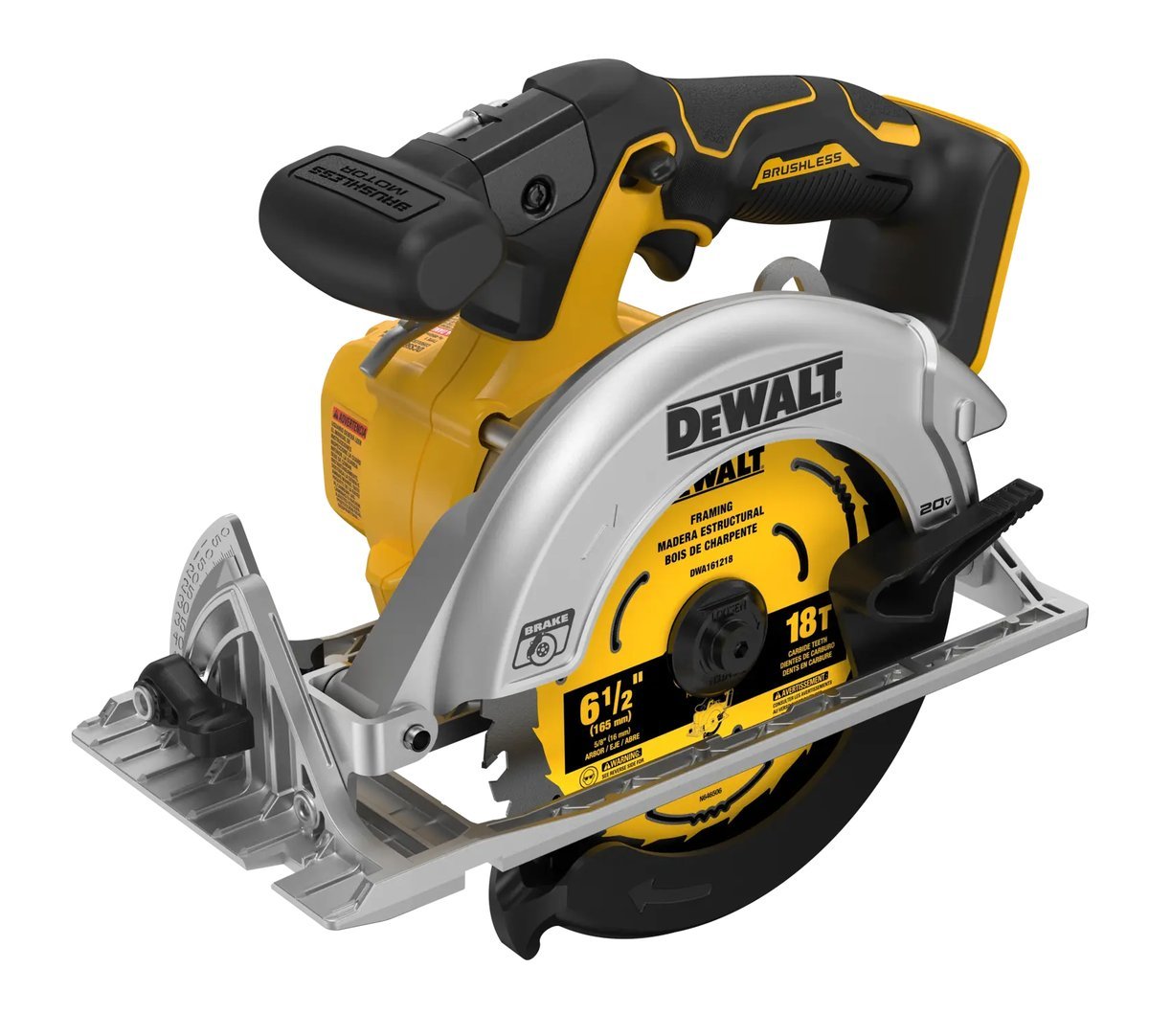
DEWALT DCS565
This is the answer to the "lightest circular saw" keyword, and it's not close among full-capability saws: the DCS565 is a 20V MAX brushless cordless saw with a 6-1/2" blade that weighs just 6.3 lb as a bare tool. For sheet goods, trim, plywood breakdown, and overhead cuts, everything where you're holding the saw up or guiding it one-handed, that weight difference versus a 9–11 lb full-size saw i
- It's still a real saw, not a toy: 4,950 RPM no-load, a 50° bevel with tool-free adjustment, 2-1/8" depth of cut at 90° (enough for 2x material), an electric brake, a bright LED, a built-in rafter hook, and a magnesium sh
- The blade sits on the left for a clear sightline, and it accepts all DEWALT 20V MAX and FLEXVOLT batteries.
- The optional dust chute connects to DEWALT's AirLock system or a standard 35mm dust extractor.
Important limitation: The 6-1/2" blade gives up cutting depth versus 7-1/4" saws (2-1/8" vs 2-9/16"), fine for 2x lumber and plywood but not for 4x posts or deep bevels in thick stock; bare tool, so factor in a battery and charger if you're not on the platform; 50° maximum bevel is the shallowest here (rivals reach 53-57°), so steep compound cuts are more limited.
- Platform: 20V MAX (battery and charger sold separately), brushless motor
- Blade: 6-1/2" (24-tooth blade included), left-side blade
- No-load speed: 4,950 RPM
Best for: DIYers breaking down sheet goods, trim carpenters, anyone working overhead, and buyers who already own DEWALT 20V MAX batteries. If your shoulder has opinions, start here.
Verdict: This is the answer to the "lightest circular saw" keyword, and it's not close among full-capability saws: the DCS565 is a 20V MAX brushless cordless saw with a 6-1/2" blade that weighs just 6.3 lb as a bare tool. For sheet goods, trim, plywood breakdown, and overhead cuts, everything where you're holding the saw up or guiding it one-handed, that weight difference versus a 9–11 lb full-size saw is the whole story.
It's still a real saw, not a toy: 4,950 RPM no-load, a 50° bevel with tool-free adjustment, 2-1/8" depth of cut at 90° (enough for 2x material), an electric brake, a bright LED, a built-in rafter hook, and a magnesium shoe. The blade sits on the left for a clear sightline, and it accepts all DEWALT 20V MAX and FLEXVOLT batteries. The optional dust chute connects to DEWALT's AirLock system or a standard 35mm dust extractor.
Key specifications (per DEWALT manual/retailer spec data): - Platform: 20V MAX (battery and charger sold separately), brushless motor - Blade: 6-1/2" (24-tooth blade included), left-side blade - No-load speed: 4,950 RPM - Weight: 6.3 lb (bare tool) - Depth of cut: 2-1/8" at 90° - Bevel: 0–50°, tool-free lever - Features: electric brake, LED light, rafter hook, magnesium shoe, optional dust chute - Warranty: 3-year limited
Who it's for: DIYers breaking down sheet goods, trim carpenters, anyone working overhead, and buyers who already own DEWALT 20V MAX batteries. If your shoulder has opinions, start here.
Limitations, honestly: The 6-1/2" blade gives up cutting depth versus 7-1/4" saws (2-1/8" vs 2-9/16"): fine for 2x lumber and plywood, but not for 4x posts or deep bevels in thick stock. And it's a bare tool: factor in a battery and charger if you're not on the platform.
Buying Guide: How to Choose a Circular Saw
Corded vs cordless: the first decision
Corded saws deliver full power indefinitely: no battery to drain mid-cut, no platform commitment, and usually a lower purchase price for equivalent cutting capacity. The trade-off is the cord: on a jobsite it snags, on a ladder it's a hazard, and at distance from the outlet you're managing extension cords (use a properly rated one; undersized cords starve the motor and overheat).
Cordless saws have closed the performance gap (brushless motors genuinely sustain heavy cuts), but runtime is finite, batteries are heavy (the Milwaukee goes from ~9 lb bare to ~12.6 lb with the 12Ah battery), and buying into a battery platform is a long-term commitment. Rule of thumb: if you already own batteries on a platform, go cordless on that platform. If you don't, a corded saw buys more cutting capacity per dollar.
Worm drive vs sidewinder
In a sidewinder (also called direct drive), the motor sits in line with the blade: the saw is shorter, lighter, and easier to maneuver; four of the five saws in this guide are sidewinders. In a worm drive, the motor sits behind the blade and drives it through worm gears: longer, heavier, more torque, with the blade on the left for a clear sightline. For framing and heavy lumber, the worm drive's torque is the classic answer (that's why the SKILSAW SPT77WML-01 is this guide's overall pick). For everything else (remodeling, DIY, sheet goods), a modern 15-amp sidewinder like the DEWALT DWE575SB has made the torque gap largely academic.
Blade size and depth of cut
The standard full-size blade is 7-1/4": it cuts 2x lumber at 90° and 45°, and replacement blades are everywhere (four of the five saws here use one). Compact saws use 6-1/2" blades (the DEWALT DCS565: 2-1/8" depth at 90°), fine for 2x material and sheet goods, but not for 4x posts or deep bevels in thick stock. Check the depth-of-cut figure, not just the blade diameter: the DEWALT DWE575SB's 2-9/16" at 90° is the deepest here.
The safety features that actually matter
Circular saws deserve respect. OSHA's construction standards treat them accordingly, and the safety guidance below is drawn from OSHA's own publications and the saw manuals, not from marketing copy.
- Blade guard: OSHA Standard 1926.304(d) requires portable circular saws to have guards above and below the base plate. The lower guard must automatically and instantly return to cover the blade when the saw is withdrawn from the work (per OSHA guidance summarized by weeklysafety.com). Never tie, wedge, or clamp the lower guard open: a saw with a defeated guard is the single most dangerous tool on the site.
- Electric brake: stops the blade quickly when you release the trigger instead of letting it coast. Three of the five saws here have one (DEWALT DWE575SB, Milwaukee 2732-20, DEWALT DCS565). It's not a substitute for the guard, but it's the feature that most reduces the "set it down too soon" accident.
- Kickback prevention: kickbacks happen when the blade binds: dull blades, wrong depth setting, or unsupported workpieces are the usual causes (per OSHA's woodworking eTool). Keep blades sharp, set depth so the blade extends just past the material, support the workpiece on both sides of the cut, and never stand directly behind the saw.
- PPE: eye protection is non-negotiable (sawdust and the occasional thrown fragment), hearing protection for extended cutting, and a dust mask when cutting pressure-treated lumber or MDF. Keep the cord (or your body) out of the cut path, and let the blade reach full speed before entering the wood.
Weight: the spec you feel
Published weights range from 6.3 lb (DEWALT DCS565, bare) to 11.5 lb (SKILSAW worm drive). Five pounds sounds trivial until hour three. For overhead work, trim, and sheet goods, the 6.3–8.8 lb saws (DCS565, SKIL 5280-01, DWE575SB) are dramatically easier to live with. For bench-height framing cuts where the saw's weight stabilizes the cut, heavier is fine, even welcome. Buy weight for your actual work, not your aspirations.
Bevel capacity and cut quality
Most saws bevel to 45°; the saws here go further (50–57°), which matters for compound cuts and steep miters. Positive stops at 22.5° and 45° (standard on the DEWALT and SKIL picks) speed up the common angles. For cut quality, the blade matters more than the saw: a 24-tooth framing blade rips fast and rough; a 40-tooth (or higher) finish blade cuts plywood and trim cleanly. Budget for a second blade.
What to ignore
RPM comparisons across brands (no-load speeds don't predict cutting performance under load), "cuts per charge" figures (lab conditions), and price as a quality signal (the SKIL 5280-01 cuts 2x lumber just as well as saws costing twice as much; the money goes to durability, weight, and features, not cutting ability).
Types of Circular Saws
Sidewinders (direct drive): the default: motor in line with the blade, lighter, more maneuverable. The DEWALT DWE575SB and SKIL 5280-01 are corded sidewinders; the Milwaukee 2732-20 and DEWALT DCS565 are cordless sidewinders.
Worm drives: motor behind the blade, worm-gear reduction, blade-left layout, maximum torque. The SKILSAW SPT77WML-01 is the archetype. Heavier, longer, and the framer's choice.
Compact/mini saws: smaller blades (4-1/2" to 6-1/2"), lighter, easier to handle one-handed. The DEWALT DCS565 (6-1/2") is the full-capability end of this category, and it still cuts 2x lumber. Smaller 4-1/2" saws trade depth of cut for portability and are specialty tools, not general-purpose saws.
Track saws / plunge saws: a different category for splinter-free sheet-goods cuts on a guide rail. More precise than a circular saw with a straightedge, much more expensive, and overkill unless you're breaking down sheet goods daily.
Circular Saw vs the Alternatives
Circular saw vs miter saw: a miter saw makes fast, accurate crosscuts and miters in a fixed station; a circular saw goes to the work: ripping plywood, cutting lumber to length on sawhorses, working on site. Most shops eventually own both; if you can only own one, the circular saw is more versatile.
Circular saw vs table saw: a table saw is more precise for repetitive rip cuts; a circular saw is portable and handles sheet goods the table saw can't. For a small shop or jobsite, the circular saw wins on versatility per dollar.
Circular saw vs jigsaw: a jigsaw cuts curves; a circular saw cuts straight lines fast. Different tools, complementary, not substitutes.
Corded vs cordless (within this guide): corded wins on unlimited runtime and price-per-capability; cordless wins on mobility. The honest answer for most buyers: corded if you work near outlets, cordless on your existing battery platform if you don't.
Common Mistakes When Buying a Circular Saw
- Buying on RPM alone. No-load RPM doesn't predict cutting power under load: torque, blade quality, and motor design matter more.
- Ignoring the guard. A saw with a sticky, slow, or defeated lower guard is dangerous regardless of its other specs. Check guard action before anything else.
- Wrong blade for the job. The stock 24-tooth framing blade is for framing. Cutting plywood or trim with it guarantees tear-out, so buy a fine-tooth finish blade.
- Setting the depth wrong. Too deep wastes power and increases kickback risk; too shallow binds. Set the blade to extend just past the material.
- Skipping the electric brake. On a saw you'll set down between cuts, the brake is a genuine safety upgrade: it's worth prioritizing.
- Buying cordless without batteries. A bare tool is only a deal if you own the batteries. Price the full kit before comparing.
- Overlooking bevel stops. Positive stops at 22.5° and 45° save real time; saws without them slow every miter cut.
- Choosing weight you can't wield. An 11.5 lb worm drive is the right tool for framing, and the wrong tool for overhead trim work you'll do twice a year.
Bad Advice We Found Online, Corrected
Conflicting spec numbers from marketplace-scraper pages. Spec-aggregator pages (manual-mirror sites) publish contradictory figures for the same model: one lists the Milwaukee 2732-20 at 8,000 RPM while Milwaukee's own materials and retailer spec data say 5,800; another lists the SKIL 5280-01 at 6.95 lb while SKIL's manual says 8.7 lb. When aggregator pages disagree, the manufacturer's manual and spec sheet win. Every figure in this guide is traced to a manufacturer manual, official spec sheet, or retailer spec table.
Lab-condition battery claims presented as real-world figures. "Up to 750 cuts per charge" (Milwaukee's figure for the 2732-20 on a 12Ah battery) describes controlled test cutting, not your jobsite. Treat all cuts-per-charge and runtime claims as ceilings.
AI-assisted roundups with stale prices. At least one 2026 roundup in the search results discloses it was created with AI assistance and lists prices ($59, $129, $179) that change constantly and vary by configuration. We publish no prices in this guide for exactly that reason, and treat any roundup's price claims as unverified.
"Best compact saw" picks without depth-of-cut warnings. Several compact-saw roundups recommend 4-1/2" saws for general use without noting that their shallow depth of cut can't handle 2x lumber at 45°. If a roundup doesn't list depth of cut, it isn't a buying guide. It's a list..
Regional models mixed into US results. Search results mix Australian and Indian-market roundups (240V/230V models, different model numbers) into US queries. The picks in this guide are US-market 120V/18V/20V MAX models.
Safety guidance missing from nearly every "best saw" roundup. Most competing roundups compare RPM and weight and never mention guard function, kickback, or the electric brake, the features that determine whether a saw is safe to own. This guide's buying guide covers them because a saw review without safety guidance is incomplete.
FAQs
A sidewinder mounts the motor in line with the blade: shorter, lighter, more maneuverable. A worm drive mounts the motor behind the blade with worm-gear reduction: longer, heavier, more torque, blade on the left for a clear sightline. Framers cutting heavy lumber favor worm drives (like the SKILSAW SPT77WML-01); everyone else is well served by a modern sidewinder.
Yes, with respect for the safety basics: keep the guard functional (never wedge it open), wear eye protection, let the blade reach full speed before cutting, support the workpiece, and keep hands clear of the cut line. A lighter saw with a laser guide (like the SKIL 5280-01) and an electric brake is the friendliest starting point.
For most buyers, a 7-1/4" saw. It cuts 2x lumber at 90° and 45°, and blades are available everywhere. A 6-1/2" compact saw (like the DEWALT DCS565) handles the same 2x material at lower weight but gives up depth for 4x posts and deep bevels. Match the saw to the thickest material you'll cut regularly.
Use a sharp blade matched to the material, set the cutting depth so the blade extends just past the workpiece, support the material on both sides of the cut, cut in straight lines, and don't force the saw; let the blade do the work. Never stand directly behind the saw in the kickback path.
Corded if you work near outlets and want maximum cutting capacity per dollar with unlimited runtime. Cordless if you move around the jobsite, ideally on a battery platform you already own, since batteries and chargers are a separate purchase on bare tools.
It stops the blade quickly when you release the trigger, instead of letting it coast to a stop. It reduces the risk of the "set it down too soon" accident and speeds up repetitive cutting. Three of the five saws in this guide have one.
With the right blade, yes, but not with the wood blades these saws ship with. Metal-cutting and diamond masonry blades exist for circular saws, and cutting metal or masonry demands additional PPE (face shield, respirator for silica dust). For occasional cuts it works; for regular metal or masonry work, buy the purpose-built tool.
Worm drive and sidewinder (direct drive), distinguished by motor placement relative to the blade as described above. Compact saws and track saws are sub-categories by size and function rather than drivetrain.
Final Verdict
For most buyers, the decision is between the two corded full-size saws at the top of this guide. Framing or heavy lumber daily? The SKILSAW SPT77WML-01 worm drive: torque that never quits, in the lightest worm-drive package SKILSAW makes. Everything else, corded? The DEWALT DWE575SB: 8.8 lb, electric brake, 57° bevel, the best all-round value in the pro tier. Cutting without outlets? The Milwaukee M18 FUEL 2732-20 if you're on M18; the DEWALT DCS565 if you want the lightest saw that still cuts 2x lumber. On a budget? The SKIL 5280-01 cuts everything the expensive saws cut.
Whichever you choose, buy the blade for your material, keep the guard working, and respect the kickback physics. Do that, and any of these five will cut straight and true for years.
Final Recommendations
Best Overall Circular Saw: SKILSAW SPT77WML-01: 15A worm drive, 7-1/4", 11.5 lb, 53° bevel
Best Corded Sidewinder: DEWALT DWE575SB: 15A, 5,200 RPM, 8.8 lb, electric brake, 57° bevel
Best Cordless Circular Saw: Milwaukee M18 FUEL 2732-20: 18V brushless, 5,800 RPM, magnesium shoe, electric brake
Best Value: SKIL 5280-01: 15A, 5,300 RPM, 8.7 lb, laser guide, 51° bevel
Lightest Circular Saw (Best Compact): DEWALT DCS565: 20V MAX, 6-1/2", 4,950 RPM, 6.3 lb bare tool, 50° bevel
Related Guides
- Chop Saw vs Miter Saw: for readers deciding between a handheld circular saw and a stationary chop/miter saw.
- Best Drill Bit Set: the other half of the drilling-and-cutting toolkit.